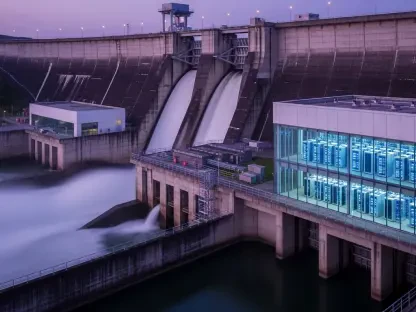

The ceaseless hum of servers processing global data demands a colossal and uninterrupted stream of electricity, a reality that presents a formidable challenge to the vision of a purely renewably powered internet. As tech giants push toward ambitious carbon-free goals, the intermittency of solar and wind power remains a significant obstacle. In a pioneering move to bridge this gap, Google is championing an innovative energy storage solution that uses compressed carbon dioxide in a closed-loop system, aiming to provide its data centers with reliable, round-the-clock green power. Through an equity investment and partnership with the Milan-based company Energy Dome, Google is helping to scale a technology that could redefine grid-scale energy storage for the digital age.
When the Sun Sets and the Wind Stops, How Does a Data Center Stay Green?
The fundamental challenge for any carbon-free data center is maintaining continuous operation. Unlike conventional power plants that can generate electricity on demand, solar panels and wind turbines are entirely dependent on weather conditions. This inherent variability creates a critical energy gap during nighttime hours, calm days, or overcast skies. For facilities that must guarantee 100% uptime, this intermittency has historically forced a reliance on fossil fuel-powered backup generators or a grid that is still largely supported by them, undermining sustainability commitments.
Google has set a high bar with its goal to operate on 24/7 carbon-free energy by 2030, a commitment that goes beyond simply purchasing renewable energy credits. The objective is to match every kilowatt-hour of electricity consumption with carbon-free electricity production on the same grid, every hour of every day. Achieving this requires a new class of energy storage technologies capable of discharging clean power for many hours, or even days, to ensure that the digital infrastructure remains powered by green electrons even when renewable generation sources are offline.
The Achilles’ Heel of the Grid: A Need for Long-Duration Solutions
The modern electrical grid’s greatest vulnerability in the transition to renewables is the lack of effective long-duration energy storage. While lithium-ion batteries have become ubiquitous for short-term storage, their economic viability is typically limited to providing power for four to eight hours. This duration is insufficient to cover extended periods of low renewable output, such as a multi-day weather event that reduces both solar and wind generation, a scenario that often forces grid operators to fire up natural gas “peaker” plants to prevent blackouts.
This technological gap has made long-duration energy storage a critical focus for enabling a fully decarbonized grid. Such systems must be able to store massive amounts of energy affordably and release it steadily over periods of 10 hours or more. Without a scalable and geographically flexible solution, the ambitious goals of corporations and governments to run entirely on clean energy remain just out of reach, tethering the green transition to the reliability of fossil fuels.
Unpacking the Technology: How a Dome of CO2 Powers the Cloud
The CO2 Battery, developed by Energy Dome, operates on established thermodynamic principles in a novel, closed-loop configuration. During charging, the system uses excess electricity from solar or wind to draw carbon dioxide from a large, atmospheric-pressure dome and compress it into a liquid, which is stored in tanks. The heat generated during compression is captured and stored separately. When power is needed, the process is reversed: the liquid CO2 is heated, causing it to rapidly expand back into a gas that drives a turbine, generating electricity before the CO2 is returned to the dome, ready for the next cycle.
A successful demonstration facility in Sardinia, Italy, has already proven the system’s viability, storing 2,000 metric tons of carbon dioxide. This pilot plant is capable of delivering 20 megawatts of power for 10 hours, providing a total of 200 megawatt-hours of dispatchable energy. By leveraging CO2, a non-flammable and abundant fluid, the technology avoids the supply chain and degradation issues associated with other battery chemistries, creating a robust system designed for industrial-scale deployment near power-hungry data centers.
The CO2 Advantage: A Comparison with Existing Storage
When compared to established storage technologies, the CO2 Battery presents several compelling advantages. Energy Dome projects that its system will have a lifespan nearly three times longer than that of typical lithium-ion batteries and will be 30% cheaper, with costs expected to decline further as plant capacity increases. This combination of durability and cost-effectiveness makes it an attractive alternative for long-duration applications where lithium-ion becomes prohibitively expensive.
Furthermore, the technology offers significant logistical benefits over pumped-hydro storage, the most common form of large-scale energy storage. Pumped-hydro projects require specific mountainous topography and can take over a decade to permit and construct. In contrast, a CO2 Battery facility can be built in under two years on just a few acres of flat land, allowing for standardized deployment across diverse geographic regions, including the areas in the United States, Europe, and Asia where Google plans to build them.
From Pilot Project to Global Blueprint: Overcoming Hurdles
Despite its promise, the path to widespread adoption is not without its challenges. The most immediate is public perception, as the system’s massive, stadium-sized dome could face local opposition due to its visual impact on the landscape. Additionally, while the system is a closed loop, the risk of a CO2 release from a damaged dome exists. However, Energy Dome’s CEO, Claudio Spadacini, has asserted that such a leak would be environmentally negligible compared to industrial emissions.
The technology’s momentum, however, has already begun to build beyond the tech sector, signaling its broader potential. Public utility Alliant Energy in Wisconsin received approval to build a CO2 Battery to provide clean backup power for up to 18,000 homes, marking a significant step toward commercialization. As Google and other early adopters prove the technology’s effectiveness, the CO2 Battery is poised to become a standardized, scalable blueprint for securing a stable, renewably powered future. The partnership between a tech giant and an engineering innovator ultimately demonstrates that solving the puzzle of 24/7 clean energy requires not just ambition, but also tangible and deployable technological breakthroughs.