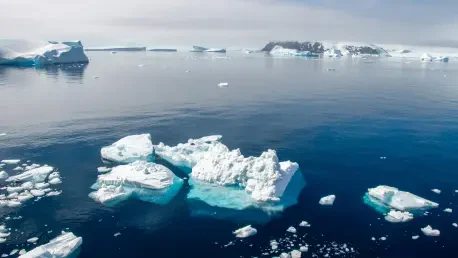

Scientific communities once held a fragile hope that the catastrophic melting of the Southern Ocean’s ice sheets might carry a hidden benefit: a self-regulating mechanism for the planet’s carbon levels. This concept, often termed the “silver lining” hypothesis, posited that as massive glaciers like the Thwaites “Doomsday Glacier” disintegrated, they would release vast quantities of trapped iron. This iron, acting as a potent fertilizer, was expected to trigger massive blooms of phytoplankton. These microscopic organisms perform the heavy lifting of carbon sequestration, inhaling atmospheric CO2 and transporting it to the deep ocean floor upon their death, theoretically cooling the Earth as the ice disappeared.
Fundamentals of the Antarctic Iron Fertilization Theory
The core principle of this theory rests on the biological pump, a natural process where nutrient-starved waters are revitalized to stimulate life. In the vast Southern Ocean, iron is the primary limiting factor; without it, algae cannot thrive regardless of how much sunlight or other nutrients are available. Historically, researchers suggested that glaciers acted as giant storage units for this essential mineral, and their accelerated melting would provide an inadvertent boost to the ocean’s ability to scrub carbon from the atmosphere.
This hypothesis gained traction because it offered a technological and ecological symmetry. As humanity’s carbon emissions warmed the poles, the poles would respond by fertilizing the seas to remove those same emissions. It was an elegant, if desperate, model of a natural feedback loop. However, the complexity of the Southern Ocean’s chemistry has proven that such straightforward narratives rarely survive rigorous field testing, particularly as we gain better access to the environment beneath the ice.
Mechanisms and Sources of Nutrient Distribution
The Role of Glacial Meltwater in Carbon Sequestration
In the traditional model, the performance of the biological pump was thought to be directly tied to the volume of glacial discharge. The idea was that ice, having scraped across continents for millennia, held a rich concentrated supply of bioavailable iron. When this ice melted, it was expected to create a nutrient plume that would drive productivity in the surrounding High-Nutrient, Low-Chlorophyll (HNLC) zones. This process was seen as a critical, albeit accidental, geoengineering service provided by the changing climate.
Alternative Nutrient Contributors: Deep Currents and Sediments
Contrary to those earlier expectations, sophisticated mapping of the Dotson Ice Shelf has revealed a different technical reality. Analysis shows that the primary drivers of iron distribution are actually deep-sea currents and the physical stirring of the continental shelf. These mechanisms transport iron from the seafloor—where it is ground from bedrock by the weight of the ice—up into the water column. It is the mechanical action of the ice sheets moving over land, rather than the melting of the ice itself, that provides the bulk of the nutrients.
Emerging Research and the Shift in Scientific Consensus
A pivotal study by Rutgers University-New Brunswick has fundamentally altered the scientific behavior toward these melting regions. By utilizing high-resolution chemical analysis, researchers could finally distinguish between iron that was truly “new” from meltwater and iron that was simply being recirculated from the seabed. The data indicated that only about 10% of the iron in these critical zones actually originated from the melting ice. This finding effectively dismantled the “silver lining” narrative, proving that the melting process is an environmental liability with no significant compensatory benefit.
Real-World Applications and Geoengineering Proposals
This shift in understanding has profound implications for artificial iron fertilization, a proposed geoengineering technology. If natural meltwater is insufficient to trigger meaningful sequestration, some advocate for deliberate nutrient dumping to mimic this process. However, the industry now faces a sobering reality: if the natural systems are already being fed primarily by deep-sea upwelling, adding more iron might not yield the linear increase in carbon capture that early models predicted. The feasibility of large-scale ocean nutrient enhancement is now under intense scrutiny.
Challenges and Environmental Risks
Technical hurdles remain immense, specifically in measuring the chemical signatures of liquid layers trapped in deep ice cavities. Moreover, the risk of “dead zones” hangs over these proposals. When massive algae blooms are artificially induced, their eventual decomposition consumes vast amounts of oxygen. This can suffocate local marine biodiversity, turning a carbon-capture project into an ecological graveyard. These risks make the regulatory and ethical landscape for ocean fertilization increasingly treacherous.
Future Outlook for Southern Ocean Carbon Management
The loss of the “silver lining” narrative forced a transition toward more direct and reliable climate strategies. Rather than relying on the ocean’s biological pump to bail out global emissions, policy shifted toward aggressive carbon reduction at the source. Research redirected its focus toward high-resolution mapping of low-oxygen layers, seeking to understand how the loss of ice will permanently alter ocean circulation and nutrient cycles.
The investigation into Antarctic iron fertilization ultimately revealed that nature’s feedback loops are not always restorative. Scientists demonstrated that the nutrient yields from melting ice were significantly lower than anticipated, meaning the Southern Ocean cannot serve as a natural buffer against rising temperatures. This realization clarified that the collapse of Antarctic ice sheets is a singular threat, reinforcing the urgency of direct human intervention in climate management.