
A recent federal court ruling has injected a surge of cautious optimism into the embattled U.S. offshore wind industry, directly challenging a Trump administration freeze order and setting the stage for a high-stakes legal showdown over the future of renewable energy. In a significant development, a federal judge granted an injunction that allows the Revolution Wind project to proceed with construction, halting a stop-work order issued by the U.S. Department of the Interior. This decision represents more than just a procedural victory; it is a substantial legal setback for an administration that has persistently sought to curb the expansion of offshore wind development. The ruling not only allows a major project to move forward but also casts serious doubt on the legal foundations of the government’s broader campaign against the industry, raising pivotal questions about whether judicial intervention can successfully shield these multi-billion-dollar energy investments from political opposition.
A Decisive Legal Victory
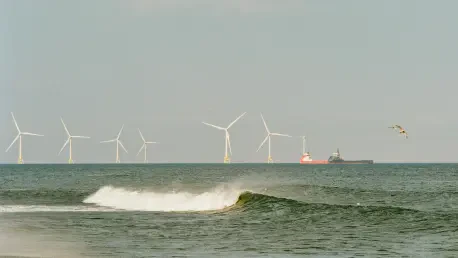
At the heart of the ongoing conflict is a clear and decisive order granted by Judge Royce C. Lamberth of the U.S. District Court for the District of Columbia. The ruling permits Revolution Wind, a 700-megawatt project situated off the coast of Rhode Island and co-owned by industry giants Ørsted and Global Infrastructure Partners’ Skyborn Renewables, to resume its construction activities while the larger legal challenge against the government’s actions is adjudicated. In his brief but impactful order, Judge Lamberth, a Ronald Reagan appointee, affirmed that the developer had successfully met all the stringent legal standards required for such an injunction. He concluded that Revolution Wind had convincingly demonstrated a “likelihood of success on the merits of its underlying claims,” would probably suffer “irreparable harm” if the construction freeze were to continue, that the “balance of the equities” was squarely in the developer’s favor, and that granting the injunction to preserve the status quo was ultimately in the “public interest.”
This legal decision is not an isolated event but rather the latest chapter in a protracted and contentious campaign by the Trump administration against the advancement of offshore wind energy. The most recent construction suspension, which directly prompted this lawsuit, was a sweeping order issued on December 22 that applied to all offshore wind projects currently under construction. The administration attempted to justify this broad action by citing ambiguous “national security risks” that were supposedly identified in “recently completed classified reports.” However, this move was preceded by an earlier, more targeted stop-work order against the Revolution Wind project specifically. In a nearly identical turn of events, the same judge blocked that initial order with a similarly worded injunction in September. That first order had also vaguely cited national security concerns along with potential interference with “reasonable uses” of federal waters, establishing a clear pattern of administrative opposition and judicial rebuke.
Industry Analysis and Broader Implications
The administration’s legal maneuvering and the nebulous rationale behind its stop-work orders have drawn considerable skepticism from both industry analysts and seasoned legal observers. A key point of contention has become the government’s steadfast refusal to disclose any specific details regarding the alleged national security threats, a position that has frustrated developers and the courts alike. Dominion Energy, the developer of the 2.6-gigawatt Coastal Virginia Offshore Wind (CVOW) project and another major company impacted by the freeze, has forcefully argued in court that the government’s lack of transparency represents a significant departure from established protocols. The company maintains that this secrecy effectively prevents any meaningful response or potential resolution, leaving developers in a state of legal and operational limbo without a clear path forward to address the government’s purported concerns.
Financial and energy analysts widely interpreted the court’s decision as a profoundly positive signal for other affected projects that are currently navigating similar legal challenges. In a note to clients, analysts from Jefferies described the injunction as a “solid near-term victory” for the Revolution Wind project. While they were careful to acknowledge that the ruling does not entirely eliminate “longer-term concerns” about whether the project will ultimately be completed and become operational, they expressed strong optimism for parallel cases. Specifically, they predicted a favorable outcome for Dominion Energy in its separate case, anticipating that the massive CVOW project would likely receive permission to resume its construction activities soon. Their analysis suggests that because the government’s underlying national security argument should, in theory, be consistent across all projects, its repeated failure to convince the court bodes well for other developers seeking similar relief.
The Persistent Shadow of Political Headwinds
This optimistic sentiment was echoed by other expert groups who are closely monitoring the situation. Analysts at Clearview Energy Partners suggested that while Judge Lamberth’s ruling is not legally binding on other courts or jurisdictions, it strongly “could suggest favorable outlooks” for the other suspended projects that have initiated their own legal challenges. Similarly, analysts at Capstone expressed deep skepticism regarding the administration’s claims, noting that the courts would likely view the vague national security concerns as “politically motivated” attempts to obstruct the industry. They pointed to the significant geographical diversity of the affected projects, each possessing unique security considerations, which makes a single, blanket justification appear less credible under scrutiny. In response to this legal pushback, the federal government has attempted to compartmentalize the cases, arguing in a court filing against linking the legal challenge from Ørsted’s other major project, Sunrise Wind, to the Revolution Wind case.
Despite the crucial success in the courtroom, the persistent and overt political opposition from the federal government created tangible financial headwinds for developers that a single injunction could not erase. On the very same day that the favorable ruling was announced, the credit rating agency Moody’s took the notable step of downgrading developer Ørsted’s outlook from stable to negative. The agency’s report cited the “elevated risk that persistent political opposition in the US” could seriously impede the company’s ability to complete its portfolio of American projects, highlighting the broader market uncertainty and significant financial strain directly caused by the administration’s actions. This move underscored the reality that even with legal victories, the ongoing political battle casts a long shadow over the industry’s financial stability. The Department of the Interior offered no comment on the injunction or the mounting taxpayer costs associated with its sustained legal fights against the offshore wind industry.