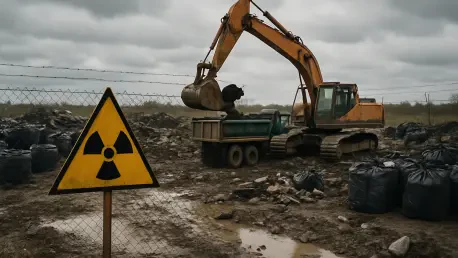

A profound chasm has formed between official state assurances and the lived reality of residents in Martins Ferry, Ohio, where a facility once brimming with over 10,000 tons of radioactive waste from oil and gas operations has been declared clean, yet deep-seated fears of lasting contamination persist. The central conflict revolves around the adequacy of a state-led remediation at the former Austin Master Services site, a location perilously close to the city’s primary drinking water source, leaving a local environmental advocacy group to question whether the cleanup was truly comprehensive or merely a surface-level solution to a deeply rooted problem. This situation highlights a growing disconnect between regulatory declarations and public trust, as the community grapples with the potential long-term health and environmental consequences of the site’s troubled history, which includes flagrant violations of storage limits and allegations of deliberate corporate misconduct. The state’s confident proclamation of a successful, multi-million dollar cleanup stands in stark contrast to the impending arrival of federal investigators, a development that only validates the anxieties of those who believe the danger has not been fully eradicated.
A Community’s Unanswered Questions
The Advocate’s Standpoint
The Buckeye Environmental Network (BEN), a grassroots organization, has become the primary voice for a community demanding more than just official pronouncements. During a recent and tense Martins Ferry City Council meeting, BEN’s Appalachian Community Organizer, Bev Reed, articulated the persistent anxieties that state declarations have failed to quell. Reed questioned the efficacy of the state’s chosen remediation method—primarily power washing—for a site saturated with radioactive materials. The core of BEN’s argument is that such a superficial cleaning process seems wholly inadequate for the level of contamination suggested by the facility’s history. This skepticism is amplified by the fact that the legal case against Austin Master Services resulted in one of the most substantial environmental civil penalties ever levied in Ohio. For residents, this massive fine is not just a number; it is a stark indicator of the severity of the violations and the potential for deep-seated contamination that a simple wash-down is unlikely to resolve, leaving a cloud of uncertainty over the long-term safety of their environment and health.
In their pursuit of accountability, the Buckeye Environmental Network has moved beyond general expressions of concern to formally challenge the city’s officials with a series of pointed inquiries. Bev Reed submitted a detailed list of questions to the Martins Ferry City Council, seeking concrete evidence and a clear plan of action. The group is demanding to see the raw data—the inspection and sampling reports from the Ohio Division of Natural Resources’ cleanup—to independently verify the state’s claims. Furthermore, BEN is pressing for clarity on how city officials intend to coordinate with the U.S. Environmental Protection Agency’s forthcoming multiyear investigation, ensuring local interests are represented. A primary concern is the protection of the municipal drinking water supply, and the group has asked what specific, ongoing monitoring steps are being taken to safeguard this critical resource. Highlighting their deep-seated distrust in the official narrative, BEN also questioned whether the city would consider commissioning additional, independent testing, a request underscored by documented reports of elevated radium isotope readings discovered within the facility before the cleanup began.
A Legacy of Contamination and Neglect
The current apprehension is deeply rooted in the site’s disturbing history under the operation of Austin Master Services. The Pennsylvania-based oilfield waste company specialized in processing and storing byproducts from hydraulic fracturing, a process known to bring naturally occurring radioactive materials (NORM), such as radium-226 and radium-228, to the surface. State records paint a damning picture of corporate negligence and willful disregard for regulations. While the company was officially permitted to store a maximum of 600 tons of this hazardous material, it had accumulated a staggering 10,000 tons on the property. This was not a simple case of mismanagement. A lawsuit filed by the Ohio Attorney General in March 2024 alleged that the company deliberately stockpiled the waste to maximize its profits, prioritizing financial gain over public safety and environmental protection. This pattern of egregious misconduct ultimately led a Belmont County Common Pleas Court to order the company in January 2024 to pay over $34 million in penalties and associated fees, a figure that speaks volumes about the scale of the environmental threat it created.
The community’s fears were not a recent development but had been steadily growing since early 2021, fueled by a visible pattern of problematic conditions and what many perceived as regulatory inaction. Bev Reed and BEN had documented and raised alarms about a leaking roof at the facility, a condition state regulators allegedly allowed to persist for years, creating a direct pathway for contaminants to leach into the building’s structure and potentially the surrounding soil and groundwater. Concerns were further escalated when residents reported observing workers using heavy equipment to clean waste spillage from public areas, including parking lots and roadways, raising serious questions about the company’s containment protocols and the potential for off-site contamination. BEN also presciently warned officials that the volatile nature of the oil and gas industry could lead to a scenario where Austin Master Services would abandon the site, leaving Ohio taxpayers to foot the bill for an expensive and complex cleanup—a fear that was partially realized. These long-standing anxieties reached a terrifying peak when severe flooding along the Ohio River in the spring of 2024 brought river water directly to the facility’s doors, creating an imminent threat of a widespread and uncontrolled release of radioactive contaminants into the region’s primary waterway.
Conflicting Narratives and Official Responses
State Cleanup vs. Federal Scrutiny
In the face of mounting legal action and intense public pressure, the Ohio Division of Natural Resources (ODNR) stepped in to manage the cleanup of the abandoned site. The state-led effort, which cost taxpayers over $6 million, was presented as a decisive and successful resolution to a significant environmental threat. By May 2024, the agency issued a definitive statement through its Press Secretary, Karina Cheung, who announced that the remediation effort was complete. Cheung stated unequivocally that the site was now clean and that all hazardous waste had been “eradicated.” This declaration was intended to close a troubling chapter for Martins Ferry and restore public confidence. However, the state’s narrative of a fully remediated site has failed to find purchase among local advocates and residents. For them, the official announcement feels premature and dismissive of their legitimate concerns about residual contamination. The state’s position of absolute certainty is directly contradicted by the fact that the matter is far from settled, with the impending arrival of federal investigators signaling that a higher level of scrutiny is deemed necessary.
The decision by the U.S. Environmental Protection Agency (EPA) Region 5 to conduct its own independent investigation serves as a powerful counter-narrative to the state’s claims of a completed cleanup. This federal involvement is not a sudden development but the culmination of years of local advocacy and a demonstration of a long-standing lack of faith in state-level oversight. The EPA’s intervention is the direct result of a 2022 petition filed by residents who felt their concerns were not being adequately addressed by Ohio regulators. The federal agency’s investigation, which is slated to begin sampling in the spring of 2026, will be comprehensive. It aims to determine if the property qualifies for federal intervention under the stringent criteria of a Superfund or Brownfield site designation, which could unlock significant federal resources for a more thorough remediation. Moreover, the EPA’s scope will extend beyond the radioactive materials associated with Austin Master Services, as it will also address other potential contaminants, including hexavalent chromium, a highly toxic substance linked to both the oil and gas waste and the former steel mill that previously occupied the property for decades.
The Rush to Reopen and the City’s Dilemma
A particularly troubling development for the community is that despite the unresolved questions and the pending multiyear federal investigation, the industrial facility is already being actively marketed to new commercial tenants. This move to repopulate the site has created a sense of urgency and outrage, prompting the Buckeye Environmental Network to formally confront the Martins Ferry City Council. The advocacy group is demanding to know what specific measures the city is taking to ensure the building is verifiably safe for future workers and to guarantee that any new industrial activities will not pose a renewed threat to public health or the nearby municipal well field that supplies the city’s drinking water. BEN’s written questions press for accountability, asking if the city has independently obtained and reviewed the state’s cleanup reports or if it is simply taking the ODNR’s word. The group is demanding a clear strategy for protecting the city’s water supply and for cooperating with the EPA, highlighting a fear that without proactive local oversight, history could repeat itself, once again placing the community in jeopardy.
The response from Martins Ferry officials during the council meeting revealed what appeared to be a significant information gap between state agencies and the local government responsible for the community’s welfare. Councilman Gus Harris expressed genuine surprise at the details presented by BEN, stating that he had operated under the belief, based on ODNR’s public announcements, that the site had been fully and definitively remediated. This sentiment was echoed by Services Director Andy Sutak, who admitted he had not received any official communications from either state or federal agencies regarding the final cleanup status or plans for further testing. Sutak also acknowledged his lack of awareness regarding what, if any, environmental assessments were conducted when the prior steel mill on the property closed. This exchange indicated that city leaders may have been relying solely on the state’s official, high-level narrative, while the advocacy group was digging into the details and demanding a more proactive and skeptical approach to ensure the long-term safety and well-being of the community they were elected to protect.