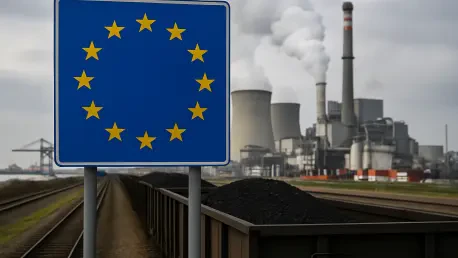

From Climate Ambition to Global Trade Reality: The EUs Carbon Tax Enters a New Era
The seemingly invisible carbon embedded in everyday products is rapidly becoming a tangible cost at European borders, reshaping the fundamental principles of international trade. Born from the ambitious framework of the European Green Deal, the Carbon Border Adjustment Mechanism (CBAM) represents one of the world’s most assertive attempts to fuse climate policy with commerce. It was designed not merely as an environmental tool but as a critical economic stabilizer, intended to prevent the erosion of Europe’s industrial base in the face of global competition.
At the heart of the policy is the drive to counteract “carbon leakage,” the phenomenon where industries relocate production to countries with less stringent environmental standards, thereby shifting emissions elsewhere rather than reducing them. By imposing a levy on certain carbon-intensive imports, the EU aims to create a level playing field. European producers, who already pay for their emissions through the internal Emissions Trading System (ETS), face higher operational costs, and the CBAM seeks to equalize this burden for foreign competitors selling into the European market.
This initiative is now transitioning from a targeted pilot into a far-reaching policy instrument. The proposed expansion of the CBAM signals a new phase where the carbon tax moves beyond raw materials to touch complex supply chains and finished goods. This escalation has ignited a global debate, forcing nations and corporations alike to confront the economic consequences of their carbon footprints and positioning the EU at the center of an international firestorm over climate, trade, and sovereignty.
Dissecting the CBAM Expansion: From Policy to Global Impact
Beyond Steel and Cement: Redrawing the Carbon Border with New Industries
The initial phase of the carbon tax, set to take effect in 2026, focused squarely on foundational industrial materials like steel, aluminum, cement, and fertilizers. However, the latest proposals dramatically widen this net to include a range of manufactured goods, such as refrigerators, washing machines, and crucial car parts. This shift represents a significant escalation, moving the carbon border from the factory gate of raw material producers to the assembly lines of complex consumer products.
This broadened scope carries substantial financial implications. Projections indicate that including these new sectors could increase the revenue generated by the CBAM by as much as 23%, adding an estimated €2.1 billion annually to the EU’s coffers by 2030. These figures underscore the high political and economic stakes, transforming the mechanism from a niche environmental policy into a significant fiscal tool. Moreover, it signals to global manufacturers that no sector with a heavy carbon footprint is permanently off-limits.
However, this ambition brings with it immense operational challenges. Calculating the embedded carbon in a ton of cement is a relatively straightforward process. In contrast, assessing the total carbon footprint of a washing machine, with components sourced from multiple countries and assembled through a complex global supply chain, presents a daunting logistical and administrative task. This complexity raises critical questions about verification, transparency, and the potential for bureaucratic bottlenecks.
Fortifying Europes Industrial Base While Exporting Carbon Costs
The primary rationale behind the CBAM remains the creation of a truly level playing field. European industries have long argued that the costs imposed by the EU’s Emissions Trading System place them at a competitive disadvantage against foreign producers who do not face equivalent carbon pricing. The CBAM addresses this by effectively exporting the EU’s carbon price, compelling importers to account for the emissions generated during the production of their goods.
To mitigate concerns that this policy could still leave domestic industries vulnerable, especially in export markets, the EU has proposed a novel support mechanism. Under the plan, 25% of the revenue generated by the CBAM between 2026 and 2027 would be allocated to a temporary fund. This capital is specifically earmarked to assist European heavy industries in their transition toward cleaner technologies, ensuring they can maintain competitiveness while undertaking costly decarbonization efforts.
This support fund, while intended to safeguard European industry, walks a fine line in international trade law. There is a tangible risk that trading partners could view it as a prohibited subsidy, designed to give EU companies an unfair advantage. Such a perception could provoke retaliatory tariffs or formal disputes at the World Trade Organization, further complicating an already tense global trade environment and potentially undermining the collaborative spirit needed for global climate action.
From Brussels to Beijing: Confronting Accusations of Green Protectionism
The CBAM’s expansion has been met with sharp and coordinated criticism from some of the world’s largest economies. Major trading partners, including China, India, and Brazil, have publicly condemned the measure as a form of “green protectionism.” They argue that it acts as a discriminatory trade barrier that unfairly penalizes developing nations and leverages climate policy to shield European markets, potentially violating long-standing international trade rules.
In response, the European Commission has mounted a robust legal defense, asserting that the CBAM is meticulously designed to be fully compliant with World Trade Organization (WTO) regulations. Officials maintain that the mechanism is non-discriminatory because it applies the same carbon price to imported goods as it does to domestic production, ensuring equal treatment. The EU’s position is that it is not asking more of others than it demands of itself, but rather standardizing environmental accountability.
Amid this friction, the EU has also engaged in careful diplomacy to manage the fallout. Efforts have been made to reassure key allies, such as the United States, that the economic impact on their exports will be minimal, citing simplifications made to the process. This dual approach—defending the policy’s legality while attempting to soothe transatlantic tensions—highlights the delicate balance the EU must strike between advancing its climate agenda and preserving stable international trade relationships.
Weighing Ambition Against Reality: Could Loopholes Undermine the Goal?
While the CBAM is lauded in some circles as a bold climate initiative, environmental organizations offer a more cautious assessment. Groups like Bellona Europa, for instance, acknowledge the positive step of using revenues for genuine emissions reductions but raise significant concerns about potential loopholes that could weaken the policy’s overall effectiveness. Their analysis suggests that without airtight rules, the mechanism may not deliver the environmental benefits it promises.
A primary point of contention is the potential acceptance of international carbon credits. Critics fear that foreign producers might be allowed to purchase inexpensive carbon offsets on the global market to meet their CBAM obligations. This could create a pathway to compliance that bypasses the need for substantive, long-term investments in decarbonizing their actual production processes, thereby allowing high-carbon manufacturing to continue unabated.
Ultimately, this debate challenges the core assumption that a border tax alone can be a panacea for industrial emissions. The policy’s success hinges not just on its existence but on its execution. Without rigorous enforcement, transparent verification systems to accurately track embedded carbon, and a commitment to closing potential loopholes, there is a risk that the CBAM could become more of a revenue-generating tool than a transformative instrument for global climate action.
Adapting to the New Climate-Trade Nexus: Strategic Imperatives for Global Business
The expansion of the CBAM creates a new set of strategic imperatives for businesses worldwide. For international exporters targeting the lucrative EU market, the era of treating carbon emissions as a cost-free externality is over. For domestic EU producers, the policy offers a degree of protection but also intensifies the pressure to innovate. Meanwhile, supply chain managers everywhere must now factor carbon liability into their logistical and sourcing decisions.
In this new landscape, proactive adaptation will be crucial for survival and success. Businesses must begin by conducting thorough assessments of their carbon liabilities across their entire value chain. This requires investing in robust data collection and analysis to accurately measure the carbon footprint of their products. Following this, strategic investments in low-carbon production technologies and processes will be essential to mitigate future tax burdens and meet the evolving demands of a climate-conscious market.
This regulatory pressure can also be reframed as a powerful competitive opportunity. Companies that lead the charge in green innovation and transparently report their environmental performance can differentiate themselves from competitors. By embracing decarbonization not as a compliance burden but as a core business strategy, industries can build more resilient supply chains, enhance their brand reputation, and secure a leading position in the emerging global green economy.
The Dawn of Climate-Driven Trade: A Bold Precedent or a Divisive Path?
The European Union’s decision to expand its carbon border tax marks a pivotal moment in the relationship between climate policy and international commerce. It moves the concept of carbon pricing from a domestic concern to a global trade reality, establishing a precedent that could fundamentally alter how goods are produced, priced, and traded across the world.
The long-term implications of this policy are profound and far-reaching. Global supply chains, long optimized for cost and efficiency, will now need to be re-evaluated through the lens of carbon intensity. This could spur a significant realignment of manufacturing and sourcing, favoring regions and producers with cleaner energy grids and greener industrial processes. Furthermore, the CBAM may serve as a catalyst for a new wave of climate-focused trade agreements, where environmental standards become as critical as tariffs and quotas.
Ultimately, the CBAM stands at a crossroads, and its legacy remains to be written. It could become the global blueprint for holding industries accountable for their emissions, inspiring other nations to adopt similar measures and accelerating a worldwide transition to a low-carbon economy. Conversely, if perceived primarily as a protectionist tool, it could trigger escalating trade friction, fragment the global market, and undermine the international cooperation essential for tackling the climate crisis.