
Christopher Hailstone brings decades of frontline experience in energy management and grid reliability to the table as a leading expert in utilities and renewable delivery. His deep understanding of how market mechanisms influence industrial stability makes him a vital voice in the current debate over the European Union’s climate strategy. As energy prices fluctuate and global competition intensifies, Christopher analyzes the complex relationship between carbon pricing, industrial survival, and the logistical hurdles of a green transition.
High energy and carbon costs are increasingly viewed as a “tariff” on companies trying to compete with China and the United States. How does this financial burden specifically threaten the survival of the chemical industry, and what are the risks of waiting for long-term EU negotiations?
The chemical industry operates on thin margins and high energy intensity, making it particularly vulnerable to any mechanism that functions like a tariff on production. When European firms face these costs while their American and Chinese counterparts operate under different regulatory regimes, the risk of a total collapse of the European chemical sector becomes a tangible threat. Waiting for the slow wheels of EU negotiations to turn could take months or years that these companies simply do not have, potentially leading to permanent closures. If we do not act to provide immediate relief, we are essentially witnessing the erosion of European industrial ideology in real-time as factories relocate or shut down.
While some see the carbon market as a competitive hurdle, others argue it provides the certainty necessary for investments in clean technology. How do these conflicting views impact private financing for infrastructure, and what specific steps can be taken to ensure the system remains technology-neutral?
The tension between viewing the Emissions Trading System as a hurdle or a catalyst creates a volatile environment for private investors who crave stability above all else. When political leaders suggest suspending the system, it sends a wave of uncertainty through the financial sector, making it harder to secure the private financing needed for critical infrastructure and electrification projects. To maintain a technology-neutral stance, we must ensure the market remains a market-based instrument rather than a political tool, allowing the most efficient solutions to win. Consistency is the only way to convince lenders that clean energy production is a reliable long-term bet rather than a fleeting regulatory trend.
The Emissions Trading System has reduced emissions by nearly 40% since 2005 while generating over €260 billion in revenue. How should these funds be redistributed to support the decarbonization of heavy industry, and what occurs to technological innovation if the carbon price signal is suspended?
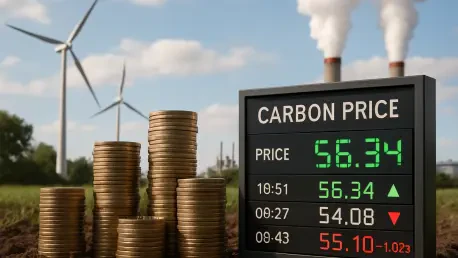
The €260 billion generated by the ETS represents a massive war chest that should be funneled directly back into the decarbonization of heavy industry and the expansion of critical infrastructure. If we suspend the carbon price signal, we effectively kill the economic incentive for companies to innovate, as there would no longer be a financial penalty for sticking with old, polluting methods. Innovation and competitiveness are now inextricably linked to our ability to decarbonize; without that price pressure, the transition away from expensive fossil fuels would grind to a halt. We must use these revenues to lower the barriers to entry for green technologies, ensuring that the 39% reduction in emissions we have achieved so far is just the beginning.
As the carbon market expands to include landfills, incinerators, and international aviation, what new logistical challenges will these sectors face? Additionally, what are the potential trade-offs of stripping carbon costs from electricity bills to provide immediate relief to consumers and businesses?
Expanding the ETS to include landfills, incinerators, and international aviation introduces a layer of logistical complexity, as these sectors must now develop rigorous monitoring and reporting frameworks for their emissions. This expansion forces industries that were previously outside the carbon tent to rethink their entire operational models and account for carbon as a primary cost of doing business. While stripping carbon costs from electricity bills offers immediate relief to struggling consumers and businesses, the trade-off is a weakened price signal that could delay the necessary shift toward renewable energy. It is a delicate balancing act between preventing short-term economic hardship and maintaining the momentum required for a long-term environmental overhaul.
Suspending established climate policies can lead to market uncertainty and a continued reliance on expensive fossil fuels. How does a lack of policy stability affect a nation’s long-term financial health, and what alternative fiscal tools could reduce energy levies without abandoning environmental goals?
A lack of policy stability acts as a poison for a nation’s financial health because it discourages the very investments needed to escape the cycle of high energy prices. When we backtrack on established frameworks, we inadvertently lock ourselves into a continued reliance on expensive fossil fuels, which keeps energy costs high and volatile. Instead of suspending the ETS, we should look at alternative fiscal tools, such as using dividends from energy companies or existing fiscal revenues to reduce the burden of levies on power bills. This approach provides the necessary financial relief to the public and industry without dismantling the regulatory structures that drive technological progress.
What is your forecast for the European carbon market?
I anticipate that the European carbon market will undergo a significant “stress test” in the coming months as industrial leaders and politicians push for more flexibility to protect competitiveness. While there will be intense pressure to suspend or drastically alter the mechanism, the most likely outcome is a series of targeted reforms that better redistribute revenues back into industrial innovation rather than a full suspension. We will likely see a more integrated approach where carbon pricing is paired with aggressive fiscal support to ensure that European companies can lead the global transition without being priced out of existence. Ultimately, the ETS will remain the cornerstone of EU policy, but its survival depends on its ability to evolve from a “perverse tax” into a more effective engine for industrial renewal.