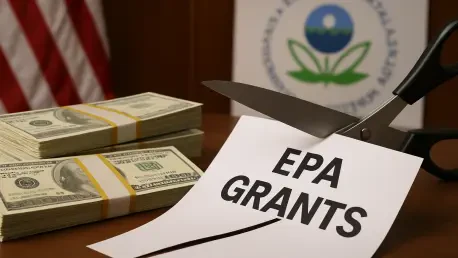

The silent cancellation of massive federal funding packages often happens behind closed doors, yet the ripples are felt most acutely by families whose tap water remains tainted by lead or whose local economies are stalled. When the administrative axe fell on $1.5 billion in Environmental Protection Agency (EPA) grants, it did more than just shift decimals on a federal balance sheet. This sudden reversal effectively halted the construction of localized microgrids, froze energy-efficient housing retrofits, and left community leaders across the nation scrambling to cover the costs of promised improvements. While the move was framed by the executive branch as a necessary check on government spending, a report from the EPA’s Office of the Inspector General (OIG) tells a fundamentally different story about the legitimacy of these programs.
The Invisible Toll of a Legislative U-Turn
The termination of these grants represents a significant moment of tension between the legislative intent of the previous Congress and the administrative priorities of the current executive branch. When the funding was stripped, it wasn’t just money that disappeared; it was the culmination of years of rigorous planning and community engagement. This shift raises profound questions about the stability of federal commitments and whether the executive branch has the moral or legal right to strip away resources once a selection process has already deemed them essential for public welfare.
Unpacking the 2022 Inflation Reduction Act and the July Rescission
To understand the gravity of this $1.5 billion cut, one must look back to the 2022 Inflation Reduction Act, which originally allocated $2 billion to the Community Change Grant Program specifically for disadvantaged neighborhoods. These funds were legally appropriated by Congress to combat pollution and climate risks, yet they became a primary target of the “One Big Beautiful Bill Act.” The OIG’s investigation confirms that the EPA followed every rigorous and appropriate protocol before the funds were rescinded, countering any claims of administrative mismanagement or procedural shortcuts during the initial awarding phase.
The Human and Economic Impact of Revoked Grants
The termination of these grants dismantled years of hope in areas that have historically been overlooked by federal investment. By analyzing the specific projects that lost funding, the tangible loss of progress toward environmental justice becomes clear. For example, the Lucky Shoals Community Association in Georgia lost nearly $20 million intended for lead pipe replacement. This was a direct effort to ensure clean drinking water and build a community resilience hub to serve as a lifeline during climate emergencies.
Beyond the immediate infrastructure, these grants were designed as engines for local job creation. Projects focused on solar power installations and workforce training programs aimed to revitalize blighted areas by putting people to work in the emerging green economy. When the funds were pulled, the expected construction jobs and long-term economic benefits vanished, leaving local organizations with thousands of hours of wasted preparatory work and no clear path forward.
Expert Perspectives on Administrative Accountability
The OIG report serves as a critical piece of evidence, explicitly stating there was no evidence of “fraud” or “waste” in the initial grant selection. This finding bolsters the arguments of advocacy groups who contend that the government acted unlawfully. Experts argue that if the selection process was sound, the rescission represents a breach of trust rather than a fiscal necessity. The EPA itself has not disputed these findings, creating a scenario where the agency’s own watchdog validates the legitimacy of programs the administration chose to dismantle.
Navigating the Legal Path to Restitution
For the 50-plus organizations left in the wake of these cancellations, the battle for funding shifted from the court of public opinion to the U.S. Court of Federal Claims. A recent federal court ruling mandated that these disputes cannot be settled through a single collective reversal; instead, each affected organization had to present its case individually. This required a granular approach to legal documentation, forcing small nonprofits to navigate a specialized and expensive legal landscape to prove their specific losses and the validity of their original contracts.
In response to these judicial hurdles, legal clinics mobilized to provide representation for communities that lacked the resources for a protracted federal battle. This strategy focused on pro bono expertise to help local leaders reclaim their funding, ensuring that the burden of a shifting political climate did not fall solely on those the grants were meant to protect. Moving forward, policymakers must establish stronger legal safeguards to prevent the arbitrary rescission of appropriated funds, ensuring that future environmental commitments remain insulated from sudden executive reversals. Organizations began documenting the long-term opportunity costs of these delays to strengthen their claims for damages beyond the original grant amounts.