
The ambitious vision of a seamless, coast-to-coast network of electric vehicle charging stations, a cornerstone of national infrastructure policy, was abruptly thrown into legal turmoil before a federal court intervened decisively. A landmark $5 billion program, designed to bridge the gaps in America’s charging infrastructure, was suddenly paused by the federal government, sparking a high-stakes legal confrontation that pitted states and environmental advocates against the administration. This legal battle culminated in a judicial order that not only released the frozen funds but also raised fundamental questions about executive authority and the future of the nation’s transition to electric mobility. The court’s ruling forced the release of billions of dollars, restarting stalled projects and reaffirming the legislative intent behind one of the most significant infrastructure investments in recent history.
A Sudden Halt to Powering America’s Electric Future
The controversy began when the Trump administration abruptly froze the National Electric Vehicle Infrastructure (NEVI) initiative. The official justification for this sudden halt was the need for a comprehensive review intended to make the program “more efficient.” This unexpected pause sent ripples of uncertainty across the country, as state transportation departments had already invested significant time and resources into developing detailed implementation plans based on the original framework. The administration’s move effectively unplugged a national effort just as it was beginning to gain momentum, leaving the future of dozens of projects in limbo.
Adding a layer of political complexity to the procedural delay, Secretary of Transportation Sean Duffy publicly articulated a personal disagreement with the concept of subsidizing green energy. Despite this, he affirmed that the administration would “respect Congress’ will and make sure this program uses federal resources efficiently.” This statement framed the freeze not merely as a bureaucratic review but as an action influenced by a differing policy philosophy. For the coalition of states and environmental groups that would soon challenge the decision, the review was seen as a pretext to undermine a program established by a previous administration.
The Blueprint for a National Charging Network
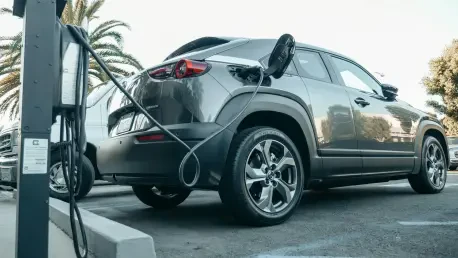
The NEVI program itself originated from the landmark Bipartisan Infrastructure Investment and Jobs Act of 2021. Its core mission was to eliminate “range anxiety” for EV drivers by funding a reliable and accessible national network of charging stations. The program specifically targeted major highways designated as “alternative fuel corridors,” ensuring that drivers could travel long distances with confidence. Under this framework, the federal government committed to covering up to 80% of the costs for eligible state-led projects, providing a powerful financial incentive to build out the necessary infrastructure.
Beyond the funding, the NEVI program was significant for establishing the first-ever nationwide standards for federally funded chargers. To qualify for the funds, charging stations were required to feature at least four ports capable of simultaneously delivering up to 150 kW of power, ensuring rapid charging speeds. Furthermore, the standards mandated that these stations be non-proprietary, feature open-access payment methods, and remain publicly available. These requirements were designed to create a consistent, high-quality user experience, preventing a fragmented system of incompatible chargers and payment systems.
The Legal Battle That Unplugged the Program
In response to the administration’s freeze, a formidable coalition comprising 20 states, the District of Columbia, and prominent environmental groups like the Sierra Club filed a lawsuit. They argued that the administration had overstepped its authority by unilaterally halting a program mandated by Congress. The suit contended that the delay was causing irreparable harm to their efforts to combat climate change, improve air quality, and provide their residents with essential transportation infrastructure. This legal challenge set the stage for a direct confrontation over the executive branch’s power to impede the implementation of established law.
The legal entanglement deepened when the administration, following an initial court ruling that lifted the freeze, issued new guidance. This revised framework included a critical procedural hurdle: states, including those whose plans had already been approved, were required to resubmit their proposals for re-approval. This step was seen by opponents as a tactic to prolong the delay, effectively continuing the freeze under a different name. The court ultimately agreed, with U.S. District Judge Tana Lin of the Western District of Washington ruling that the administration had acted unlawfully. In her decision, she concluded that the freeze was a “capricious” violation of the Administrative Procedure Act, stating that withholding funds for reasons not explicitly outlined in the 2021 law was not how things are “lawfully done.”
Voices from the Courtroom and the States
Judge Lin’s ruling was unequivocal, using sharp language to describe the administration’s actions. She characterized the sudden cessation of the program as akin to “yanking the NEVI Formula Program’s cord out of the outlet,” a metaphor that underscored the abrupt and disruptive nature of the freeze. Her decision permanently barred the federal government from unlawfully withdrawing state funds or interfering with the implementation of their approved plans, providing a clear legal victory for the plaintiffs. The ruling served as a strong affirmation of the principle that congressionally appropriated funds for a specific purpose cannot be withheld at the discretion of the executive branch.
The real-world consequences of the funding delay were not abstract. Court filings from Delaware, for instance, provided a tangible example of the financial strain placed on states. The state detailed how it was left with a $49,875 funding shortfall for an active and approved NEVI project, forcing it to divert money from other sources to cover construction costs already incurred. For advocates, this highlighted the immediate harm caused by the freeze. Following the verdict, the Southern Alliance for Clean Energy celebrated the decision, stating, “The Court’s order clears the way for states to implement the NEVI plans they have worked for years to develop.”
The Road Ahead Between Obligated and Disbursed Funds
In the wake of the ruling, the Department of Transportation (DOT) has maintained that its revised guidance, issued after the initial freeze was lifted, has ultimately improved the program. The department asserted that the new framework better aligns the NEVI initiative with the administration’s priorities of safety, efficiency, and innovation. According to the DOT, 49 states have since had their plans re-approved under the new guidance and are now “free to obligate funds,” suggesting the program is back on track.
The DOT also made a bold claim, stating that in just five months under its new framework, Secretary Duffy had obligated 39% more NEVI funds than the previous administration had in the preceding three years. However, this assertion leaves a critical question unanswered. There is a significant difference between funds that are “obligated”—meaning they are reserved on paper for a specific purpose—and funds that have been “disbursed” to the states for actual construction. As the program moves forward, stakeholders will be closely watching to see how quickly these obligated billions translate into operational charging stations on America’s highways.
The court’s decision represented a pivotal moment, definitively ending the administrative blockade and ordering the release of critical funds for the nation’s electric vehicle infrastructure. This legal resolution not only allowed stalled state projects to resume but also reinforced the separation of powers by affirming that executive agencies must implement the laws passed by Congress. With the legal hurdles cleared, the focus shifted back to the immense practical challenge of building a truly national charging network, a task that now continues with its federal funding secured.