
The rapid proliferation of artificial intelligence and a significant wave of industrial onshoring are creating an unprecedented surge in electricity demand across the United States, placing the nation’s existing power grid under immense and unforeseen strain. This new era of consumption is not a distant forecast but a present-day reality, pushing an aging and capacity-constrained transmission system to its breaking point. The central challenge now facing the energy sector is the urgent need for a multi-faceted and rapidly deployed strategy to expand and modernize this critical infrastructure. Navigating this period of historic growth requires a delicate balance of optimizing current assets while embarking on an ambitious campaign of building a more resilient, high-capacity grid capable of powering America’s technological and economic future. The decisions made today will determine the reliability of the nation’s power supply for decades to come.
A Demand Surge of Unprecedented Scale
The sheer magnitude of the new power demand is staggering, driven primarily by the computational needs of AI and the return of energy-intensive manufacturing to American shores. An influential 2024 study projected that data centers alone could consume as much as 9% of the nation’s total electricity generation by 2030, a figure that would more than double their current usage. Even more alarmingly, many industry experts now believe that this recent and substantial forecast may already be an underestimate, as the pace of AI development continues to exceed expectations. This historic growth is creating an immediate reality where utilities are struggling to meet connection requests, and the existing transmission infrastructure is proving inadequate to handle the accelerating demand for capacity. This isn’t a future problem; it is a present-day challenge that requires immediate action from every corner of the energy sector.
The rapid escalation in energy consumption is creating significant operational challenges for a grid that was designed for a different era of slower, more predictable growth. Utilities and regulatory bodies find themselves on the back foot, attempting to accommodate massive new loads within a system that lacks the flexibility and capacity to do so efficiently. The core of the issue lies in the profound mismatch between the speed of technological innovation and the traditionally deliberate pace of infrastructure development. While new data centers and manufacturing plants can be planned and built in just a few years, the transmission lines needed to power them are often mired in a decade-long process of planning, permitting, and construction. This discrepancy creates a growing risk of capacity shortfalls, grid instability, and potential constraints on economic development in key regions across the country.
The Bottleneck in Building New Infrastructure
A major roadblock to reinforcing the grid is the notoriously slow and cumbersome process of building new, large-scale transmission lines. Current permitting and regulatory frameworks are so complex that bringing a single new high-voltage line into service can easily take more than a decade from conception to completion. This lengthy timeline is critically misaligned with the exponential speed at which energy demand is increasing. The grid faces a ticking clock, where the demand for power is growing far faster than the physical infrastructure required to deliver it. While policymakers and industry stakeholders continue to debate necessary permitting reforms to streamline this process, the immediate reality is that the nation cannot afford to wait a decade for solutions. This forces the energy sector to seek out and deploy alternative strategies that can bridge the capacity gap more rapidly.
This “permitting paralysis” has profound consequences, creating a widening chasm between the power the economy needs and what the grid can reliably supply. As debates over long-term regulatory reform continue, the risk of localized and even regional capacity shortfalls becomes more acute. This situation necessitates a strategic pivot toward solutions that can be implemented in the near term to prevent grid congestion and maintain reliability. The industry’s focus is shifting toward maximizing the potential of existing assets and deploying proven upgrades that do not require the same lengthy approval processes as new corridors. This dual approach—pursuing long-term projects while aggressively implementing short-term fixes—is essential to navigate the current crisis and prevent the energy supply from becoming a bottleneck to national progress and technological leadership.
Optimizing the Grid We Have Today
To address these immediate needs, the energy sector is increasingly turning to a suite of Grid-Enhancing Technologies (GETs) designed to optimize the infrastructure that is already in place. These are sophisticated hardware and software solutions that can maximize the capacity, efficiency, and flexibility of the existing transmission network. Technologies such as advanced power flow control allow grid operators to intelligently reroute electricity to avoid congestion and unlock latent capacity on underutilized lines. Similarly, transmission topology optimization uses advanced software to reconfigure the grid in real time to improve its performance. By deploying these smart technologies, utilities can extract more value from their current assets, providing a crucial, near-term response to today’s challenges while more extensive, long-term infrastructure projects are developed and built.
Another key example of a well-tested hardware upgrade that can be adopted today is the use of advanced conductors. These modern power lines are engineered with new and existing materials, such as composite carbon cores, that significantly increase their thermal capacity. This design allows them to operate safely at much higher temperatures—often above 300°F—enabling them to carry substantially more electricity than conventional lines of the same size. However, it is important to maintain a nuanced perspective, as advanced conductors are not a universal panacea. Their cost-effectiveness must be carefully weighed against other available options. Furthermore, potential challenges, including the risk of installation damage, the need for specialized training for line crews, and unique ongoing maintenance requirements, must be considered through detailed, case-by-case engineering and economic analysis to ensure they are deployed where they will have the greatest impact.
The Future Is Extra-High Voltage
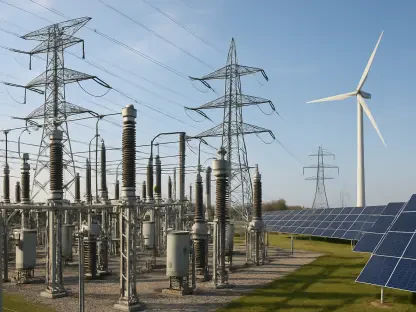
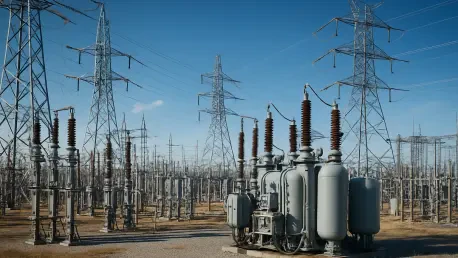
For the long-term, high-capacity needs of the nation, the energy industry is championing the reemergence of extra-high voltage (EHV) 765-kilovolt (kV) transmission infrastructure. This technology, which has a proven track record of reliability spanning more than half a century of global use, is being reevaluated as a compelling solution for handling massive power transfers across regional and interregional distances. Its advantages are significant; a single 765-kV circuit can increase power loading capacity by up to five times compared to lower-voltage alternatives that are more common today. Its primary benefit becomes most apparent over long distances, typically between 200 and 500 miles, where it maintains voltage stability far more effectively than lower-voltage lines, resulting in a more efficient and reliable bulk power system.
The renewed industry consensus on the value of 765-kV technology is also driven by its efficiency in terms of land use, a critical consideration in an increasingly land-constrained environment. While a 765-kV line requires a 200-foot right-of-way, similar to a 500-kV line, it delivers vastly more megawatts per square foot of land occupied. This makes it the most spatially efficient option for moving large amounts of power. The proposal of nearly 5,000 miles of new 765-kV lines across the U.S. in 2024 signals a significant strategic shift. This ambitious build-out reflects a growing recognition that such high-capacity infrastructure is not just an option but a necessity for building a robust, resilient national grid capable of supporting the AI era and ensuring America’s continued economic growth and energy security.
A Balanced Path Forward
The electric sector found itself at a pivotal moment, having to navigate both immediate operational hurdles and critical long-term strategic imperatives. The analysis concluded that no single solution could suffice to meet the historic surge in demand. Instead, the industry pursued a comprehensive and balanced strategy that integrated a portfolio of solutions. This included the rapid deployment of Grid-Enhancing Technologies to optimize the existing grid, the strategic upgrading of key corridors with advanced conductors, and the ambitious construction of new, high-capacity infrastructure like 765-kV and HVDC lines. Through this collaborative and multi-pronged approach, the energy industry worked to build a more reliable, resilient, and cost-effective grid, successfully powering the AI era and securing the nation’s economic vitality.