
A landmark federal court ruling has declared the Trump administration’s suspension of a $5 billion national electric vehicle charging initiative unlawful, ordering the immediate release of funds meant to build a coast-to-coast network of public chargers. The decision, handed down by U.S. District Judge Tana Lin, marks a decisive conclusion to a protracted legal battle, asserting that the executive branch cannot arbitrarily halt a multi-billion-dollar infrastructure program established by Congress. This verdict not only unlocks critical funding for state-level projects but also raises fundamental questions about the separation of powers and the future of long-term national investments.
When the Government Unplugs a National Project: The Core of the Legal Showdown
At the heart of this legal showdown was a fundamental constitutional question: can a presidential administration legally halt a multi-billion dollar infrastructure program established by a previous Congress? The case hinged on the executive branch’s authority over Congressionally-appropriated funds. The court’s decision firmly answers this question in the negative, establishing a significant precedent for future infrastructure projects. Judge Lin’s ruling underscored that the government is prohibited from withholding NEVI funding for any reason not explicitly outlined in the original legislation, the Infrastructure Investment and Jobs Act of 2021.
The ruling is a rebuke of the administration’s argument that it needed to pause the program for an efficiency review. Judge Lin found this justification insufficient, ruling that the Department of Transportation (DOT) and the Federal Highway Administration (FHWA) acted in an arbitrary and capricious manner, violating the Administrative Procedure Act. Her scathing assessment described the government as having “yanked the NEVI Formula Program’s cord out of the outlet,” a move she deemed contrary to lawful governance. This legal battle illustrates the tension that can arise when a new administration’s policy goals clash with legislative mandates already in motion.
Understanding the National Electric Vehicle Infrastructure Program
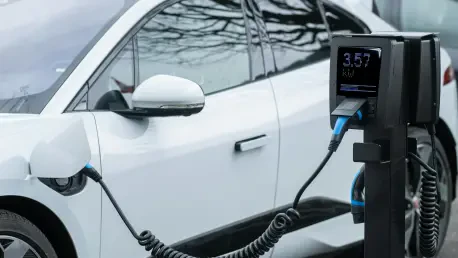
The National Electric Vehicle Infrastructure (NEVI) program represents a bipartisan cornerstone of the 2021 infrastructure law, designed to build a reliable and accessible nationwide network of public EV chargers. Its primary goal is to address “range anxiety,” one of the most significant barriers to widespread EV adoption, by placing fast-charging stations along major highways, designated as “alternative fuel corridors.” By creating a predictable and convenient charging experience, the program aims to accelerate the nation’s transition away from gasoline-powered vehicles.
Financially, the program was structured to catalyze state action by covering up to 80% of eligible project costs. This substantial federal contribution was intended to significantly lower the financial barrier for states, empowering them to build out their charging infrastructure according to federally approved plans. Beyond funding, NEVI also established the first-ever national standards for federally funded chargers. These standards mandate a minimum of four 150 kW fast-charging ports per station, the use of non-proprietary technology, and open-access payment systems, ensuring a consistent and high-quality experience for all drivers, regardless of their vehicle brand.
The Freeze, The Fight, and The Final Verdict
The conflict began in February 2025, when the Trump administration abruptly paused the NEVI program, citing a need for a review to make it “more efficient.” This action effectively brought state-level projects, many of which were already in advanced planning or early construction phases, to a standstill. The move triggered immediate and widespread opposition, culminating in a formidable legal challenge. A coalition of 20 states, the District of Columbia, and several environmental organizations, including the Sierra Club, filed suit, arguing the freeze illegally disrupted plans and projects already in motion.
Their fight led to a decisive verdict from the federal court. In her final ruling, U.S. District Judge Tana Lin sided with the coalition, deeming the administration’s actions unlawful and ordering the immediate release of the obligated funds. She characterized the administration’s halt as “an instantaneous and sudden cessation of the program,” clarifying that such executive actions were not permissible under the law. This ruling validated the states’ claims that the freeze had created chaos and financial uncertainty, undermining years of planning and bipartisan effort.
Voices from the Courtroom and the Cabinet
The court’s decision was amplified by strong language from the bench. Judge Lin’s assertion that the administration’s move was “simply not how things are lawfully done” resonated through the legal and environmental communities. The real-world consequences of the freeze were detailed in court filings. For instance, the state of Delaware reported a $49,875 shortfall for a single approved project, a gap that forced the state to divert its own funds to prevent a construction halt. This example highlighted the tangible financial strain placed on states by the federal pause.
In response to the legal pressures, the administration maintained a posture of reluctant compliance. Transportation Secretary Sean Duffy, while voicing his personal opposition to the subsidies, stated, “We will respect Congress’ will and make sure this program uses federal resources efficiently.” Meanwhile, advocates celebrated the court’s order as a major victory. The Southern Alliance for Clean Energy declared that the ruling cleared the way for states to “implement the NEVI plans they have worked for years to develop,” marking a triumph for clean energy infrastructure and the rule of law.
Navigating the Aftermath: New Rules and Disputed Progress
Even after a preliminary ruling lifted the initial freeze, the path forward remained complicated. The administration issued revised guidance that created a new bottleneck, requiring all states—including those with previously approved plans—to resubmit their proposals for re-approval. The DOT and FHWA then refused to release funds until these revised plans were accepted, leaving states in a precarious financial position for projects that were already underway. This administrative hurdle was seen by many as a tactic to delay the program’s implementation further.
The Department of Transportation defended its actions, claiming its updated guidance improved efficiency and aligned the program with its priorities. In a striking comparison, a DOT spokesperson asserted that in just five months under the new rules, the administration had obligated 39% more NEVI funds than the Biden administration did over three years. However, this claim drew scrutiny. Critics pointed out a critical distinction: the DOT’s statement did not specify how much of the “obligated” money had actually been “disbursed.” This left a crucial gap between a federal funding promise on paper and the actual transfer of cash to state projects, fueling skepticism about the administration’s commitment to the program’s success. The final court ruling was designed to close that gap permanently.