
Today we’re sitting down with Christopher Hailstone, a leading expert on the U.S. energy landscape, to unpack the recent volatility we’ve seen in electricity and natural gas markets. With extensive experience in energy management and electricity delivery, Christopher provides critical insights into the forces shaping our utility bills and the reliability of our power grid. We’ll explore the dramatic surge in natural gas prices and its ripple effects across the economy, the surprising regional differences in electricity rate hikes, and the complex dance between weather, demand, and our nation’s shifting energy sources.
With natural gas prices at the Henry Hub jumping a staggering 88.5% year-over-year in November, what were the primary drivers behind such a dramatic increase, and how does a spike of this magnitude affect both electricity generation costs and industrial operations? Please share some examples.
That 88.5% jump is the kind of number that really makes you sit up and take notice. The core driver was a fundamental increase in demand for natural gas throughout 2025. You have to remember, this followed a year in 2024 where the annual average spot prices were the lowest on record when adjusted for inflation. So, we swung from a historic low to a significant high, with the 2025 spot price average increasing 56% overall. When the price of your primary fuel for electricity generation shoots up like that, it’s a direct pass-through cost. Power plants that rely on gas suddenly face much higher operating expenses, which inevitably get reflected in the electricity rates for everyone. For industrial operations, it’s a double whammy. Not only do their electricity bills go up, but many use natural gas directly as a feedstock or for heating processes, so their production costs skyrocket, impacting everything from manufacturing to agriculture.
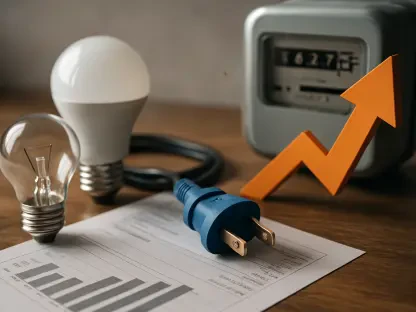
We saw significant regional differences in electricity rate hikes, with Washington D.C. experiencing a 25.9% increase while the national average was 6.8%. Could you explain the local market or policy factors that create such stark disparities between different states and jurisdictions?
It’s a perfect illustration that all energy markets are, at their heart, local. A 25.9% increase in D.C. feels worlds away from the national average, and that comes down to a few key factors. First is the regional fuel mix. Areas more heavily dependent on natural gas for power generation felt the price shock far more acutely than those with a more diversified portfolio of nuclear, coal, or renewables. Second, you have state-level regulations and procurement strategies. Some utilities may have locked in long-term contracts at lower prices, insulating their customers, while others are more exposed to the volatile spot market. In the case of D.C., and its neighbors like Pennsylvania and Ohio which saw increases of 20.3% and 18.6% respectively, their proximity and reliance on specific energy corridors and generation fleets made them particularly vulnerable to these market shifts. It’s a complex web of infrastructure, policy, and market exposure that creates these pockets of extreme price hikes.
In November, residential electricity rates rose 5.5%, while the transportation sector saw a much higher increase of 10.3%. What accounts for this difference in rate increases between sectors, and what specific challenges does this pose for the ongoing electrification of transportation?
That’s a fascinating and critical point. The difference often lies in the rate structures and types of service. Residential rates are often more heavily regulated and may have built-in cushions to prevent extreme short-term volatility for consumers. The transportation sector, on the other hand, is a newer and rapidly growing source of electricity demand. The infrastructure required for commercial fleet charging or public fast-charging stations can come with different pricing models, including demand charges, that are more sensitive to the wholesale cost of power. A 10.3% jump is a serious headwind for the economics of electrification. It directly increases the “fueling” cost for electric vehicles, which can slow adoption rates for both commercial fleets and individual drivers who see the cost-per-mile advantage over gasoline start to shrink. It underscores the need for intelligent charging strategies and rate designs that can protect this burgeoning sector from such dramatic price swings.
While most parts of the country saw less generation from natural gas, coal consumption rose nearly 18%. What specific market conditions or grid reliability concerns prompted this shift back to coal, and what does this tell us about the energy transition during periods of high gas prices?
This is the raw economics of the grid at work. When natural gas prices surged to $3.79 per million British thermal units, it simply became cheaper for many utilities to fire up their coal plants. All parts of the country except the Northeast dialed back their gas generation. In its place, coal became the more cost-effective option to meet demand, leading to that 17.9% increase in consumption. It’s a pragmatic, if not environmentally ideal, response. This tells us that the energy transition isn’t a straight line. Coal, while being phased out, remains a critical backstop for both affordability and reliability, especially during periods of market stress. When the primary fuel source becomes too expensive, the grid operators look at their dispatch stack and call on what’s available and affordable. It’s a stark reminder that as we move toward renewables, maintaining a diverse and resilient energy mix is absolutely essential to weather these economic storms.
Florida’s net electricity generation decreased by 4.7% due to milder weather, while 31 states saw colder temperatures and higher demand. How do these weather-driven demand swings impact grid planning, and what steps are operators taking to manage these increasing regional weather extremes?
These weather-driven swings are one of the biggest challenges for grid planners today. You had a situation where 31 states and D.C. were experiencing more heating degree days and cranking up their thermostats, while Florida, a huge load center, was unusually moderate and saw its demand fall. This creates massive geographical imbalances. Power doesn’t just stay within state lines; it flows across regions. Planners have to forecast these diverse conditions and ensure there’s enough generation capacity online and sufficient transmission capability to move power from where it’s being over-produced to where it’s desperately needed. To manage this, operators are increasingly relying on more sophisticated weather forecasting, improving coordination between regional grids, and investing in flexible resources like battery storage that can respond to these rapid shifts. The days of predictable, uniform weather patterns are over, and the grid has to become much more nimble and interconnected to keep the lights on reliably for everyone.
What is your forecast for consumer energy prices in the coming year?
Looking ahead, I don’t see significant relief on the horizon for consumers in the short term. The market forces that led to these increases in late 2025 are largely still in play. The cost of fuel, particularly natural gas, has a direct and profound impact on electricity generation costs, and those costs are ultimately passed on to customers. Furthermore, we are in a period of significant investment in grid modernization and building out new generation, and those capital costs are also recovered through rates. While there will be regional variations, the overall trend points toward continued pressure on utility bills. As one recent analysis put it, for 2026, “the cake is baked.” Consumers should brace for prices to remain elevated as the entire energy system navigates this volatile and transformative period.