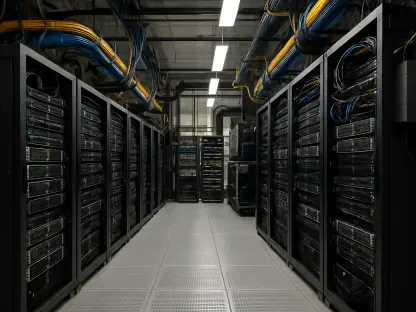
In a world increasingly driven by artificial intelligence, an unseen crisis brews beneath the surface of digital innovation, threatening the stability of our power systems. Data centers, the powerhouses behind AI’s rapid advancements, are consuming electricity at an unprecedented rate, with some facilities demanding as much as 300 megawatts in a single burst—enough to power a small city. This insatiable hunger is placing immense strain on an aging electric grid, designed decades ago for far more predictable loads. As volatility spikes and local substations falter, a pressing question emerges: can the very technology driving this chaos also become its savior? This exploration delves into the clash between digital demand and grid stability, uncovering potential solutions hidden within the problem itself.
The importance of this issue cannot be overstated. With hyperscale data centers multiplying across the nation, the North American Electric Reliability Corp. has issued stark warnings about the risks of erratic power consumption destabilizing entire regions. Beyond mere inconvenience, these disruptions threaten critical infrastructure, from hospitals to transportation systems, that rely on a steady flow of electricity. Addressing this challenge is not just about keeping servers online; it’s about safeguarding the backbone of modern society. The stakes are high, and innovative approaches are essential to transform data centers from grid stressors into stabilizing forces.
The Hidden Strain of AI on the Power Grid
Data centers have become the beating heart of the AI revolution, but their energy appetite is pushing the electric grid to its limits. Unlike traditional industries with consistent power needs, AI operations create dramatic fluctuations, pulling massive loads one second and idling the next. This unpredictability has led to tripped transformers and strained utilities, with some regions reporting a 20% increase in grid instability incidents tied to digital infrastructure over the past two years. The scale of this challenge grows as new facilities come online, each adding gigawatts of demand to an already overburdened system.
This strain isn’t merely a technical glitch; it’s a systemic issue with far-reaching consequences. Local communities bear the brunt when power quality dips, facing risks of outages during peak demand. Utilities, caught between aging infrastructure and skyrocketing needs, struggle to maintain balance, often resorting to costly emergency measures. The ripple effects extend beyond the grid, impacting everything from economic stability to environmental goals as fossil fuel backups are activated to bridge gaps. Recognizing this hidden burden is the first step toward crafting meaningful solutions.
Why Data Centers and the Grid Are at Odds
At the core of this tension lies a fundamental mismatch between modern data center demands and the grid’s outdated design. Built for steady, predictable consumption patterns, the grid falters under the erratic spikes driven by AI workloads, which can surge thousands of times per second. Such volatility overtaxes local substations, disrupts frequency control, and risks widespread instability, as evidenced by recent industry reports highlighting a sharp rise in grid stress events near major tech hubs. This disconnect reveals a critical flaw in infrastructure unprepared for the digital age.
Compounding the problem is the sheer pace of expansion in the data center sector. As companies race to build hyperscale campuses to support AI growth, the cumulative load on the grid multiplies exponentially. Unlike older facilities with flatter demand curves, these new centers introduce dynamic challenges that legacy systems simply cannot handle without significant upgrades. The urgency to address this clash grows as more regions grapple with balancing technological progress against the reliability of essential power networks.
The broader implications of this discord affect not just tech giants but every consumer tied to the grid. When data centers destabilize local systems, the resulting fluctuations can degrade power quality for entire communities, undermining trust in utility services. Bridging this gap requires a deep understanding of both the technological drivers behind AI’s energy needs and the structural limitations of current grid architecture, setting the stage for innovative interventions.
Unpacking the Volatility of AI Workloads and Grid Impact
Diving deeper into the issue, the unique power profile of AI workloads emerges as a primary culprit. Unlike traditional computing, which maintained relatively stable energy draws, AI processing creates rapid, unpredictable fluctuations akin to a stuttering engine. A single data center can swing from near-zero consumption to full capacity in moments, introducing risks like harmonic distortion and overloading local feeders. Industry gatherings, such as RE+ in Las Vegas, have showcased real cases where such volatility triggered backup system failures, underscoring the tangible threat to operational continuity.
This erratic behavior doesn’t just challenge individual facilities; it reshapes grid dynamics on a regional scale. As more centers cluster in tech-heavy areas, the cumulative effect of their load swings amplifies stress on shared infrastructure, leading to tighter frequency margins and unplanned outages. Data from reliability assessments indicates that some utilities now face up to a 30% higher risk of instability during peak AI training cycles. These patterns highlight why theoretical concerns have swiftly become pressing realities demanding immediate attention.
Moreover, the rapid build-out of data centers exacerbates these challenges, outpacing the grid’s ability to adapt. New facilities, often constructed in under two years, add gigawatts of volatile demand before mitigation strategies can be implemented. This growth trajectory signals a need for scalable solutions that can match the speed of digital expansion while addressing the root causes of instability. Understanding these dynamics is crucial for developing frameworks that protect grid integrity amidst relentless technological advancement.
Voices from the Field: Insights on Grid Challenges and Opportunities
Industry leaders and engineers are increasingly vocal about the dual nature of data centers as both problem and potential solution. Amanda Simonian of TerraFlow Energy emphasizes, “These facilities aren’t just draining resources; with the right approach, they can bolster grid reliability.” Her perspective, echoed at events like Data Center World Power, points to a growing consensus that energy management must evolve to handle AI-driven demands. Such insights from the front lines reveal the urgency of rethinking how digital infrastructure interacts with power systems.
Reliability organizations further amplify these concerns, noting that the grid remains ill-equipped for the strobe-like load swings characteristic of modern computing. Reports highlight instances where rapid fluctuations have forced utilities into reactive rather than proactive modes, straining budgets and resources. Yet, amidst these warnings, there’s a thread of optimism—experts argue that data centers, if equipped with advanced tools, could pivot from being liabilities to assets in maintaining power quality. This shift in narrative underscores a shared responsibility among stakeholders.
Conversations with hyperscale site operators add another layer to this dialogue, illustrating the day-to-day realities of managing volatile loads. Many describe a balancing act between meeting computational needs and minimizing grid impact, often under tight regulatory scrutiny. Their experiences suggest that collaboration between tech companies, utilities, and policymakers is not just beneficial but essential. These firsthand accounts ground the discussion in practical challenges while pointing toward a future where partnership drives progress.
Harnessing AI and Energy Storage for Grid Stability
Turning challenges into opportunities, data centers can leverage AI itself alongside advanced energy storage to stabilize the grid. Long-duration flow batteries stand out as a game-changer, capable of cycling endlessly without degradation, unlike traditional lithium-ion systems. These batteries absorb power spikes in milliseconds and release energy over hours, acting as a critical buffer at the DC link between data center demands and grid supply. Early adopters report a 40% reduction in load volatility, proving the technology’s potential to smooth out disruptive fluctuations.
Implementation requires a structured approach tailored to facility-specific needs. The first step involves using AI-driven analytics to map out load volatility patterns, identifying peak stress points. Next, integrating flow batteries allows real-time power conditioning, mitigating sudden surges before they ripple outward. Finally, aligning with utilities on ramp control and inertia support ensures a cohesive strategy that benefits the broader network. This three-pronged framework offers a blueprint for transforming data centers into stabilizing forces rather than sources of strain.
Beyond individual facilities, this approach holds promise for systemic resilience. By acting as distributed energy resources, data centers equipped with storage solutions can help balance regional grids during high-demand periods, reducing reliance on fossil fuel backups. Pilot programs in tech-heavy corridors are already demonstrating how such systems can cut grid stress by up to 25% during peak hours. Embracing these innovations positions the industry to not only address current challenges but also shape a more reliable energy landscape for years to come.
Looking back, the journey to harmonize data centers with the electric grid revealed both daunting obstacles and remarkable ingenuity. The volatile power demands of AI workloads had once threatened to unravel decades of grid stability, pushing utilities and communities to the brink. Yet, through persistent collaboration and the adoption of cutting-edge solutions like flow batteries, stakeholders turned a point of friction into a pillar of strength. Moving forward, the focus must remain on scaling these technologies, fostering partnerships between tech and energy sectors, and investing in infrastructure upgrades over the next few years, from 2025 to 2027. Only by sustaining this momentum can the digital revolution continue without compromising the power networks that underpin it, ensuring a balanced and resilient future for all.