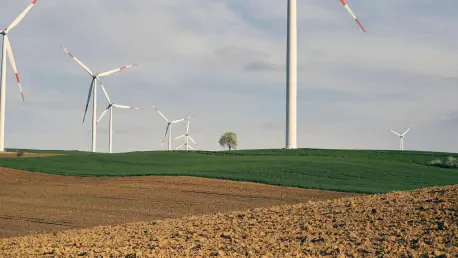

Towering over the agricultural plains of Cross County, a new kind of harvest is now underway, one that captures the wind to power a digital future and redefine the state’s energy identity. The recent launch of the Crossover Wind project, a 135-megawatt facility developed by Cordelio Power, marks a pivotal moment for Arkansas as it becomes fully operational. This is not merely the installation of new infrastructure; it represents the state’s first foray into utility-scale wind energy, introducing a significant source of clean power into a grid historically dominated by other resources. The project’s activation signals a major transformation in the regional energy landscape, driven by a strategic partnership that connects the vast, open spaces of rural Arkansas with the immense energy demands of the global technology sector. As these turbines begin their long-term service, they stand as symbols of a forward-looking energy strategy, promising economic revitalization and environmental benefits that could ripple across the entire state for decades to come.
A New Economic Engine for Rural Arkansas
The Crossover Wind project is delivering a substantial and immediate economic windfall to its host community, creating a new, reliable revenue stream that complements the region’s agricultural heritage. Cross County is set to receive approximately $950,000 in annual payments, a significant infusion of capital that can be used to fund public services, infrastructure improvements, and educational programs without raising local taxes. Beyond the direct benefits to the county government, the project provides a direct financial boost to local landowners. Participating farmers and property owners who lease their land for the turbines are projected to earn over $50 million throughout the project’s operational lifespan. This arrangement establishes a powerful “win-win” model, allowing agricultural activities to continue alongside energy generation, thereby diversifying farm income and providing a hedge against fluctuating crop prices. This synergy addresses common concerns about land use in large-scale energy projects and showcases a path for rural communities to thrive by embracing the clean energy transition.
The financial viability and ultimate success of the Crossover Wind project are anchored by a landmark 20-year power purchase agreement with Microsoft. The technology giant has committed to acquiring 100% of the energy generated by the facility, a move that provides the long-term revenue certainty needed to secure financing and execute such a large-scale development. This partnership highlights a growing trend where corporate sustainability goals are becoming major drivers of renewable energy expansion across the country. Microsoft’s investment is strategically aligned with its need to power its growing portfolio of data centers with clean energy, demonstrating how corporate demand can directly fuel local economic development and grid modernization. This symbiotic relationship ensures that the clean power generated in rural Arkansas has a dedicated buyer, creating a stable and predictable market that benefits the developer, the corporate partner, and the local community simultaneously, forming a powerful template for future projects.
Modernizing the Grid and Securing a Cleaner Future
Beyond its immediate economic impact, the integration of the Crossover Wind project into the state’s energy portfolio represents a crucial step toward building a more resilient and modern power grid. By introducing a significant source of wind energy, Arkansas diversifies its generation mix, reducing its dependence on fossil fuels like coal and natural gas. This diversification is key to enhancing energy security, as it insulates consumers and industries from the price volatility inherent in global fuel markets. As stated by Cordelio Power’s CEO, John Carson, once the initial construction is complete, wind becomes a free and inexhaustible resource. This inherent characteristic of wind power offers the promise of long-term cost stability. Furthermore, the project contributes to a cleaner environment by displacing emissions from polluting power sources, which in turn leads to improved air quality and public health outcomes. This new facility is a tangible investment in a more stable and sustainable energy future capable of meeting rising electricity demand.
A Blueprint for Progress
The successful launch of the Crossover Wind project provided a powerful and practical blueprint for how large-scale renewable energy can be integrated into a state’s economy with widespread benefits. The project demonstrated that a carefully structured partnership between a developer, a major corporate off-taker, and a local community could unlock significant economic value while advancing critical environmental goals. It established a clear precedent for leveraging private sector demand for clean power to fund public infrastructure and provide direct, long-term income to rural landowners. This initiative proved that energy generation and agriculture could coexist productively, creating a diversified economic base that strengthened the local community’s resilience. The legacy of Crossover Wind was therefore not just in the megawatts it added to the grid, but in the collaborative model it pioneered, offering a replicable strategy for other regions looking to harness their natural resources to build a more prosperous and sustainable future.