
Christopher Hailstone has extensive experience with energy management, renewable energy, and electricity delivery. As a recognized utilities expert, he provides valuable insights into the evolving landscape of grid reliability, the historical competition between power standards, and the modern shift toward direct current infrastructure. This conversation explores the technical and strategic transition from alternating current to direct current, focusing on how this evolution addresses the skyrocketing demands of hyperscale data centers and electrified transportation.
Historically, AC dominated due to its ease of long-distance transmission, yet modern DC-DC converters now allow for efficient voltage changes. How do these new technologies address the limitations that once held DC back, and what specific technical hurdles remain for large-scale implementation in existing grids?
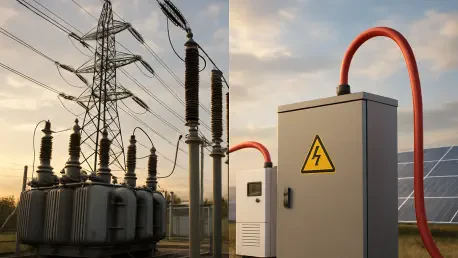
The primary reason alternating current won the “War of the Currents” a century ago was that we could easily step voltage up or down using simple transformers, which made long-distance transmission feasible for a rapidly expanding grid. Today, the development of sophisticated DC-DC power converters has eliminated that historical disadvantage by enabling efficient and reliable voltage changes without the need for traditional transformers. However, moving to a DC-dominated grid isn’t as simple as flipping a switch because direct current behaves differently over long distances, particularly regarding voltage sag. While converters handle the transformation, we still face the technical hurdle of redesigning distribution networks to manage these sags and ensuring that our existing AC-based physical infrastructure can be integrated with these new high-voltage DC components.
Standard data center setups can lose up to 18% of total power during the multiple conversion stages between the grid and the server. Could you explain the practical steps for transitioning to an end-to-end DC design and describe how this shift impacts both physical hardware footprint and operational costs?
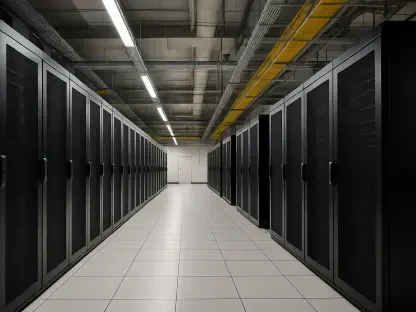
Transitioning to an end-to-end DC design involves a systematic overhaul where we bring DC power directly into the building and distribute it all the way to the racks and individual shelves. By eliminating the inefficient “ping-pong” effect where power is converted from AC to DC and back again multiple times, operators can recover that 18% loss, which represents a massive financial and strategic gain as AI workloads soar. This shift significantly reduces the physical hardware footprint because you no longer need the bulky transformers and complex UPS systems required for AC-to-DC-to-AC conversion stages. Lowering the component count not only frees up valuable floor space for more servers but also slashes operational costs by reducing heat generation and the energy required for cooling.
DC systems face specific challenges like voltage sag over distance and rapid load spikes from intensive AI workloads. What role do advanced capacitors play in stabilizing these systems, and how should engineers rethink power distribution at the rack level to maintain high power quality?
In a DC-centric architecture, advanced capacitors act as the critical stabilizing force that maintains voltage consistency between conversion stages and during sudden demand spikes. Because AI training clusters create highly volatile duty cycles, these capacitors must be strategically placed between DC buses and alongside converters to catch and smooth out rapid load changes. Engineers need to rethink rack-level distribution by treating capacitors as essential infrastructure rather than secondary components, placing them at every critical point where power quality could fluctuate. This intentional design mimics the reliability seen in telecommunications networks, ensuring that even as power density increases, the delivery to sensitive electronics remains unwavering.
Electric vehicle fleets and emerging aviation technologies, such as urban vertiports, require massive, concentrated DC power for rapid charging. What infrastructure upgrades are necessary to support these high-density loads, and how does this change the way utilities must forecast energy demand in metropolitan areas?
To support the rapid charging requirements of EV fleets and rooftop vertiports in cities like New York or Dubai, we need to deploy high-voltage DC hubs backed by advanced power electronics and high-capacity converters. These installations require dedicated DC bus architectures that can handle high-density loads far beyond what traditional municipal grids were designed to provide. Consequently, utilities must overhaul their forecasting models, as these clusters are expected to consume more electricity than entire cities by the 2030s and 2040s. We are moving away from steady, predictable urban loads toward a model where utilities must plan for massive, concentrated bursts of energy demand centered around transportation hubs.
Relying on foreign-sourced components for batteries and grid infrastructure creates significant supply chain risks during geopolitical or environmental disruptions. What are the strategic advantages of reshoring the manufacturing of advanced grid materials, and how does domestic production directly impact national energy resilience?
Reshoring the manufacturing of critical materials like advanced capacitors and grid components allows us to take back control of our energy future and national security. Currently, much of our supply chain is foreign-sourced, meaning a single geopolitical shock or extreme weather event halfway across the globe can trigger a grid reliability crisis in the U.S. By building these advanced materials domestically, we ensure a steady supply of the specialized parts needed to maintain a modern DC-ready grid regardless of international tensions. This domestic production directly bolsters national resilience by shortening lead times for repairs and ensuring that our transition to renewable energy isn’t stalled by logistics disruptions.
With data center energy use expected to more than double by 2030, current AC architectures are reaching their physical limits. How should technology leaders adapt their procurement and standards today to prepare for a DC-dominated future, and what are the risks of sticking with legacy systems?
Technology leaders must immediately begin updating their procurement standards to prioritize 400V and 800V DC architectures, moving away from the legacy AC-first mindset. This means vetting suppliers like Vertiv, Schneider Electric, or Eaton specifically for their DC-ready hardware and advanced capacitor technologies that can handle high-density AI training clusters. The risk of sticking with legacy AC systems is twofold: you face a physical limit on power density that will eventually cap your growth, and you suffer from a permanent 18% efficiency disadvantage compared to competitors. Those who fail to adapt now will find themselves burdened with high operational costs and an inflexible infrastructure that cannot support the next generation of computing and transportation.
What is your forecast for the transition from AC to DC power over the next decade?
Over the next ten years, I forecast a definitive shift where DC becomes the primary standard for high-density applications, effectively ending the era of AC dominance in industrial and data sectors. By 2030, as data center energy use more than doubles, we will see the emergence of a “hybrid grid” where the long-haul transmission may remain AC, but the “last mile” to data centers and EV depots will be almost entirely DC. We will see a massive surge in domestic manufacturing of power electronics as national security concerns drive the reshoring of the energy supply chain. Ultimately, the winners of the next decade will be the organizations that stop treating power as a background utility and start treating DC distribution as a core strategic asset for the AI-driven economy.