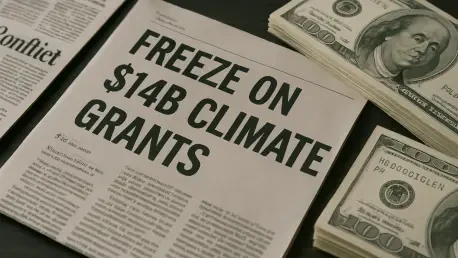

The fate of a massive $14 billion federal initiative aimed at financing clean energy and climate projects in disadvantaged communities now hangs in the balance as the U.S. Court of Appeals for the District of Columbia Circuit has agreed to a full-court rehearing on the matter. This pivotal decision vacates an earlier ruling by a three-judge panel that had upheld the Environmental Protection Agency’s (EPA) controversial freeze on the grant funding. The funds, part of the nearly $27 billion Greenhouse Gas Reduction Fund (GGRF) established by the 2022 Inflation Reduction Act, were awarded to various nonprofit organizations before being abruptly halted by the new administration. The case pits the executive authority of the EPA against the congressionally mandated allocation of funds, creating a high-stakes legal battle with significant implications for climate policy and the separation of powers. The upcoming en banc hearing, where all eligible judges of the court will preside, signals the exceptional importance of the legal questions involved and ensures a more comprehensive judicial review of the administration’s actions.
The Legal and Political Underpinnings
Judicial Scrutiny and Partisan Divide
The legal saga reached a critical point on September 2, when a divided three-judge panel of the D.C. Circuit initially sided with the Environmental Protection Agency in a 2-1 decision, allowing the freeze on the $14 billion in climate grants to continue. The majority opinion, authored by two judges appointed by President Donald Trump, centered on the argument that the previous EPA administration had acted improperly in its final days. They contended that grant agreements were deliberately modified just before the presidential transition to create significant barriers to their termination or alteration by the incoming administration. This, the judges argued, provided sufficient justification for the new EPA leadership to pause the programs to ensure they were being “faithfully executed” according to proper procedure and oversight standards. The dissenting judge, however, offered a starkly different interpretation, viewing the freeze as an overreach of executive power that defied the clear spending directives established by Congress through the Inflation Reduction Act. This initial ruling highlighted a deep judicial and ideological split over the scope of an agency’s authority during a period of political transition.
The subsequent decision to grant an en banc rehearing represents a significant procedural victory for the grant recipients and their supporters, effectively wiping the slate clean by vacating the September 2 panel ruling. This rare judicial step, reserved for cases of exceptional importance or to resolve conflicting precedents, will bring the full force of the D.C. Circuit’s judicial roster to bear on the dispute. New oral arguments have been scheduled for February 24, where lawyers for both the EPA and the nonprofit plaintiffs will present their cases before the entire cohort of eligible judges. While the granting of the rehearing offers a renewed chance for the plaintiffs to unfreeze the funds, it does not provide immediate relief. The court specifically left in place a partial administrative stay that was first issued in April, meaning the $14 billion in congressionally allocated capital remains inaccessible. This ongoing suspension prolongs the uncertainty for dozens of clean energy projects and initiatives across the country that were designed to benefit low-income and disadvantaged communities, leaving them in a state of financial and operational limbo.
Accusations and Defenses
The current Environmental Protection Agency administration, led by Administrator Lee Zeldin, has vigorously defended its decision to freeze the funds by leveling serious accusations against the previous administration’s management of the grant awards. Zeldin has publicly alleged that a thorough review uncovered significant problems with how the Greenhouse Gas Reduction Fund was administered in its final stages. The EPA claims the award process was rushed, resulting in a host of issues, including instances of “self-dealing and conflicts of interest, unqualified recipients, and intentionally reduced agency oversight.” According to this narrative, the freeze was not a politically motivated maneuver but a necessary administrative action to restore integrity and accountability to the program. The administration insists it is exercising its due diligence to protect taxpayer dollars and ensure that the funds, if and when they are released, are distributed effectively and in full compliance with federal regulations. These claims aim to reframe the debate from one of political opposition to climate initiatives to one of responsible governance and the proper stewardship of public funds.
In stark contrast, the nonprofit recipients and their allies have characterized the EPA’s actions as an unlawful and politically motivated assault on a congressionally mandated program. They argue that the administration’s freeze constitutes a “constitutional power grab” that fundamentally disregards the spending authority of Congress. In an amicus brief filed with the court, a group of Democratic members of Congress echoed this sentiment, asserting that the executive branch does not have the authority to unilaterally halt the disbursement of funds that were explicitly appropriated by law. The grant recipients have also forcefully pushed back against the EPA’s allegations of misconduct, describing them as “outrageous attacks on grantees” and a thinly veiled attempt to “fabricate criminal fraud allegations” to justify the freeze. From their perspective, the administration is engaged in a bad-faith campaign to undermine a key component of the Inflation Reduction Act and obstruct progress on climate change, using procedural complaints as a pretext to achieve a policy goal that it could not achieve through the legislative process.
Implications for Climate Action and Grant Recipients
The Human and Environmental Cost of the Stalemate
The financial and operational consequences of the funding freeze are being felt directly by several major nonprofit coalitions specifically created to channel the GGRF funds into community-level projects. Among the largest recipients now caught in this legal crossfire is the Climate United coalition, a “green bank” consortium that was awarded nearly $7 billion to provide financing for a wide range of clean energy and decarbonization initiatives. Similarly, the Coalition for Green Capital, another green bank entity, had its $5 billion award put on hold, stalling its plans to leverage public funds to attract private investment for climate-resilient infrastructure. Another significant grantee, the Power Forward Communities coalition, received a $2 billion grant earmarked for residential decarbonization projects, such as installing heat pumps, improving insulation, and deploying rooftop solar in low-income households. The leaders of these organizations have expressed profound frustration, noting that the freeze has halted critical work intended to lower energy bills, reduce pollution, and create green jobs in the very communities that are most vulnerable to the impacts of climate change. The impasse has effectively paused a multi-billion-dollar effort before it could even begin.
A Path Forward and Unanswered Questions
The court’s decision to rehear the case represented a crucial turning point in a legal and political battle that had left billions in climate funding in a state of indefinite suspension. The initial panel ruling had created a precedent that, if upheld, could have granted incoming administrations broad authority to halt programs initiated by their predecessors, thereby disrupting the continuity of federal grant-making. The nonprofit recipients, including major players like the Power Forward Communities coalition, had remained publicly optimistic, expressing confidence that “both the law and the facts” were ultimately on their side. They had argued that the EPA’s actions defied the explicit will of Congress as laid out in the Inflation Reduction Act. The granting of the en banc hearing suggested that a significant portion of the D.C. Circuit’s judiciary believed the case warranted a more thorough examination. The ultimate outcome of this full-court review was set to have profound and lasting implications, not only for the future of the Greenhouse Gas Reduction Fund but for the broader balance of power between Congress and the executive branch in the implementation of federal law.