
Christopher Hailstone is a seasoned authority in energy management and renewable technologies, bringing years of expertise in grid reliability and the intricate logistics of electricity delivery. As a specialist in utility infrastructure, he has been at the forefront of evaluating how emerging clean energy sources can be integrated into existing maritime and coastal frameworks. In this conversation, we explore the successful completion of a landmark wave energy pilot at the Port of Los Angeles and what it signifies for the future of global energy markets. We discuss the economic advantages of onshore installations, the technical hurdles of converting hydraulic pressure into power, and the geographic potential for scaling this technology across dozens of coastal sites.
The recent pilot at the Port of Los Angeles achieved a capital expenditure of under $1 million. How does avoiding seabed anchoring contribute to these lower costs, and what specific operational milestones were necessary to prove the system’s reliability under real maritime conditions?
By eliminating the need for seabed anchoring or complex offshore construction, we essentially removed the most expensive and risky variables of marine engineering. Traditional offshore projects require specialized vessels and divers to secure foundations to the ocean floor, whereas our 2024 pilot focused on attaching floaters directly to existing coastal infrastructure. This approach kept the total capital expenditure below $1 million, a fraction of what a deep-water installation would cost. To prove reliability, we had to demonstrate that the system could operate continuously under real maritime conditions, surviving the corrosive salt environment and unpredictable swells. Every milestone in the project completion report confirmed that the mechanical components could withstand these stresses while delivering consistent performance.
Onshore wave energy utilizes existing coastal infrastructure like breakwaters and piers. How does this proximity to land simplify the conversion of hydraulic pressure into electricity, and what are the primary trade-offs when comparing this method to traditional offshore wave installations?
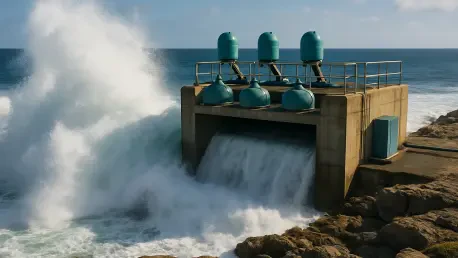
The proximity to land is a game-changer because it allows us to keep the most sensitive energy conversion equipment in a controlled, land-based environment. The movement of the waves drives hydraulic cylinders located on the floaters, which then send pressurized fluid through a closed-loop system to a power station on the pier. This setup avoids the need for expensive underwater cabling and the “complexity and cost” typically associated with maintaining machinery in the open ocean. While offshore systems might access more raw power from deeper swells, the trade-off is often prohibitive maintenance costs and lower mechanical uptime. Our onshore method prioritizes accessibility and cost-efficiency, making it a far more viable solution for commercialization in the near term.
Securing permits with no significant environmental impact is a major hurdle for renewable projects. What was the specific process for verifying the ecological safety of the hydraulic floaters, and how do you manage the integration of these systems into high-traffic commercial ports without disrupting maritime operations?
The permitting process was rigorous, yet the system was ultimately designated as having “no significant environmental impact,” which is a major victory for renewable energy deployment. Because the floaters are attached to existing man-made structures like breakwaters, they do not disturb the seabed or interfere with the local marine ecosystem. We worked closely with port authorities to ensure that the physical footprint did not impede the movement of large vessels or daily cargo logistics. By utilizing the “dead space” along the exterior of piers, the system generates power without occupying valuable dock space or interfering with shipping lanes. This seamless integration proves that clean energy can coexist with the heavy industrial activity of a Tier 1 commercial port.
A large-scale feasibility study identified dozens of potential coastal sites across the United States. What specific geographic or structural criteria make a port a prime candidate for wave energy, and how will the Los Angeles project function as a reference for these future commercial deployments?
Our collaboration with Shell resulted in a study that identified 77 potential sites across the U.S. that are ripe for this technology. A prime candidate for a wave energy project is a port that possesses long, sturdy breakwaters and a consistent wave climate that can provide steady hydraulic pressure. The Los Angeles project now serves as the definitive reference point for these sites, providing a tangible example of how the technology performs in a high-traffic environment. We are transitioning the site into a demonstration and educational facility so that stakeholders from these other 77 locations can see the mechanical reliability firsthand. This validation is critical for de-risking future investments as we move toward full-scale commercial adoption.
Research at the Port of Ngqura in South Africa suggests a potential capacity of over 8 MW. How do the technical requirements for a large-scale breakwater installation differ from a smaller pilot, and what practical steps are needed to transition from a feasibility study to a fully operational power station?
Scaling up to a target like the 8.3 MW potential identified at the Port of Ngqura requires a significant shift from localized testing to heavy-duty industrial engineering. While the pilot focused on proving the mechanical concept, a full-scale station requires an array of dozens of floaters synchronized to feed a centralized hydraulic-to-electric conversion unit. The feasibility study we conducted in South Africa confirmed the technical potential, but the next steps involve detailed environmental assessments and securing the long-term permits required for a permanent power plant. We must also ensure the local grid infrastructure can handle the 8.3 MW load, which involves a more complex electrical integration than a small-scale demonstration unit. It is about moving from a proof-of-concept to a reliable, baseload-style contribution to the national energy mix.
What is your forecast for wave energy?
I expect wave energy to follow a trajectory similar to solar power, where a series of successful pilots leads to a rapid decline in costs and a surge in global adoption. Within the next decade, I forecast that wave energy will become a standard feature for coastal municipalities and industrial ports looking to diversify their energy portfolios. As we refine the hydraulic conversion efficiency and leverage existing infrastructure, the cost of electricity from these systems will likely reach grid parity with other renewables. We are looking at a future where the world’s breakwaters are no longer just passive defense structures but are active, revenue-generating power plants that provide clean energy 24/7. This transition will be driven by the modularity of the technology and its ability to be deployed in high-traffic areas without environmental pushback.