
Beneath the surface of rivers powered by ostensibly clean and green hydropower, a silent and deadly crisis is unfolding for aquatic life, challenging the very notion of this energy source’s environmental friendliness. While hydropower dams generate electricity without emitting greenhouse gases, the very process can turn the water downstream into a lethal environment, inflicting a condition on fish disturbingly similar to the decompression sickness, or “the bends,” that afflicts human divers. This phenomenon, known as gas supersaturation, is not a rare occurrence but a widespread and intensifying threat, prompting a race to develop technology that can undo the damage before ecosystems are irreparably harmed. Researchers have now engineered a novel solution using the power of sound, but its implementation faces a formidable obstacle that technology alone cannot overcome.
The Hidden Danger of Green Energy
A Watery Grave The Science of Supersaturation
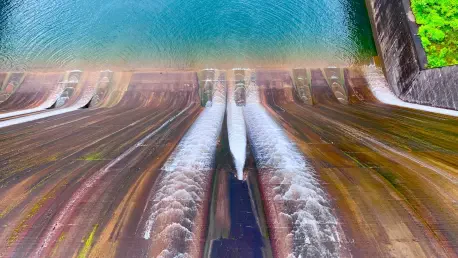
The deadly transformation of river water begins deep within the infrastructure of a hydropower dam, where air is inadvertently drawn into the high-pressure intake tunnels along with the water. As this mixture plunges towards the turbines, the immense pressure, created by the significant height difference, causes the entrained air to completely dissolve into the water. The water becomes saturated with gases, primarily nitrogen and oxygen, far beyond its natural capacity. The true danger is unleashed when this water is discharged from the power plant into the river or fjord below. In this low-pressure environment, the dissolved gas rapidly and violently comes out of solution. The discharged water can appear milky white, fizzing with countless microscopic bubbles as it struggles to return to equilibrium. This state of gas supersaturation creates an invisible but pervasive threat to any organism living within the affected waterway, turning a vital resource into a potential deathtrap.
This supersaturated environment has a devastating physiological effect on aquatic fauna, leading to a condition known as gas bladder disease. For fish, the consequences are particularly gruesome. The excess gas dissolved in the water diffuses into their bloodstream through their gills, and once inside their bodies, it forms harmful bubbles in their tissues and vital organs. The symptoms mirror those of decompression sickness in humans and include protruding eyes, severe internal and external bleeding, and debilitating infections that often prove fatal. The fins of affected fish often show significant wear from the stress. The ecological damage, however, extends far beyond fish populations. Bottom-dwelling animals, insects, and their larvae are also critically impacted. A gas saturation level of just 110 percent, a common threshold found below power stations, is considered the tolerance limit. Beyond this point, these smaller, crucial organisms can become unnaturally buoyant, causing them to float helplessly to the surface where they quickly perish, disrupting the foundational layers of the river’s food web.
A Worsening Global Crisis
The problem of gas supersaturation is both widespread and intensifying, with recent studies painting a concerning picture of its prevalence. A comprehensive analysis by the research institute NORCE LFI revealed that a substantial portion of Norway’s 1,800 hydropower plants are at risk, with nearly one-third falling into a high-risk category for causing significant ecological damage. The greatest danger stems from the country’s largest facilities, approximately 200 of which discharge directly into rivers. The unique topography of Norway, with its steep mountains and deep valleys, allows for the construction of power plants with greater height differences than those typically found in North America or Asia. This greater vertical drop generates higher water pressure, which in turn increases the water’s capacity to dissolve air, leading to more extreme levels of supersaturation. While plants in other parts of the world have recorded maximum saturation levels of 150-160 percent, studies in Norway have documented alarming levels approaching 230 percent, more than double the lethal threshold.
Compounding this existing threat is the overarching trend of climate change, which is projected to exacerbate the conditions that lead to gas supersaturation. Increasingly “wilder, wetter weather and more flooding” will result in higher water flow rates through hydropower systems. During flood events, the turbulence and volume of water increase the likelihood of air being drawn into the intake tunnels, a process known as air entrainment. This means that periods of heavy rainfall, which are becoming more frequent and intense, will likely correspond with spikes in gas supersaturation levels, placing even greater stress on aquatic ecosystems. The problem is therefore not static but dynamic, with the potential to become significantly more severe in the coming years. This escalating crisis highlights the urgent need for effective mitigation strategies that can be deployed to protect vulnerable river habitats from the unintended consequences of both hydropower generation and a changing climate.
A Sound Based Solution
Harnessing the Power of Ultrasound
In direct response to this mounting environmental challenge, a collaborative effort between researchers at the Norwegian University of Science and Technology (NTNU), the Norwegian Institute for Nature Research (NINA), and SINTEF has produced a promising technological breakthrough. Under the banner of the DeGas project, this team has developed and patented a method to actively remove excess dissolved gas from water using power ultrasound. The core of this innovative technology is an acoustic transducer, a specially designed cylindrical device that is submerged in the supersaturated water discharged from a power plant. This transducer emits powerful, high-frequency sound waves, creating an acoustic field that fundamentally alters the physical properties of the water and provides a mechanism for the harmful dissolved gases to escape before they can affect aquatic life. The technology represents a shift from passive observation of the problem to active intervention, offering a tangible tool to restore the ecological balance in affected rivers.
The scientific principle behind the DeGas technology is a phenomenon known as acoustic cavitation. The intense pressure waves generated by the transducer cause the water to locally and momentarily evaporate, creating countless minuscule, transient vapor-filled pockets or cavities. Within these pockets, the pressure is extremely low. The excess dissolved air molecules that have saturated the water are naturally and rapidly drawn into these low-pressure zones. Inside these vaporous cavities, the individual gas molecules coalesce, forming larger bubbles. As these newly formed bubbles rise towards the surface, they continue to grow by accumulating more gas from the surrounding water. Upon reaching the surface, they burst, safely releasing the trapped nitrogen and oxygen into the atmosphere. The efficacy of this method has been rigorously validated through escalating tests, starting in a controlled laboratory setting with a flow of 4 liters per second and successfully scaling up to a small power plant handling 600 liters per second. The research team has a clear roadmap to further increase capacity, aiming for an eventual goal of accommodating flows up to 100,000 liters per second, bringing the solution closer to the needs of large-scale hydropower facilities.
The Human Hurdle Regulation and Awareness
Despite the demonstrated effectiveness and promise of the ultrasound degasification technology, a significant non-technical barrier stands in the way of its widespread adoption: the complete absence of a market for it. The researchers behind the innovation are clear that this market will not materialize on its own. The fundamental issue is a lack of governmental regulation. Currently, in Norway and many other nations, there are no legal requirements compelling hydropower companies to monitor, report, or limit the levels of gas supersaturation in the water they discharge. Without such regulations, there is no commercial or legal incentive for power plant owners to invest in mitigation technologies like DeGas. The problem, though scientifically documented for nearly six decades in other parts of the world, has remained largely “under the radar” of both industry operators and regulatory bodies in regions with extensive hydropower development, leaving a critical gap between the known environmental harm and the political will to address it.
Consequently, the NTNU researchers are making a direct appeal to politicians and the Norwegian Water Resources and Energy Directorate (NVE) to enact policy changes. They advocate for the immediate implementation of mandatory monitoring programs at all hydropower plants. Such a measure, they argue, would be a cost-effective and rapid way to illuminate the true scale of the problem and pinpoint the specific plants that pose the greatest risk to aquatic ecosystems. Postdoctoral fellow Wolf Ludwig Kuhn suggests that “a single year is enough to get the facts on the table,” underscoring how quickly a comprehensive picture could be developed. Professor Ole Gunnar Dahlhaug further emphasizes that the cost of installing and operating the necessary monitoring equipment would be “vanishingly little” for the powerful and profitable energy companies. This call for regulation is not just about creating a market for a new technology; it is about establishing a framework of accountability and ensuring that the pursuit of renewable energy does not come at the expense of the environments it purports to protect.
From Awareness to Action
The issue of gas supersaturation extends far beyond any single nation’s borders, representing a global challenge for the hydropower industry. A harrowing incident at a new power plant in Brazil, where a staggering nine tons of fish were killed during a single test weekend, serves as a stark and tragic reminder of the devastating potential of this phenomenon. This event underscores a widespread lack of awareness and highlights the critical need for this potential impact to be a central consideration during the planning and design phases of the thousands of new dams being proposed worldwide. The true death toll is believed to be significantly underestimated. Fish and other animals that die and become buoyant due to internal gas bubbles are often quickly scavenged by birds and other predators, effectively removing the evidence from sight. Furthermore, tracking the mortality of smaller, yet vital, ecosystem components like insects and larvae in a flowing river is nearly impossible. This “hidden” impact means the ecological damage is likely far greater than what is currently documented, adding a profound sense of urgency to the call for proactive monitoring and mitigation.
The journey from identifying a hidden ecological threat to engineering a viable solution had revealed a critical truth. While the development of the acoustic degasification technology represented a significant scientific achievement, its potential impact was stymied by a lack of regulatory frameworks. The primary obstacle to saving countless aquatic ecosystems was not a technological one, but a political and economic one. The focus therefore shifted from celebrating a scientific innovation to advocating for the policy changes necessary to create a receptive environment for its adoption. It became clear that for technology to solve real-world problems, it needed a bridge to the market, and in this case, that bridge had to be built with regulations. The entire episode illustrated that progress depended on a symbiotic relationship between scientific advancement and forward-thinking governance, ensuring that the pursuit of clean energy did not inadvertently sacrifice the very ecosystems it was meant to preserve.