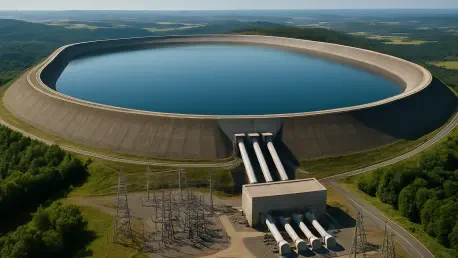

In the typically flat terrain of Jiangsu Province, a region historically unsuited for gravity-dependent hydroelectric power, an unprecedented engineering project has fundamentally reshaped the landscape and the future of energy storage. The Zhenjiang (Jurong) Pumped Storage Power Station stands as a testament to modern ingenuity, a facility that solved the critical problem of creating elevation where none existed. This monumental undertaking involved not just constructing a dam but effectively building an artificial mountain to serve as a massive, water-based battery. Its completion marks a significant milestone in China’s push for cleaner energy, demonstrating a bold approach to overcoming geographical limitations through sheer engineering will. The project’s success is rooted in its innovative design, which transforms a topographical disadvantage into a cornerstone of regional grid stability and a key enabler for the broader adoption of renewable energy sources across the country.
Engineering an Artificial Mountain
Overcoming Geographical Constraints
The primary challenge for the Zhenjiang station was its location within the Lunshan Valley in Jiangsu Province, an area characterized by its lack of significant natural elevation changes essential for traditional hydroelectric generation. To solve this, engineers conceived of and executed a plan to create an immense “artificial drop” from scratch. The centerpiece of this solution is the upper reservoir’s colossal dam, which towers 182 meters (598 feet) high, a height nearly double that of the Statue of Liberty. This structure effectively manufactures the gravitational potential energy required for a pumped-storage system. By impounding a vast quantity of water at this newly created altitude, the project artificially replicated the geographical features of a mountainous region. This feat of civil engineering not only made the project viable but also established a new precedent for developing hydroelectric storage in areas previously dismissed as topographically unsuitable, opening up new possibilities for similar projects globally.
Sustainable Construction on a Massive Scale
Beyond its impressive height, the construction of the dam and its accompanying reservoirs embodied a core principle of sustainability. Instead of sourcing materials from external quarries, a process that would have incurred significant financial and environmental costs, the project team utilized materials excavated directly from the site. This closed-loop approach minimized the facility’s carbon footprint during its construction phase and streamlined logistics in the remote valley. The scale of the upper reservoir is staggering, with a capacity to hold 17 million cubic meters of water, creating an enormous reserve of potential energy. This careful integration of sustainable practices with large-scale construction highlights a sophisticated approach to infrastructure development, where environmental considerations are woven into the very fabric of the engineering design. The result is a facility that is not only powerful in its operational capacity but also responsible in its creation.
The Mechanics of a Water-Based Powerhouse
A Subterranean Energy Hub
Deep beneath the artificially created landscape lies the operational heart of the Zhenjiang station: a vast powerhouse carved out of solid rock 800 meters underground. This subterranean chamber houses the facility’s advanced hybrid turbines, the critical components that convert the immense force of falling water into electricity. Placing the powerhouse deep underground was a strategic decision that maximizes the hydraulic head—the vertical distance the water falls—thereby increasing the efficiency and power output of the turbines. This design also minimizes the surface footprint of the facility, preserving the surrounding environment. The complexity of excavating and constructing such a large and deep cavern, complete with intricate networks of tunnels for water flow and access, represents a significant achievement in geotechnical engineering. This hidden infrastructure is what allows the station to function with such immense power, operating silently and efficiently far below the visible reservoirs.
Balancing the National Power Grid
The Zhenjiang (Jurong) station’s primary mission is not to provide a constant stream of electricity but to act as a colossal shock absorber for the national power grid. It functions as a rechargeable battery, inhaling surplus energy during times of low demand and exhaling it when consumption peaks. During off-peak hours, typically overnight when wind and solar farms may still be generating power that is not needed, the facility uses this excess electricity to pump water from the lower reservoir to the upper one. This process converts electrical energy into stored potential energy. When demand surges, the gates of the upper reservoir are opened, and the stored water rushes down through the turbines to generate electricity almost instantly. With an installed capacity of 1.35 gigawatts, the plant can absorb 1.8 billion kilowatt-hours annually and generate 1.35 billion kilowatt-hours, providing a critical balancing service that is essential for integrating intermittent renewable sources into the grid.
A Blueprint for Future Energy Landscapes
The successful completion and operation of the Zhenjiang (Jurong) facility became a landmark achievement in global energy infrastructure. It definitively demonstrated that even regions without natural topographical advantages could host large-scale pumped-storage hydroelectricity, effectively transforming a geographical impossibility into a modern engineering triumph. The station’s ability to stabilize the grid enabled a far greater integration of intermittent wind and solar power, which was a crucial step in the nation’s transition away from fossil fuels. By preventing the emission of hundreds of thousands of tons of carbon dioxide annually and supplying reliable power to approximately 360,000 households, its impact was both immediate and profound. Ultimately, the project did more than just generate power; it established an innovative and adaptable blueprint that reshaped the conversation around the future of energy storage and sustainable development worldwide.