
A fragile truce designed to save one of the Pacific Northwest’s most iconic species has shattered, plunging a billion-dollar promise into the turbulent waters of a federal courtroom and reigniting a bitter, decades-long war over the future of the region’s rivers. The collapse of a landmark agreement has once again pitted states, Native American tribes, and conservation advocates against the U.S. government, with the very survival of imperiled salmon hanging in the balance. This renewed legal battle centers on the massive federal hydropower system in the Columbia River Basin and forces a profound question: can modern industry coexist with ancient ecosystems?
When a Billion-Dollar Deal Isn’t Enough
A breakthrough appeared to be on the horizon with the 2023 Resilient Columbia Basin Agreement. Brokered by the Biden administration, this pact was hailed as a monumental step toward peace, pausing long-standing litigation. It committed an unprecedented $1 billion over the next decade toward comprehensive salmon restoration projects and the development of clean energy initiatives led by tribal nations. The agreement was structured to provide a pathway for collaboration, moving the conflict from the courtroom to the riverbank.
However, this carefully constructed truce was abruptly dismantled. The subsequent Trump administration scuttled the deal, condemning it as an instrument of “radical environmentalism.” The primary fear voiced by the administration was that the agreement’s framework could eventually lead to the breaching of four highly contested dams on the lower Snake River, a tributary to the Columbia. With the political foundation for compromise destroyed, the plaintiffs had little choice but to return to the courts, re-opening a legal fight that now carries the weight of a failed promise and heightened urgency.
The Tangled Waters of a Decades-Old Dispute
The Columbia River Basin was once the most fertile salmon-producing river system on the planet, a vibrant circulatory system for the entire Pacific Northwest ecosystem. Today, that legacy is a shadow of its former self. Multiple distinct salmon and steelhead stocks have been driven to extinction, while many others are listed as threatened or endangered under federal law. Their decline threatens not just the health of the river but the very fabric of the regional environment.
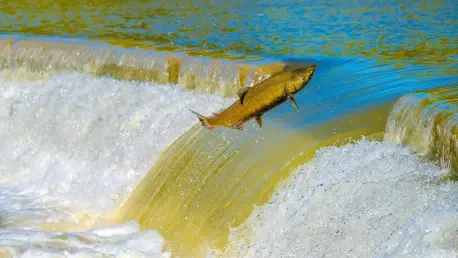
At the heart of this ecological crisis is a massive federal hydropower system, an engineering marvel that provides affordable electricity and creates an inland navigation route for commerce. However, conservationists and tribes identify this system, particularly the four dams on the lower Snake River, as the primary obstacle to salmon recovery. The concrete barriers impede the migration of both adult salmon swimming upstream to spawn and juvenile fish heading toward the ocean, creating a perilous journey that has decimated their populations over generations.
The repercussions of the salmon’s decline extend far beyond the river’s edge, creating a domino effect that reaches deep into the Pacific Ocean. These fish are a keystone species, serving as a critical food source for a wide array of wildlife. Most notably, their scarcity is directly linked to the plight of the endangered southern resident killer whales, which depend heavily on Chinook salmon for their diet. The health of the river is inextricably tied to the survival of these iconic marine mammals, connecting a freshwater dispute to an oceanic crisis.
The Battle Lines Are Drawn in Federal Court
With the political accord in ruins, the conflict has moved back into the formal, adversarial setting of a federal courtroom. The coalition of plaintiffs—which includes the states of Oregon and Washington, the Yakama Nation, the Nez Perce Tribe, and a host of conservation groups—has refiled its lawsuit. Their central claim is that the federal government’s current operational plan for the dams violates the Endangered Species Act by pushing vulnerable salmon populations closer to the brink of extinction.
The primary legal objective of the plaintiffs is to secure a preliminary injunction that would force immediate operational changes at eight federal dams. They are requesting a court order to increase “spill,” the practice of sending more water over the dam spillways rather than through power-generating turbines, which helps young salmon migrate more safely. Additionally, they are asking for reservoirs to be drawn down to lower water levels, further aiding the downstream passage of juvenile fish.
In response, federal attorneys are mounting a vigorous defense of the current system. They argue that their management of the hydropower dams is lawful and that the operational changes demanded by the plaintiffs are not scientifically guaranteed to produce significant benefits for the fish. Moreover, the government contends that such an injunction would constitute a “sweeping scheme to wrest control” of the federal system, potentially compromising dam safety, destabilizing the regional power grid, and ultimately increasing electricity costs for millions of consumers.
Voices from a Divided Courtroom
The arguments presented in court reflect the deep chasm separating the two sides. Amanda Goodin, an attorney for Earthjustice representing conservation groups, conveyed a message of extreme urgency to the presiding judge. She argued that without immediate judicial intervention, the window to save these species could close forever, stating plainly that the fish are “on the cusp of extinction.” This plea for swift action underscores the belief that incremental measures are no longer sufficient to reverse decades of decline.
The government’s legal team painted a starkly different picture, questioning the certainty of the plaintiffs’ scientific claims. Federal lawyers argued against the injunction, characterizing it as a premature and potentially reckless move. They suggested that mandating increased spill without further study could disrupt a carefully balanced system with unforeseen consequences, all while seizing operational authority from the federal agencies Congressionally tasked with managing the dams.
Adding another layer to the dispute, commercial and agricultural interests have voiced strong opposition to the proposed changes. The Inland Ports and Navigation Group, representing businesses that rely on the river, warned of severe economic disruption. They argued that altering dam operations to increase spill could interrupt barge traffic on the Columbia and Snake rivers, a vital corridor for farmers shipping wheat and other crops to coastal ports. Their testimony framed the issue as a direct threat to the regional economy and the livelihoods that depend on it.
Competing Worldviews Culture, Commerce, and Conservation
For the tribal nations involved, this legal battle transcends environmental policy; it is a fight for cultural survival. Jeremy Takala, a council member for the Yakama Nation, described the profound personal and communal loss tied to the salmon’s decline. The disappearance of fish means the loss of fisheries, the disruption of sacred first-food ceremonies, and an inability to pass on essential traditions to younger generations. His powerful declaration that “extinction is not an option” encapsulates the stakes for the tribes, for whom the salmon are an inseparable part of their identity and heritage.
In sharp contrast, supporters of the dams view them as pillars of the regional economy. The hydropower they generate is a major source of clean energy, and the system of locks and reservoirs creates inland seaports in Idaho and eastern Washington, providing a cost-effective way to transport agricultural goods to global markets. From this perspective, the dams are indispensable infrastructure, and calls for their removal or significant alteration are seen as a threat to economic stability and progress.
Ultimately, the conflict boils down to a fundamental environmental argument. Conservation advocates posit that while mitigation efforts like fish ladders and hatcheries have been implemented for decades, they have failed to halt the salmon’s slide toward extinction. They argue that no technological fix can fully compensate for the ecological damage caused by the dams. In their view, the only viable long-term strategy for restoring the species and the ecosystem it supports is to restore a more natural, free-flowing river, a goal that keeps the controversial prospect of dam breaching at the center of the debate.
The court’s decision on the preliminary injunction was seen as a critical juncture, one that could have dramatically shifted the operational landscape of the Columbia River Basin for years to come. Regardless of the outcome of that initial ruling, the underlying tensions between energy production, economic interests, tribal rights, and ecological preservation were solidified. The courtroom became the arena for a conflict that the river itself has silently witnessed for nearly a century, ensuring that the fate of the Pacific Northwest’s iconic salmon would continue to be decided through prolonged legal and political struggle.