
A river of mud threatens to choke the life out of the Chesapeake Bay, and a legal document filed in a state office could decide whether the floodgates of environmental disaster are held back or thrown wide open. At the center of this storm is the Conowingo Dam, a nearly century-old hydroelectric behemoth whose reservoir is now dangerously full of sediment. A landmark $340 million settlement, intended to secure the dam’s future for another 50 years while funding crucial Bay restoration projects, has been thrown into jeopardy. A coalition of Eastern Shore counties, feeling sidelined and betrayed, has launched a formal appeal, arguing the deal sacrifices the long-term health of the nation’s largest estuary for a politically convenient but inadequate solution. This high-stakes legal challenge has frozen all progress, pitting local leaders against state officials in a battle over transparency, responsibility, and the very future of the Chesapeake.
A Landmark Deal or a Reckless Gamble for the Chesapeake Bay
The agreement brokered between the state of Maryland and Constellation Energy, the dam’s owner, was presented as a historic breakthrough. After years of litigation and stalled negotiations, the state secured a commitment of $340 million over five decades to fund a portfolio of environmental initiatives. These projects range from restoring mussel populations, which act as natural water filters, to cleaning up debris and, critically, studying the feasibility of large-scale dredging. For state officials, this represented a tangible victory, transforming a contentious legal stalemate into a concrete plan of action. It was a deal designed to provide a predictable funding stream for Bay health while allowing Maryland’s largest source of renewable energy to continue operating under a new 50-year federal license.
However, for the Clean Chesapeake Coalition, representing several Eastern Shore counties, the settlement is not a victory but a perilous gamble. The coalition’s decision to appeal the agreement risks the entire $340 million package, a move state officials have labeled as reckless. From the counties’ perspective, the risk is necessary. They argue that the state’s deal was negotiated in secret, excluding the very communities that bear the brunt of the environmental consequences when sediment and nutrient pollution pour into the Bay. This has created a tense standoff, where one side sees the appeal as a catastrophic delay that could lead to a worse outcome, while the other sees it as a last-ditch effort to demand a more robust and transparent plan that truly protects the fragile ecosystem they depend on for their livelihoods and heritage.
The Ticking Time Bomb in the Susquehanna River
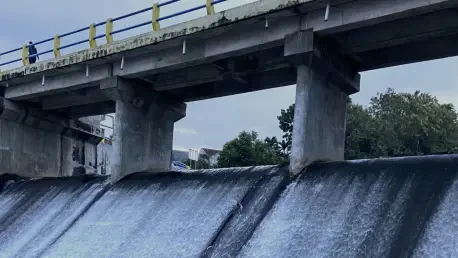
The Conowingo Dam is far more than a simple power plant; for nearly a century, it has also served as an unwitting environmental gatekeeper. Built in the 1920s, the dam created a 14-mile-long reservoir that trapped vast quantities of sediment and the phosphorus attached to it, preventing these pollutants from flowing down the Susquehanna River and into the Chesapeake Bay. This function was an accidental benefit, but a critical one for the Bay’s health. Over the decades, however, this silent service has reached its limit. The reservoir has effectively reached its storage capacity, transforming the dam from a protective barrier into a ticking time bomb.
The science behind this crisis is straightforward. With the reservoir full, the dam has lost its ability to trap significant amounts of new sediment. Now, during major storm events, powerful river flows can scour the millions of tons of accumulated material from the reservoir floor and flush it downstream in a massive, destructive plume. Such an event would be catastrophic for the Chesapeake Bay, smothering oyster beds, blocking sunlight needed for vital underwater grasses, and devastating marine life. This is not a theoretical threat; watermen still recall the ecological devastation that followed sediment releases during Hurricane Agnes in 1973, and scientists warn that a similar storm today could cause even greater, longer-lasting damage.
This environmental threat is inextricably linked to the dam’s operating license. Under the federal Clean Water Act, Constellation Energy cannot receive a new 50-year license from the Federal Energy Regulatory Commission (FERC) without a water quality certification from the state of Maryland. This requirement gives the state powerful leverage. It is the one opportunity in a generation for Maryland to impose legally binding conditions on the dam’s operation to mitigate its environmental impact. The state used this authority to negotiate the $340 million settlement, but the coalition’s appeal now challenges whether that leverage was used effectively, arguing that a 50-year operational guarantee was traded for protections that fall dangerously short of what is needed.
Anatomy of the Appeal Two Competing Visions for the Bay’s Future
The Clean Chesapeake Coalition’s appeal is built on a foundation of procedural and substantive objections. At its core is the allegation that the settlement was negotiated “behind closed doors,” a process that violated state law by excluding meaningful public participation. Coalition attorney Charles “Chip” MacLeod argues that key stakeholders, including the impacted counties, were kept in the dark until the deal was a fait accompli, rendering the state’s certification legally invalid. This lack of transparency is a central grievance, fueling a deep distrust of the state’s motivations and the fairness of the final agreement.
Substantively, the coalition’s sharpest critique targets the settlement’s approach to the sediment crisis. The agreement allocates millions for dredging studies but includes no firm commitment from Constellation to actually remove the accumulated material. Local leaders view this as a critical failure, arguing that more studies are a delay tactic for a problem that is already well understood. Furthermore, the coalition contends that the state inexplicably abandoned a more stringent 2018 agreement that would have held the dam’s owner financially liable for up to $172 million annually for sediment reduction. The appeal also claims the current deal fails to account for updated climate change projections, which predict more frequent and severe storms, and ignores pressing ecological issues like the sharp decline in the Bay’s striped bass population. Finally, questions are being raised about the dam’s physical condition, citing federal documents that reportedly detail structural and monitoring issues that the coalition believes the state should have considered.
In response, state officials portray the appeal as a grave miscalculation that misunderstands the legal and political realities of the situation. They counter the “secret talks” charge by explaining that confidentiality was a legal requirement for settling the active litigation surrounding the 2018 certification. Jay Apperson, a spokesperson for the Maryland Department of the Environment (MDE), insists that public input was considered and that feedback from county partners directly led to the inclusion of the dredging study funds. Officials argue the settlement represents a pragmatic and historic achievement after decades of gridlock, securing actionable funding that would otherwise remain tied up in court. The most urgent warning from the state is that the appeal freezes all funding and halts all progress, plunging the issue back into years of delay. MDE officials fear a nightmare scenario where a prolonged legal fight could lead federal regulators at FERC to lose patience and issue a new 50-year license with “zero environmental improvements,” stripping Maryland of all its hard-won leverage.
Voices from the Front Lines Key Figures Define the Stakes
The legal arguments find their human voice in the key figures on both sides of the dispute. For Charles “Chip” MacLeod, the coalition’s attorney, the issue is a matter of legal principle. He maintains that the secret negotiations that produced the settlement render the state’s certification fundamentally “invalid,” arguing that a lawful process must involve the public and affected stakeholders in a meaningful way. His stance frames the appeal not just as an environmental fight, but as a defense of transparent governance and the public’s right to be heard on decisions that will shape their communities for the next half-century.
This perspective is powerfully echoed on the ground by local leaders like Kent County Commissioner Ronald Fithian. A lifelong waterman, Fithian brings a firsthand understanding of the stakes. He vividly recalls the murky, lifeless waters that followed the sediment release during Hurricane Agnes and expresses deep skepticism about the value of more studies. For him and his constituents, the problem is not a lack of data but a lack of action. This view contrasts sharply with that of state officials like Deputy Environment Secretary Adam Ortiz, who defends the studies as a strategic necessity. Ortiz explains that the high cost of dredging is a major barrier and that the research is designed to explore ways to make a large-scale project economically viable, potentially by finding beneficial reuses for the sediment that could attract federal funding.
The state’s defense is articulated with a sense of urgency and frustration. MDE spokesperson Jay Apperson has called the coalition’s appeal “reckless,” warning it will “plunge us back into even more years of delay with no action.” This highlights the state’s fear that the perfect has become the enemy of the good, and that the quest for an ideal solution risks scuttling a substantial, achievable one. Meanwhile, Constellation spokesperson Paul Adams has moved to rebut safety concerns raised in the appeal, affirming that the dam is structurally sound, “built to last,” and subject to rigorous federal oversight. He characterized the ongoing maintenance and monitoring dialogues with FERC as signs of a healthy regulatory process, not a cause for alarm.
The Fork in the River Potential Outcomes and Their Consequences
The legal challenge has pushed the fate of the Conowingo Dam and the Chesapeake Bay to a critical crossroads, with two starkly different paths ahead. The first path involves the settlement moving forward, either through a rejection of the appeal or a withdrawal by the coalition. This outcome would unlock the $340 million in funding over the next 50 years. These funds would be immediately directed toward projects aimed at improving the Bay’s health, such as large-scale mussel restoration, targeted clean-ups of debris and trash, and, crucially, the feasibility studies intended to pave the way for a financially viable dredging solution. This path provides a long-term, predictable framework for environmental investment directly tied to the dam’s continued operation, representing what its proponents call a pragmatic and actionable victory for the Bay.
The second path is one of prolonged uncertainty and risk, triggered if the appeal halts the entire process. In this scenario, all settlement funds would be frozen indefinitely, putting the planned restoration projects on ice. The state and the coalition would likely be drawn into a lengthy and expensive court battle, extending the gridlock that has characterized this issue for years. The greatest risk in this scenario, as warned by state officials, is that Maryland could lose its regulatory authority. Tired of the delays, federal regulators could intervene and grant Constellation its 50-year license without any of the environmental conditions negotiated by the state. This would leave the dam operating for another half-century with no dedicated funding for Bay restoration, a result that both sides of the current dispute would consider a catastrophic failure.
The appeal filed by the Clean Chesapeake Coalition represented a profound moment of reckoning for environmental policy in Maryland. It laid bare the deep chasm between local stakeholders who demanded absolute protection for the Chesapeake Bay and state regulators who pursued a negotiated, pragmatic compromise. The conflict became a case study in the immense difficulty of balancing environmental preservation, economic interests, and the legal complexities of federal licensing. Ultimately, the standoff over the Conowingo Dam settlement was a powerful reminder that the path toward restoring a natural treasure is rarely straight, and the choices made at such critical junctures carried consequences that would be felt for generations.