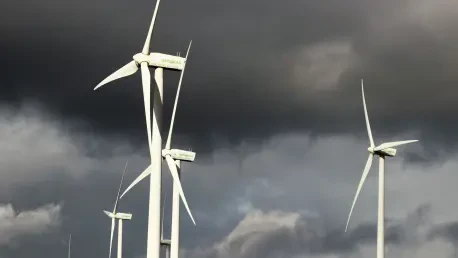

A 459-foot wind turbine fire on the German North Sea coast recently highlighted the physical limits of modern firefighting equipment and safety protocols. The incident occurred in the small community of Simonsberg, where a nacelle ignited at a staggering elevation of 276 feet. Despite the presence of sixty specialized emergency responders, the situation quickly became an exercise in passive observation rather than active suppression. The height of the fire was simply beyond the reach of standard German ladder trucks, which are designed to peak at roughly 100 feet. This significant discrepancy between the altitude of the flames and the reach of the equipment underscores a growing challenge for renewable energy infrastructure. As turbines continue to scale upward to capture more efficient wind currents, the gap between the hazard and the solution widens, leaving firefighters with few options beyond securing the perimeter and waiting for the fuel source to exhaust itself. This event serves as a stark reminder of the unique logistical hurdles faced in modern industrial fire management.
Tactical Limitations and Safety Protocols
Understanding the “Let It Burn” Strategy
The decision to allow a wind turbine fire to burn out naturally is not a matter of negligence but a strict adherence to established safety guidelines from the German Fire Service Association. These national protocols dictate that when a fire occurs in the nacelle, the safest and most effective course of action is non-intervention. Firefighters are instructed to focus their energy on protecting the ground-level environment, such as the tower base or nearby transformer sheds, while the upper assembly remains unreachable. The logic behind this approach is based on the extreme risk of falling debris and the futility of attempting to project water or foam hundreds of feet into the air with insufficient pressure and accuracy. By prioritizing the safety of the crew over the preservation of an already failing asset, departments can prevent injuries that would likely occur during a high-altitude operation. This strategy acknowledges the current technological limitations of mobile firefighting platforms in the face of massive industrial structures.
Furthermore, the materials found within a nacelle make direct firefighting particularly hazardous and largely ineffective. A typical turbine housing contains hundreds of gallons of flammable gearbox oil and hydraulic fluid, which burn at intense temperatures once ignited. Because the exterior of the nacelle and the blades are often constructed from reinforced fiberglass and resins, the fire produces a toxic plume of smoke and causes the structural integrity of the components to fail rapidly. Attempting to intervene at such heights would expose firefighters to molten materials and falling structural fragments without any realistic chance of extinguishing the blaze. Consequently, the official protocol emphasizes the containment of the physical area at the base of the turbine. This ensures that while the machine is a total loss, the surrounding landscape and personnel remain protected. This pragmatic approach to risk management is becoming the standard for high-altitude industrial accidents where traditional suppression methods reach their physical breaking point.
The Critical Role of Exclusion Zones
Establishing a comprehensive exclusion zone is the most vital step in managing a high-altitude turbine emergency. Guidelines mandate a minimum safety perimeter of 1,640 feet, which is designed to protect both responders and the public from the phenomenon known as “blade throw.” When the internal structure of a turbine blade is weakened by heat, the high winds typical of these sites can cause massive fragments of fiberglass to be projected over significant distances. In the Simonsberg incident, the rapid establishment of this cordon was essential for preventing injuries as the nacelle began to shed molten fragments. Law enforcement and fire crews work in tandem to secure all access roads and public paths within this radius, ensuring that no unauthorized individuals enter the danger zone. This perimeter is not just a safety measure for the immediate area but also a safeguard against the unpredictable nature of structural failure at extreme heights, where the trajectory of falling debris can be influenced by wind.
In addition to physical debris, the management of the exclusion zone must account for the dispersion of toxic smoke and particulate matter. The combustion of industrial oils and composite plastics releases a variety of chemicals that can be hazardous to the local population and the environment. Therefore, the safety radius is often expanded downwind to ensure that residents are not exposed to the concentrated plume. Monitoring the integrity of this zone requires continuous coordination between multiple agencies, especially in regions with high foot traffic or agricultural activity. By maintaining a strict boundary, emergency services can effectively isolate the hazard, allowing the fire to run its course without endangering the community. This method of containment represents the primary defensive strategy in the current firefighting arsenal for wind energy, as it mitigates the most immediate threats to human life while accepting the reality that the infrastructure itself cannot be saved through conventional means.
Statistical Realities and Infrastructure Gaps
Frequency of Incidents in High-Density Regions
While the sight of a burning turbine is dramatic and often goes viral in the news, these events remain statistically rare when viewed against the backdrop of the entire industry. At the start of the year, Germany operated nearly 30,000 onshore wind turbines, yet the number of nacelle fires remains relatively low, with estimates suggesting fewer than a dozen such incidents occur annually nationwide. This equates to an incident rate of approximately one fire for every few thousand turbines. However, the perceived risk is significantly higher in regions like Nordfriesland, which features one of the highest densities of wind power installations in Europe. For the local volunteer fire departments serving these “wall-to-wall” turbine landscapes, a fire is viewed as an inevitable logistical challenge rather than a freak occurrence. This localized frequency necessitates specialized training programs and a deep familiarity with the specific layouts of local wind farms to ensure that when an alarm sounds, the response is both rapid and measured.
The visibility of these fires also creates a unique public relations challenge for the renewable energy sector. Because turbines are often located in open fields or along coastal dikes, a fire can be seen for miles, drawing significant public and media attention. This visibility often leads to a disproportionate concern regarding the safety of wind technology, despite data showing it to be one of the safest forms of power generation. To combat this, industry associations and emergency planners emphasize transparency and the success of safety protocols. In high-density regions, the focus is on constant refinement of communication strategies to keep the public informed without causing undue alarm. The goal is to demonstrate that while fires cannot be entirely eliminated in any industrial sector, the procedures in place are more than capable of protecting the surrounding community. This statistical context is essential for understanding why resources are allocated more toward containment and warning systems than toward specialized high-reach equipment.
The Widening Gap in Equipment Capabilities
The most pressing issue facing modern emergency services is the fact that wind technology is evolving at a pace that far exceeds the development of firefighting infrastructure. In the current landscape of 2026, newly installed turbines are reaching total heights that dwarf the units of the previous generation. While the 459-foot turbine in Simonsberg was already beyond the reach of ladder trucks, modern offshore and onshore models are now exceeding 700 feet, with nacelles positioned at heights that make physical contact from the ground a literal impossibility. This “ladder gap” is a permanent reality of the industry, as the quest for more consistent and powerful wind requires larger blades and taller towers. Consequently, the reliance on external firefighting methods is becoming a thing of the past. The industry is forced to look inward, focusing on the development of internal safety systems that can address fires at the source before they escalate into a catastrophic nacelle event that requires a massive ground-level response.
To address this height discrepancy, many modern turbines are being built with integrated fire suppression technology, such as automated gas flooding or specialized water mist systems. These internal safeguards are designed to detect heat or smoke within the nacelle and activate without the need for human intervention. However, a significant challenge remains with the thousands of older turbines currently in operation that lack these advanced features. Retrofitting these aging units with modern suppression tech is often a complex and expensive undertaking, leading to a varied landscape of safety capabilities across different wind farms. This means that for the foreseeable future, fire departments must remain prepared for the worst-case scenario where no internal systems exist. The widening gap in equipment capabilities serves as a catalyst for a broader discussion about mandatory safety standards in turbine manufacturing. As the machines grow taller, the industry must ensure that the internal defenses are robust enough to compensate for the fact that no ladder on earth will ever reach the top.
Public Safety and Environmental Management
The Simonsberg incident provided a definitive template for the evolution of fire safety in the wind energy sector through 2026 and beyond. It demonstrated that as the infrastructure of the future grows beyond the reach of traditional tools, the focus must shift entirely toward preventative design and strict ground-level management. Operators and manufacturers were encouraged to accelerate the integration of automated internal suppression systems as the only reliable method of tackling nacelle fires. Regional safety planners prioritized the development of more sophisticated drone-based monitoring to assess structural damage from a distance without risking personnel. The coordination between local fire departments and utility companies became more formalized, leading to a new standard of site-specific emergency response plans. By recognizing the physical limits of current technology, the industry began to treat high-altitude hazards with the same level of caution as other major industrial sectors. This proactive shift ensured that the benefits of wind energy were not overshadowed by the logistical challenges of its inevitable failures.