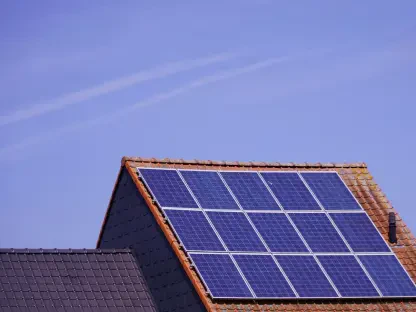

The push for energy independence is increasingly moving from sprawling, remote farms directly to the suburban backyard, challenging the long-held notion that significant power generation is exclusively the domain of large-scale utilities. As homeowners actively seek ways to reduce their carbon footprint and insulate themselves from volatile energy markets, the demand for accessible, efficient, and non-intrusive renewable solutions has surged. While solar panels have become a common sight on rooftops, they represent only one piece of the puzzle, often limited by daylight hours and the availability of unshaded space. This creates a distinct need for complementary technologies that can harness other natural resources. A new generation of personal wind turbines is emerging to fill this gap, engineered specifically to overcome the traditional barriers of noise and size that have historically confined wind power to rural and industrial settings, making clean energy a more practical reality for the average household.
A New Generation of Residential Energy
Design Philosophy and Performance
The Hercules turbine represents a significant leap forward in making wind energy a practical option for individual homeowners, primarily through a sophisticated approach to its material composition and engineering. By integrating lightweight wood with high-strength carbon fiber and steel, its design achieves a delicate balance between durability and manageable weight. This combination ensures the structure is robust enough to withstand varied weather conditions while remaining light enough for a more straightforward installation process, circumventing the need for the heavy industrial equipment associated with massive wind farm turbines. This thoughtful construction directly supports its core function: generating approximately 4 kW of power, a capacity sufficient to meet a substantial portion of the average home’s electricity needs. The result is a device that effectively decentralizes power generation, empowering consumers to produce their own clean electricity directly on-site. This shift marks a pivotal move away from a complete reliance on centralized grids and toward a more resilient, distributed energy model where individuals play an active role in their power supply.
Overcoming Traditional Barriers
A primary obstacle that has long hindered the widespread adoption of residential wind turbines is noise pollution, a concern that the Hercules turbine directly addresses with its near-silent operation. Rated at a remarkably low 38 dBA, its sound output is comparable to the ambient noise level of a quiet library or a softly humming refrigerator, making it an unobtrusive addition to a residential environment. This engineering feat is critical for its viability in populated suburban areas, where excessive noise from mechanical equipment can be a major point of contention among neighbors. By minimizing its auditory footprint, the technology becomes a far more tenable solution for dense communities. Furthermore, the turbine offers a distinct operational advantage over solar power, its most common renewable counterpart. Unlike solar panels, which are entirely dependent on daylight, a wind turbine can generate electricity at any hour, day or night, as long as sufficient wind is present. This continuous generation potential provides a more consistent and reliable stream of power, reducing dependency on battery storage or the grid during nighttime hours and overcast days.
Context and Real-World Application
The Bigger Picture of Decentralization
Innovations like the Hercules turbine are instrumental in the broader global transition toward a sustainable energy future, serving as a key driver for the decentralization of power grids. By enabling energy generation at the point of consumption, such technologies reduce the strain on aging, centralized infrastructure and minimize the energy losses that occur during long-distance transmission. This model of distributed generation, where countless small-scale producers contribute to the overall supply, fosters a more resilient and flexible energy system that is less vulnerable to large-scale outages. Each home or small business that adopts a personal wind turbine becomes an active participant in the fight against climate change, directly displacing the need for fossil fuel-based power. This grassroots approach to clean energy adoption is crucial for meeting ambitious global carbon emission reduction targets. It democratizes the energy sector, shifting power from a few large corporations to a multitude of individual stakeholders and fostering a culture of environmental stewardship and energy independence.
The Critical Factor of Location
While the Hercules turbine presents a compelling solution for personal energy generation, its effectiveness is fundamentally tied to a non-negotiable factor: the local climate. The promise of 4 kW of clean power is entirely contingent on the availability of consistent and sufficiently strong winds, making a thorough site assessment an indispensable first step for any potential user. The turbine’s performance will vary dramatically from one location to another; a home situated on an open plain or a coastal bluff will experience far greater energy output than one in a sheltered valley or a dense urban area surrounded by tall buildings. Factors such as local topography, prevailing wind patterns, and the presence of obstructions like trees and neighboring structures must be carefully evaluated to determine viability. This inherent dependency on geography means that while the turbine is a powerful tool, it is not a universal solution. Its implementation requires a realistic understanding of environmental conditions, reinforcing the principle that the most effective renewable energy strategies are those tailored to the specific resources of a given location.
A Look at What This Shift Signified
The development and introduction of user-focused technologies like the Hercules turbine marked a definitive turning point in the renewable energy landscape. It demonstrated that the conversation around wind power could successfully move beyond industrial-scale farms and into the realm of personal application. This shift was pivotal, as it validated the concept of a decentralized energy grid powered not only by large utilities but also by a network of individual producers. The successful engineering of a quiet, compact, and efficient turbine provided a tangible proof of concept that empowered consumers and paved the way for further innovations in localized power generation. The result was a more diverse and resilient energy ecosystem, where individual contributions became a meaningful part of the global solution to a more sustainable future.