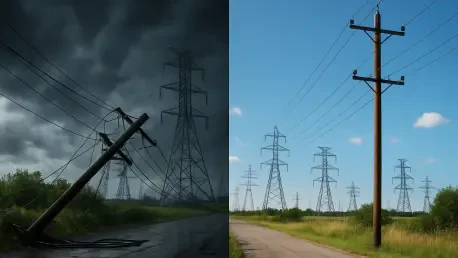

Catastrophic weather events, from hurricanes to ice storms, have become powerful, if unforgiving, catalysts for change in the American utility sector. While these disasters leave devastation in their wake, they also expose critical vulnerabilities in the nation’s power grid, creating an undeniable mandate for innovation. For forward-thinking utilities, a crisis presents an opportunity to move beyond short-term, reactive fixes and invest in long-term, proactive resilience. By learning from failure, these companies are fundamentally transforming their approach to infrastructure, technology, and risk management to prepare for an increasingly volatile climate. The experiences of several key utilities across the country illustrate a clear evolution, where the painful lessons of the past are directly shaping a more robust and intelligent grid for the future, proving that the most effective strategies are often forged in the crucible of disaster.
From Hurricane Aftermath to a Hardened Grid
For Florida Power & Light (FPL), the turning point came in 2005 with Hurricane Wilma, a storm that left millions without power for weeks and shattered the company’s reputation with both customers and regulators. This profound failure prompted the launch of the “Storm Secure” program, an aggressive, decade-long initiative focused on hardening the physical grid. Instead of simply replacing downed poles, FPL systematically replaced vulnerable transmission structures with robust steel and concrete. On the distribution level, it fortified lines by strategically inserting concrete poles within spans of regular ones to act as backstops, a tactic designed to prevent the “domino effect” of cascading pole collapses. The true test of this investment came twelve years later during Hurricane Irma. While the storm was immensely powerful, FPL’s transmission system suffered zero failures, a stark contrast to the widespread collapses seen after Wilma and a clear validation of its long-term hardening strategy.
While the transmission system held strong during Hurricane Irma, the storm revealed a new, significant weakness in the distribution network, which was decimated by falling trees and other vegetation. This lesson spurred the next major phase of FPL’s resilience strategy, one that moved beyond the main arteries of the grid to the final mile of delivery. In 2018, the utility launched the “Storm Secure Undergrounding” pilot program to move vulnerable neighborhood power lines beneath the ground, protecting them from wind and debris. This initiative was significantly accelerated a year later when a new Florida law facilitated the recovery of costs for such storm resilience projects, allowing FPL to convert the pilot into a permanent, large-scale program. The utility has since buried thousands of miles of lines, embarking on a long-term goal to underground its entire neighborhood distribution system over the next quarter-century, demonstrating a continuous cycle of learning and adaptation driven by disaster.
The Wildfire Imperative and Technological Defense
In California, Southern California Edison’s (SCE) resilience journey was sparked not by a direct disaster in its own territory, but by the existential threat of wildfires posed by utility equipment, a danger tragically demonstrated by fires started by a neighboring utility. This external catalyst prompted SCE to adopt an aggressive, proactive stance to mitigate its own fire risk. Recognizing that burying its entire system was prohibitively expensive and time-consuming, with costs ranging from $1.5 million to over $5 million per mile, SCE pioneered the widespread use of “covered conductors.” This more practical and scalable alternative involves wrapping overhead lines in durable, insulating materials for a fraction of the cost of undergrounding. This pragmatic strategy has allowed SCE to harden an impressive 90% of its system in just a few years, showcasing an effective balance between risk reduction and financial feasibility in the face of an ever-present threat.
Beyond physical hardening, SCE has become a leader in integrating advanced technology to build a more intelligent and predictive grid. The utility developed an AI-powered system called the Advanced Waveform Anomaly Recognition System (AWARE), which functions much like a health monitor for the electrical network. By synthesizing data from thousands of sensors, AWARE can predict the location and timing of potential equipment faults before they occur, allowing for preemptive maintenance. It also significantly improves the ability to pinpoint the location of existing faults, a notoriously difficult task, especially for underground lines. This shift from simple reinforcement to predictive analytics represents a crucial evolution in managing risk. However, the sobering reality that SCE’s equipment was implicated in a fatal 2023 fire serves as a stark reminder that even with aggressive investment and innovation, the mission to eliminate disaster risk remains relentless and urgent.
Confronting Winter’s Fury with Systemic Upgrades
Texas-based Pedernales Electric Cooperative (PEC) has reshaped its resilience strategy in response to two distinct winter storms that exposed different systemic weaknesses. The statewide grid crisis during Winter Storm Uri in 2021 revealed a critical operational flaw when PEC’s software for managing mandated rolling blackouts failed under the immense strain. This forced employees into a high-stress, manual process of flipping feeders on and off from the operations center, an unsustainable solution during a crisis. In response, the cooperative invested heavily in upgrading its control systems and software architecture to ensure they could reliably and automatically handle such emergency directives from the grid operator. This experience highlighted that modern grid resilience depends as much on the reliability of its software and operational protocols as it does on the strength of its physical components, especially during widespread emergencies that push systems to their absolute limits.
Two years later, Winter Storm Mara delivered a direct physical blow to PEC’s service area, causing nearly 100,000 outages and widespread pole collapses. A thorough investigation revealed a specific, unexpected vulnerability: poles shared with telecommunications companies. The extra telecom lines created a thicker surface area, allowing more ice to accumulate, which, combined with the weight of falling vegetation, led to catastrophic failures. A staggering 75% of the cooperative’s pole breaks occurred at the communication line level. This finding prompted two major initiatives. First, PEC began using LiDAR technology to precisely map and manage vegetation near its power lines, a move that has dramatically reduced tree-related outages. Second, the cooperative instituted a comprehensive “pole test and treat program” with the ambitious goal of testing and, if necessary, replacing every pole in its system over a ten-year cycle to ensure structural integrity.
The New Era of Tech-Infused Resilience
The varied experiences of these utilities revealed a clear and accelerating trend toward building resilience as a core strategic priority, driven primarily by the hard-won lessons from past disasters. While the specific catalysts differed—hurricanes in Florida, wildfires in California, and ice storms in Texas—the resulting strategies have converged on common elements. There is a universal focus on hardening physical infrastructure, whether through stronger materials or undergrounding. More importantly, there has been a profound shift toward the integration of sophisticated technology like AI and LiDAR for predictive maintenance and enhanced operational efficiency. The collective journey of FPL, SCE, and PEC demonstrated that while the path to a truly resilient grid is complex and costly, it is the proactive application of lessons learned from failure that has best prepared the industry for the environmental challenges ahead.