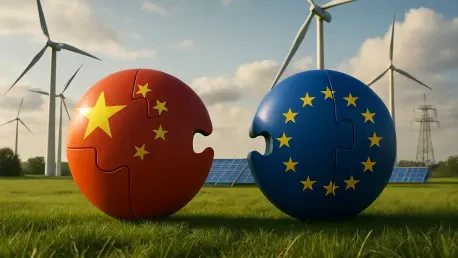

The global transition toward sustainable energy, a movement intended to foster international cooperation against climate change, has ironically become the newest battleground for economic and political disputes between major world powers. A recent decision by the European Commission to launch an in-depth investigation into a prominent Chinese wind power enterprise has sharply escalated tensions, transforming the shared goal of a green future into a flashpoint of geopolitical rivalry. This probe, initiated under the EU’s Foreign Subsidies Regulation (FSR), has been met with a swift and forceful rebuke from Beijing, which perceives the action not as a legitimate regulatory measure but as a thinly veiled act of protectionism. Officials from both the Chinese Ministry of Commerce and the Foreign Ministry have publicly condemned the move, framing it as a discriminatory attack designed to stifle the competitive edge of Chinese firms in the burgeoning green technology sector. This standoff highlights a fundamental divergence in perspective, with the EU citing the need for a level playing field while China accuses the bloc of weaponizing trade policy to protect its domestic industries, thereby threatening the very collaboration needed to address the world’s environmental challenges.
The European Union’s Regulatory Gambit
Scrutinizing Foreign Subsidies
The European Commission’s action stems from the implementation of its Foreign Subsidies Regulation, a powerful tool designed to address market distortions allegedly caused by financial contributions from non-EU governments. The investigation into the Chinese wind power company represents a significant application of this regulation within the critical green energy sector. The FSR grants the Commission the authority to investigate subsidies provided by non-EU countries to companies operating in the single market, and if distortions are found, to impose redressive measures. In this case, the EU’s focus is on whether state support has given the Chinese firm an unfair advantage in public procurement processes within the Union. From the EU’s perspective, this is about upholding the principles of fair competition and ensuring that all companies, regardless of their origin, compete on equal terms. However, this regulatory maneuver is seen by many in China as part of a broader, more aggressive European strategy to counter the growing influence of Chinese technology on the continent, moving beyond traditional trade defense instruments like anti-dumping duties to a more direct challenge of foreign industrial policies.
A Pattern of Protectionism
Beijing’s response has been unequivocal, characterizing the EU’s probe as the latest in a series of protectionist actions targeting its industries. A spokesperson for the Ministry of Commerce argued that the EU is misusing its unilateral FSR tool, pointing to a pattern of frequent investigations into Chinese firms across various sectors, including security inspection equipment and now wind power. China contends that the EU is overgeneralizing the definition of “foreign subsidies,” initiating complex and burdensome cases with insufficient preliminary evidence, and conducting these procedures in a manner that lacks transparency. This view was solidified in January 2025, when China’s Ministry of Commerce formally classified these EU practices as significant trade and investment barriers. The core of China’s argument is that the EU is constructing a protectionist wall under the guise of “fair competition,” selectively targeting successful Chinese companies to shield less competitive European counterparts from market pressures, an approach Beijing warns will ultimately backfire by stifling innovation and raising costs.
Beijing’s Firm Rebuttal
Defending a Competitive Edge
In a robust defense of its green technology sector, China has firmly rejected the notion that the success of its enterprises is a product of unfair state support. Officials assert that the global leadership of Chinese companies in areas like wind power is the direct result of sustained investment in technological innovation, the development of a highly integrated and comprehensive industrial supply chain, and the sharpening effects of intense domestic market competition. According to this narrative, Chinese firms have earned their place by developing high-quality, cost-effective green products that are making a substantial contribution to the global effort to combat climate change. The government emphasizes that these companies are not merely beneficiaries of state largesse but are engines of progress, providing essential technologies that enable countries around the world, including those in Europe, to meet their ambitious decarbonization goals. This defense frames the EU’s investigation as an attack not just on a single company, but on a successful model of industrial development that has proven critical to advancing the global green transition.
The Broader Economic Fallout
Beyond the immediate dispute, Beijing has issued a stark warning about the significant negative consequences it believes the EU’s actions will have on the broader economic relationship and global climate ambitions. Chinese officials argue that the persistent use of these investigative tools erodes the foundation of trust and disrupts mutually beneficial industrial cooperation between the two economic giants. This climate of uncertainty and regulatory scrutiny is said to undermine the confidence of Chinese companies to invest and operate in Europe, potentially depriving the continent of crucial capital and technology. Furthermore, China cautions that such protectionist measures will inevitably slow down the green transition, not only in Europe but globally, by restricting access to affordable and advanced technologies. In its view, these actions ultimately tarnish the EU’s international image as a champion of free trade and climate leadership, recasting it as a protectionist bloc more concerned with insulating its own market than with fostering the global cooperation required to address the planet’s most pressing environmental crisis.
An Uncertain Path Forward
The diplomatic standoff left both sides entrenched in their positions, with the future of green-tech trade hanging in the balance. China’s government had made its stance clear, urging the European Union to immediately reconsider its approach and exercise greater prudence with its unilateral trade instruments. Beijing’s official communications consistently advocated for resolving these complex differences through structured dialogue and consultation, emphasizing a preference for a cooperative rather than a confrontational path. However, this call for diplomacy was accompanied by an unambiguous warning. The Chinese government stated it would closely monitor the EU’s subsequent actions and was fully prepared to deploy all necessary countermeasures to resolutely safeguard the legitimate rights and interests of its enterprises. This left the international business community watching intently, as the EU’s next move would likely determine whether the situation would de-escalate toward a negotiated settlement or spiral into a retaliatory trade conflict that could have far-reaching implications for the global economy and the collective fight against climate change.