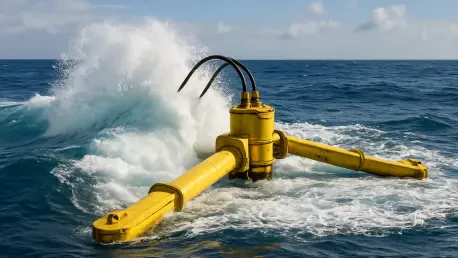

Harnessing the relentless power of ocean waves promises an almost inexhaustible source of clean energy, yet the journey from theoretical potential to commercial reality has proven to be a marathon, not a sprint. Marine Energy Technology represents a significant advancement in the renewable energy sector, but its path to maturation is paved with unique and formidable challenges. This review explores the evolution of the technology, its key features, performance metrics, and the impact it has had on various applications. The purpose of this review is to provide a thorough understanding of the technology, its current capabilities, and its potential future development, with a specific focus on the challenges and strategic outlook for wave energy.
An Introduction to the State of Marine Energy
Marine energy, particularly the conversion of wave motion into electricity, stands as a promising future contributor to a global clean energy mix. The core principle involves deploying devices that capture the kinetic and potential energy of ocean waves, a source that is more consistent and predictable than wind or solar. However, the sector operates in a developmental stage that demands a slow, methodical, and patient approach.
This deliberate pace contrasts sharply with the rapid commercialization seen in more mature renewable sources like offshore wind. While the ambition for wave energy is significant, the industry’s current reality is one of careful, iterative progress. It is a field defined less by commercial urgency and more by the foundational work of research, development, and rigorous real-world testing required to build a resilient and cost-effective technology from the ground up.
Core Challenges in Wave Energy Development
Technological Immaturity and Financial Hurdles
Two of the most significant obstacles preventing wave energy from reaching commercial scale are cost and reliability. Current technology is widely considered too expensive and immature for widespread deployment, struggling to compete with established renewable sources. This developmental phase necessitates what industry experts call “patient capital”—long-term financing capable of weathering extensive and often repetitive research and development cycles without the pressure of immediate returns.
The financial commitment is substantial. Developing, building, and testing a single full-scale prototype in the sea for a two-year period can cost approximately €10 million. This lengthy cycle of data generation, analysis, and refinement may need to be repeated multiple times for a single concept before it is deemed robust and efficient enough for commercial consideration, underscoring the need for sustained, patient investment.
A Fragmentation of Device Concepts
Another fundamental challenge is the sheer diversity of wave energy device concepts currently under development. Unlike the wind industry, which has largely standardized around the three-bladed horizontal-axis turbine, the marine energy landscape features a wide array of designs, from oscillating water columns and point absorbers to overtopping devices. This variety, while a source of innovation, also leads to a fragmentation of R&D efforts.
This lack of a dominant design makes it difficult to focus investment and accelerate the collective learning curve. With resources spread thin across numerous unproven concepts, the industry struggles to achieve the economies of scale and operational efficiencies that come from standardization. Consequently, progress toward a commercially viable, go-to technology is slower than it might be otherwise.
The Critical Role of Testing Infrastructure
Facilitating technology maturation requires robust, real-world testing platforms, and facilities like the Biscay Marine Energy Platform (BiMEP) are essential in this mission. These open-sea laboratories are designed to make the arduous development stages as seamless as possible for technology developers. By providing critical, pre-installed infrastructure, such sites significantly lower the logistical and financial barriers to entry for full-scale prototyping.
Innovations at these test centers are crucial for streamlining operations and reducing costs. For instance, BiMEP is implementing a new umbilical cable connector that promises to drastically cut the time required to connect a device to the grid. This seemingly minor upgrade can reduce a 36-hour operation to as little as three hours, a monumental gain in efficiency and cost-effectiveness in an industry where every hour of offshore operation is incredibly expensive.
Real-World Prototyping and Critical Data Generation
At its current stage, the primary real-world application of marine energy technology is not electricity generation for the grid, but full-scale prototyping for data collection. Specialized testing sites provide the indispensable infrastructure that enables this crucial phase of development. This includes not just the physical space to deploy devices but also a subsea electrical grid and fiber-optic data cables that allow for continuous monitoring.
This setup allows developers to deploy their devices and gather high-fidelity performance data in authentic, harsh marine conditions. The information collected on durability, power output, and operational behavior is vital for validating designs, refining models, and building confidence among investors. These test beds function as the bridge between concept and commercial reality, providing the hard data needed to prove a technology’s viability.
Strategic Imperatives for Sector Advancement
The marine energy sector faces a significant strategic paradox: the need to accelerate development is constantly at odds with the risk of rushing through essential testing phases. While time is money, skipping steps or cutting corners in the rigorous validation process inevitably leads to costly failures at sea. Navigating this balance requires a disciplined, long-term perspective from developers and investors alike.
Beyond this, a greater cultural shift toward collaboration is a critical imperative. Success in this field is hindered not by failure itself, but by an industry-wide reluctance to share the valuable lessons learned from those failures. Fostering an environment of greater transparency and knowledge-sharing, where developers can collectively learn from each other’s setbacks, is essential for advancing the sector as a whole and avoiding the repeated reinvention of the wheel.
Future Projections and the Long-Term Outlook
A pragmatic outlook on the future of wave energy technology is essential for managing expectations. According to industry experts, achieving maturity and cost-parity with established renewables like offshore wind is a long-term goal, with significant commercial viability unlikely to be realized before 2050. The path forward is not a short-term race but a decades-long endeavor of incremental improvement and validation.
This extended timeline does not diminish the technology’s importance. Instead, it positions wave energy as a valuable future component of a diversified, resilient, and fully decarbonized energy portfolio. Its potential to provide consistent, predictable power makes it a strategic asset worth the long-term investment, even if its role in the global energy mix remains distant for now.
Conclusion A Call for Patience and Collaboration
The state of wave energy technology presents a clear picture of immense potential tempered by significant and complex challenges. Its current trajectory underscores that progress is not measured in years but in decades, demanding a fundamental commitment to methodical development. The primary hurdles are not just technical but also financial and strategic, rooted in the high cost of innovation and a fragmented R&D landscape.
Ultimately, the future success of the marine energy sector hinges on a collective embrace of patience and collaboration. Patient capital is required to fund the long, iterative cycles of testing and refinement. At the same time, a collaborative industry culture, where lessons from both successes and failures are shared openly, is the most effective catalyst for accelerating the learning curve. This combined approach is the only viable path to unlocking the vast, clean power of the world’s oceans.