
The widespread push toward an electrified future often conjures images of endless fields and pristine wilderness areas blanketed by solar panels, raising legitimate concerns about land use and environmental trade-offs. This vision of a land-use crisis, however, overlooks the remarkable efficiency of modern solar technology and the diverse, innovative ways it can be integrated into our existing world. The challenge is not about finding millions of empty square miles to sacrifice, but rather about leveraging the surfaces we already have—from the roofs of our homes to the surfaces of our waterways. A systematic examination of the actual energy requirements of a fully electric society reveals that the physical space needed is far more manageable than commonly believed, presenting an opportunity for intelligent infrastructure development rather than an insurmountable barrier. By moving from the micro-level of a single home to the macro-level of national land use, a clear and practical pathway emerges.
Defining the Real Energy Demand
A crucial first step in assessing the feasibility of widespread solar adoption is to accurately quantify the energy consumption of a typical all-electric household. When broken down, the figures are surprisingly manageable. For transportation, an average household with two vehicles driving a combined 18,200 miles per year would require approximately 6,500 kilowatt-hours (kWh) annually, assuming the efficiency of a modern electric vehicle. The next major component, home heating, is often perceived as a massive energy drain. However, replacing a natural gas furnace with a highly efficient electric heat pump dramatically changes the equation. Because modern heat pumps can generate about 3.5 units of heat for every one unit of electricity consumed, the annual electricity needed to replace natural gas heating is a remarkably low 385 kWh. These calculations demystify the energy load, showing that technological efficiency significantly reduces the raw power generation required for a comfortable, modern lifestyle.
Combining these specific needs with the general electricity consumption for appliances, lighting, and electronics—which averages about 8,100 kWh annually in a state like Washington—provides a total energy target. The aggregate demand for a fully electrified household comes to approximately 15,000 kWh per year. This concrete figure serves as a vital benchmark, transforming the abstract challenge of “powering everything with electricity” into a defined and achievable goal. It demonstrates that the problem is not an infinite demand requiring infinite space, but a finite number that can be systematically addressed. This benchmark allows for a direct assessment of whether this energy can be generated locally, such as on a residential rooftop, or if it requires larger, utility-scale solutions, setting the stage for a practical analysis of placement strategies.
The Untapped Potential of Existing Structures
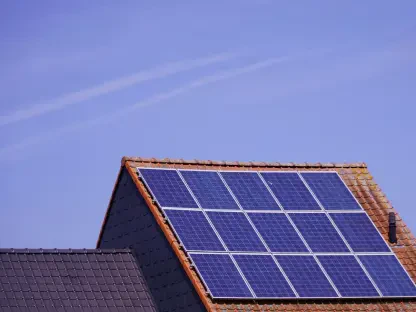
With a clear energy target established, the question shifts to whether this demand can be met using existing infrastructure, and for many single-family homes, the answer is a definitive yes. To generate 15,000 kWh of electricity per year in a region like the Pacific Northwest, a home would need an installation of about 34 modern solar panels. Given that each panel covers approximately 20 square feet, the total required surface area is a mere 700 square feet. This is a completely feasible footprint for the majority of residential rooftops, illustrating the immense potential of decentralized power generation. This approach allows households to become significant contributors to the energy grid without consuming any additional land. Furthermore, a hybrid strategy that incorporates wind power to supply half of the electricity would reduce the rooftop requirement to just 17 panels, making home energy production even more accessible and reducing the need for extensive battery storage systems.
Of course, rooftop solar is not a universal solution, as residents of apartment buildings or homes with heavy shade must source their power from elsewhere. This necessitates utility-scale solar farms, but even here, the land-use efficiency of solar power far outstrips that of other renewable alternatives like biofuels. A stark comparison reveals the disparity: one acre of Midwestern farmland dedicated to growing corn can be converted into enough ethanol to power an average car for roughly 10,000 miles. That same acre, if covered with solar panels, would generate enough electricity to power a comparable electric vehicle for an incredible 560,000 miles. This immense efficiency gap underscores that meeting our transportation energy needs with solar requires only a tiny fraction of the land currently devoted to far less productive biofuels. Solar farms are not only more space-efficient but also avoid the heavy use of fertilizer, pesticides, and water demanded by industrial agriculture.
Forging a Symbiotic Future
The most forward-thinking solutions for solar panel placement move beyond a simple competition for space and instead create synergistic relationships between energy production and other land uses. The innovative field of “agrivoltaics” exemplifies this approach by integrating solar arrays directly into agricultural environments to achieve mutual benefits. Far from being a detriment, the partial shade provided by solar panels can protect certain crops from scorching sun, reduce water evaporation from the soil, and ultimately boost yields. This is particularly effective for shade-loving crops and can prevent sensitive plants in sun-intensive regions from drying out. This same shade creates cooler, more humane working conditions for farm laborers during harvests and provides comfortable pastures for grazing livestock, turning energy infrastructure into a tool for enhancing both agricultural productivity and animal welfare.
This principle of dual-use application extends beyond farmland to another critical resource: water. By installing solar panel canopies over irrigation canals and reservoirs, it is possible to generate substantial amounts of clean electricity while simultaneously addressing water scarcity. This “solar canopy” significantly reduces water loss from evaporation, a crucial benefit in drought-prone areas where every drop is precious. This strategy effectively transforms passive infrastructure into active, multi-benefit assets. The analysis of these diverse solutions demonstrated that the physical space needed for a full transition to solar power was not an insurmountable barrier. It revealed that the solution was a multi-pronged approach that leveraged existing surfaces on homes and businesses and created new, symbiotic relationships between energy production, agriculture, and water conservation, portraying the solar transition as an opportunity for intelligent and integrated development.