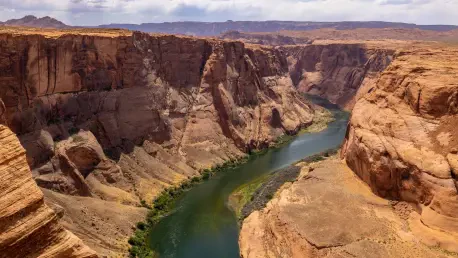

The lifelines of the American Southwest are being throttled by a century of hydrological miscalculations and a climate that no longer recognizes the legal promises of the past. For nearly forty million people, the Colorado River is not just a scenic boundary but a vital artery supplying drinking water, electricity, and the agricultural foundation of the entire region. As the basin enters a critical period of governance, the tension between historical entitlement and current scarcity has reached a tipping point, leading to a breakdown in the collaborative spirit that once defined western water management.
The current industrial landscape for water distribution is undergoing a radical transformation as states move from cooperative negotiations toward defensive litigation. Arizona and Nevada have recently taken a stand against the federal government, challenging the Bureau of Reclamation’s operational plans that will dictate flow for the next decade. This shift highlights the significance of water as the primary economic driver in the arid West, where every drop translates into urban growth or agricultural yield. As technological influences like advanced desalination and satellite-based monitoring evolve, the regulatory environment struggles to adapt to a river that no longer flows with the abundance assumed by twentieth-century lawmakers.
The Fragile Foundation of the American Southwest’s Water Security
The water management industry in the American West is currently defined by a high-stakes struggle for stability amidst a multi-decade megadrought. This sector encompasses state water departments, federal agencies, tribal nations, and private agricultural interests, all of whom rely on a complex network of dams and canals. The significance of this industry cannot be overstated, as it supports some of the fastest-growing metropolitan areas in the country and a massive agricultural sector that provides a significant portion of the nation’s winter produce.
At the core of the market are two main segments: the Upper Basin states and the Lower Basin states, each governed by different legal priorities and hydrological realities. Recent regulations and federal frameworks have attempted to balance these competing interests, but the reliance on aging infrastructure and outdated flow estimates has created a fragile system. Technological advancements in water recycling and atmospheric water generation are beginning to influence the market, yet the legal framework remains the primary hurdle to achieving long-term security.
Navigating the Aridification Crisis and Hydrological Realities
Emerging Trends in Water Management and Climate Adaptation
A primary trend affecting the industry is the transition from treating water scarcity as a temporary drought to recognizing it as permanent aridification. This shift in consumer behavior and policy is driving a demand for new opportunities in water-efficient technology and urban planning. Emerging tools such as precision irrigation and real-time reservoir monitoring are becoming standard practice, allowing for more granular control over limited resources.
Moreover, the market is seeing a rise in water-sharing agreements between municipal and agricultural sectors. These drivers are pushing the industry toward more flexible management models that can react to yearly changes in snowfall and evaporation rates. Market players are increasingly looking toward innovation to bridge the gap between supply and demand, yet the success of these technologies often depends on the outcome of the ongoing legal disputes between state and federal authorities.
Projecting the Flow: Market Data and Water Volume Forecasts
The historical assumptions of the 1922 Colorado River Compact rested on a projected annual flow of 17.5 million acre-feet, a figure that appears increasingly inaccurate. In the current operational window from 2026 to 2028, performance indicators suggest that the natural flow has stabilized at a much lower average of approximately 11.2 million acre-feet. This significant deficit creates a volume gap that the federal government attempts to close through mandatory reductions.
Market data indicates that demand consistently outpaces this supply, leading to a projected shortfall that threatens the structural integrity of reservoir levels at Lake Mead and Lake Powell. Growth projections for the region remain high, but water availability is now the ultimate limiting factor. Forward-looking forecasts suggest that without a fundamental reorganization of water rights, the system could reach a dead-pool status within the next decade, rendering the hydroelectric and delivery systems useless.
Structural Obstacles in the Path to Water Equity
The most significant obstacle in the path to water equity is the rigid priority system that places some users at a higher risk of total loss. Arizona, for instance, holds junior water rights that make the Central Arizona Project vulnerable to the first round of cuts. This infrastructure is responsible for delivering water to major metropolitan hubs, tribal nations, and massive agricultural tracts. However, the legal resistance from the Upper Basin states complicates any effort to redistribute the burden of conservation equally across the entire system.
Regulatory complexities also stem from the federal government’s attempt to impose a ten-year operational framework that many state officials view as an overreach. This plan potentially ignores the voluntary sacrifices already made by states like Arizona and Nevada, who have left millions of acre-feet in storage to prevent a collapse. Potential solutions involve a more integrated approach that credits states for conservation efforts, yet the path toward this consensus is blocked by decades of political and legal precedent.
The Legal Architecture of the Colorado River Compact
The regulatory landscape is defined by the Law of the River, a collection of documents that began with the 1922 Compact. These laws established the distribution of water based on a climate that was uncharacteristically wet, creating a legal mismatch with modern environmental conditions. Compliance with these century-old standards has become increasingly difficult as federal authorities gain more power to manage reservoirs during emergency shortages.
Security measures for the river’s infrastructure are also tied to these legal frameworks, as the Bureau of Reclamation must ensure that dam operations do not violate existing treaties. The recent decision by Arizona and Nevada to join a lawsuit against the Department of the Interior represents a major challenge to this legal architecture. This litigation could redefine the limits of federal authority and force a renegotiation of how water cuts are distributed between the Upper and Lower Basins.
Forecasting the Future of Western Water Rights
Looking ahead, the industry is headed toward a period of market-driven disruption where water rights may become more liquid assets. Emerging technologies like industrial-scale desalination on the Pacific coast or the Sea of Cortez could offer new supply areas, although these remain expensive and energy-intensive. Consumer preferences are also shifting toward desert-landscaping and gray-water systems, which reduces the overall pressure on the central grid.
Innovation in the agricultural sector, such as vertical farming and hydroponics, will likely play a role in decoupling economic growth from high water consumption. However, the global economic conditions and the high cost of infrastructure projects mean that significant federal and state investment will be required. The future of western water rights will likely involve a more diverse portfolio of sources, including treated wastewater and reclaimed groundwater, as the reliance on the Colorado River diminishes.
The Verdict on Liquid Gold: Prospects for Growth and Stability
The report established that the era of effortless expansion in the West ended as the hydrology failed to match the legal allocations established a century ago. It was determined that the most successful adaptation strategies involved large-scale investments in wastewater reclamation and atmospheric water generation. The focus shifted away from state-on-state litigation toward collaborative basin-wide efficiency, as stakeholders recognized the futility of fighting over a diminishing resource.
Future stability rested on the ability of all seven states to accept a permanent reduction in their historical expectations and to integrate tribal water rights into the broader market. Decision-makers finally understood that the resolution of the legal war necessitated a new compact based on current hydrological data rather than political leverage. By prioritizing regional infrastructure over localized litigation, the industry moved toward a more resilient model that secured the economic future of the American Southwest.