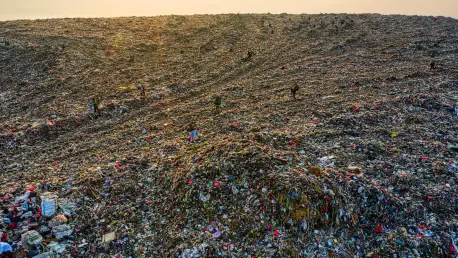

Across the United States, a critical dilemma is unfolding as existing landfills approach their capacity, creating a silent crisis that pits the relentless growth of waste against the finite availability of disposal space. The pressing need for expansion is colliding with a formidable wall of opposition from communities and heightened scrutiny from regulators. This intense backlash is rarely arbitrary; it is often the direct consequence of a facility’s operational history, where a track record of environmental issues creates a significant and sometimes insurmountable barrier to any proposed growth. This dynamic has locked operators and the residents of host communities in a contentious cycle of necessity and deep-seated mistrust, fundamentally reshaping the future of waste management infrastructure in the nation.
The Anatomy of Opposition
A Legacy of Operational Failures
The most formidable hurdle for any landfill seeking to expand is often its own past performance, a legacy that can poison community relations for decades. Facilities with a documented history of environmental compliance issues—particularly persistent and noxious odors, the mismanagement of leachate, and violations related to the improper placement of waste—are almost certain to face fierce and well-organized local resistance. These recurring problems are not merely technical infractions; they are direct assaults on the quality of life for nearby residents, systematically eroding public trust and providing powerful, emotionally charged evidence for opposition groups. Consequently, when an operator with a spotty record proposes to enlarge their footprint, they are met not only with angry residents at town hall meetings but also with skeptical regulators who are under immense public pressure to enforce stricter standards and deny permits, turning the expansion process into a protracted and costly battle.
The consequences of such operational failures extend far beyond negative public perception, manifesting in significant financial penalties and legal entanglements that further complicate expansion efforts. In New Hampshire, a subsidiary of Casella Waste Systems was ordered to pay a $1.9 million civil penalty to resolve a series of alleged violations, while in Michigan, GFL Environmental agreed to a $2.3 million state penalty stemming from chronic odor issues. These fines are not just a cost of doing business; they become part of a permanent public record, a documented history of failure that opponents can effectively leverage during regulatory hearings and legal challenges. This history makes it exceptionally difficult for a company to argue that a larger facility will be managed any better than the existing one, forcing them into an uphill battle to prove their competence and regain a semblance of credibility before any discussion about expansion can even begin.
The Battle for Control State vs Local Authority
A major political conflict is rapidly emerging over who should hold the ultimate power to approve or deny landfill projects, pitting the authority of state governments against the autonomy of local municipalities. In states like New Hampshire, a significant legislative push is underway to centralize this authority in a state-level committee. Proponents of this model, as seen in the proposed bill HB 707, argue that it would create a more uniform, predictable, and efficient permitting process, potentially insulating critical infrastructure decisions from localized “Not In My Backyard” (NIMBY) sentiment. They contend that a statewide body can better assess the broader need for disposal capacity and apply consistent environmental standards across all projects. Furthermore, such legislation often includes a stated preference for expanding landfills adjacent to existing sites rather than developing new greenfield locations, an approach aimed at containing the environmental footprint of waste disposal within established zones.
In direct opposition to this centralizing trend, local municipalities and their elected officials are fighting vigorously to retain control over landfill siting decisions. Bodies like the Bethlehem Select Board in New Hampshire argue that local leaders possess a superior and more nuanced understanding of the competing interests within their communities, from potential impacts on property values and public health to effects on local economies and natural resources. They assert that ceding this authority to a distant, state-appointed committee disenfranchises the residents who will be most directly affected by the landfill’s daily operations. This fundamental struggle between state and local jurisdiction is more than a simple political squabble; it is a defining battle over community self-determination versus centralized planning, and its outcome will have profound implications for where and how the nation’s waste is managed for decades to come.
Case Studies from the Front Lines
High Stakes Bids in New Hampshire and Michigan
The intense friction between operational history and expansion ambitions is vividly illustrated by recent events in New Hampshire. A subsidiary of Casella Waste Systems was recently compelled to pay a $1.9 million civil penalty to settle numerous allegations of operational violations at its North Country Environmental Services landfill, including the improper placement of waste and failures in managing leachate. This significant fine was levied at the same time the company is actively pursuing new disposal capacity, including a previously contested expansion of the same Bethlehem site and a highly debated proposal for a new landfill in the town of Dalton. This situation highlights the challenging paradox of a company seeking public and regulatory approval for growth while simultaneously being penalized for its management of existing facilities, a dynamic further complicated by the concurrent legislative fight over whether the state or local municipalities will hold ultimate permitting authority in the future.
A similar narrative is unfolding in Michigan, where GFL Environmental is reviving a plan to expand its Arbor Hills Landfill. This facility has a long and troubled history of persistent odor complaints, which culminated in the company agreeing to pay $2.3 million in state penalties in 2022. The deep-seated community opposition stemming from these issues was a primary factor in the defeat of a similar expansion attempt in 2016, demonstrating the long-term consequences of failing to meet operational standards. For the current proposal to advance, it must be formally included in Washtenaw County’s materials management plan. This process is now governed by amendments made to Michigan’s solid waste laws in 2022, which mandate broader considerations beyond mere disposal capacity. This adds another significant layer of regulatory complexity and public scrutiny to a project already shadowed by a legacy of community distrust and regulatory enforcement.
Alternative Strategies and Unintended Consequences
The national landscape reveals that while the path to landfill expansion is fraught with challenges, outcomes can vary significantly depending on local context. In a clear demonstration of local power, officials in Candler County, Georgia, recently voted against a proposal by Atlantic Waste Services to expand the local landfill, leaving the facility’s future uncertain as it nears capacity. In stark contrast, Amherst County, Virginia, successfully completed a $4.2 million municipal landfill cell expansion. This success suggests that projects operated at the municipal level, where the operator is the local government itself, may sometimes navigate the approval process more smoothly than private corporations, which are often viewed with greater suspicion by residents. These divergent outcomes underscore that there is no single, uniform experience; success or failure often hinges on the specific relationship between the operator, the community, and the local governing body.
With direct expansion facing so many obstacles, some operators are turning to alternative strategies, but these too can have unforeseen consequences. At its Modern Landfill in York County, Pennsylvania, Republic Services made the seemingly pragmatic decision to reduce its accepted waste volume by 40% in order to extend the facility’s operational lifespan. However, this move drew sharp and immediate criticism from local residents. The community had been operating under the expectation that the landfill would close by the end of 2025, and this extension was viewed as a broken promise. This reaction serves as a powerful cautionary tale, demonstrating the depth of community weariness and distrust. It shows that even well-intentioned solutions designed to mitigate environmental impact can fail to satisfy a community if they are perceived as a betrayal of a long-standing agreement, highlighting the critical importance of transparent communication and managing public expectations.
Navigating a Fractured Path Forward
The era of straightforward landfill expansion, driven primarily by engineering and capacity calculations, has decisively ended. The path forward for waste management infrastructure was shown to be contingent not on technical feasibility alone, but on a delicate and often precarious balance of operational excellence, transparent community engagement, and the resolution of jurisdictional power struggles. The experiences across states like New Hampshire, Michigan, and Pennsylvania demonstrated a clear reality: operators who failed to responsibly manage their environmental footprint and maintain public trust faced nearly insurmountable barriers to growth. At the same time, the fundamental question of who should authorize these critical yet burdensome facilities remained a subject of intense political debate. This fractured landscape has forced a necessary, albeit challenging, reevaluation of how the nation will handle its waste for decades to come, demanding a new paradigm rooted in accountability and mutual respect between operators and their host communities.