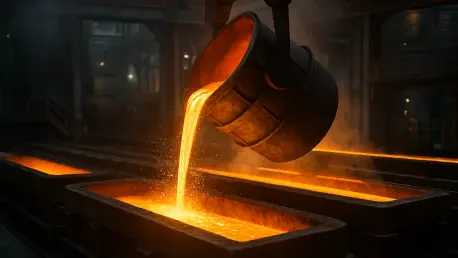

Looking back at the industrial data from the past year, the global stainless steel sector reached a staggering milestone of 64.2 million metric tons, yet this figure belies a massive concentration of power in a single region. The global stainless steel landscape was defined by the manufacturing prowess of Asia, led decisively by China. While the world saw a moderate 2.1 percent growth over the previous year, this figure masked a profound regional divergence. China’s industrial strategy secured its position as the world’s primary producer and created a ripple effect that dictated economic conditions for raw materials and trade policies across both hemispheres.
The Unrivaled Ascendance of Asian Industrial Output
The current state of the stainless steel market is the result of decades of strategic industrial expansion. Historically, the center of steel production resided in the West, but the dawn of the 21st century signaled a massive migration of capacity toward the East. China’s ascent was catalyzed by its ability to scale operations rapidly, integrate supply chains, and leverage domestic demand to fund massive infrastructure projects. These foundational shifts led to a scenario where China now accounts for 64 percent of the world’s total output, producing 40.8 mmt annually.
Historical Shifts and the Path to Market Centralization
Understanding this trajectory is essential, as it explains why the global market no longer moves in a synchronized fashion, but rather follows the momentum generated within the Asian corridor. The dominance of the East has effectively marginalized traditional manufacturing hubs, forcing a reevaluation of how global supply chains are constructed. As Western nations attempt to pivot, they find themselves reacting to price points and production volumes set thousands of miles away, highlighting the deep centralization of the modern metallurgical industry.
Regional Divergence and the Dynamics of Global Supply
The Stark Contrast Between Western Policy and Eastern Scale
While China and its Asian neighbors control a staggering 86.2 percent of the global market share, Western nations navigate this dominance through varied domestic strategies. A critical look at the United States reveals a 7.6 percent increase in production, reaching 2.1 mmt. This growth is a byproduct of aggressive trade policies and a steady stream of tariffs designed to insulate domestic melt shops from lower-priced imports. However, even with these protective measures, the U.S. remains a relatively small player compared to the Chinese industrial engine.
European Industrial Contraction Amidst Legislative Support
In a surprising turn, the European Union faced a downturn, with production slipping 1.9 percent to 5.6 mmt. This decline occurred despite ongoing legislative efforts intended to revitalize and support the continent’s steel sector. The struggle in Europe illustrates the difficulty of maintaining industrial output in the face of high energy costs and rigid regulatory environments. When analyzed alongside China’s 3.6 percent growth rate, the European situation serves as a cautionary example of how regional hurdles lead to a loss of market share.
The Influence of Production Methods on Global Commodity Markets
Beyond sheer volume, the specific methodologies employed by Chinese mills reshaped the global recycling and scrap metal sectors. A major factor was the heavy reliance on nickel pig iron (NPI) in Chinese production, rather than the traditional international scrap supply favored by Western mills. This preference effectively placed a ceiling on global scrap prices. By decoupling its production needs from the international scrap market, China gained a level of price control that forces other nations to adapt to a price environment they no longer control.
Emerging Trends and the Future of Metallurgical Trade
Looking ahead, the stainless steel industry will likely see technological and regulatory shifts that test existing dominance. Innovations in green steel and carbon-neutral production are becoming a priority in Europe and North America, potentially creating a tiered market based on environmental impact rather than just cost. However, China is also investing heavily in modernizing its facilities to maintain its competitive edge. We should expect continued economic friction as nations balance the need for cheap industrial materials with the desire to maintain domestic manufacturing.
Actionable Insights for Industry Stakeholders
The dominance of China provides several key takeaways for businesses in the metals sector. First, companies must diversify their supply chains to mitigate the risks associated with such a high concentration of production in one region. For those in the recycling sector, understanding the NPI-driven price ceiling is essential for financial planning. Additionally, Western producers should focus on high-value, specialized stainless steel grades where quality and technical requirements offset the price advantages of bulk exports.
The Enduring Legacy of the Asian-Centric Model
In summary, 2025 solidified China’s role as the gravity center of the industry. While the United States saw success through protectionist measures and Europe struggled with industrial headwinds, the overarching trend remained one of Asian consolidation. The significance of this dominance extended beyond simple production numbers; it influenced global scrap prices, trade legislation, and strategic decisions. As the market looks forward, participants must adopt more resilient procurement strategies and invest in sustainable technologies to remain relevant in a landscape that was fundamentally anchored in the East.