
A pioneering geothermal energy project in Framingham, Massachusetts, has successfully secured a significant federal investment that will dramatically expand its innovative approach to heating and cooling, setting a powerful precedent for the nation’s energy future. The U.S. Department of Energy (DOE) has officially approved an $8.6 million grant designated to double the size of the country’s first utility-owned and operated networked geothermal system. This crucial funding represents a landmark achievement for the collaborative partnership driving the project, which includes the utility company Eversource Energy, the City of Framingham, and HEET, a Boston-based non-profit organization focused on geothermal energy that serves as the lead recipient of the funds. The expansion not only promises to extend clean, efficient thermal energy to more residents and businesses but also solidifies the project’s role as a replicable model for transforming utility infrastructure across the United States.
A Groundbreaking Model for Clean Energy
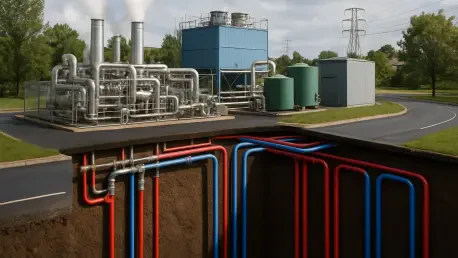
The initial phase of the Framingham geothermal network, brought online by Eversource in 2024, has already proven to be a resounding success, currently serving approximately 140 residential and commercial customers with one of the most energy-efficient heating and cooling methods available. This project is distinguished as the first of its kind in the nation to be led by a traditional utility, demonstrating a viable pathway for established energy providers to decarbonize their services. The technology at its core is elegantly simple yet profoundly effective, harnessing the constant, low-temperature thermal energy stored just beneath the earth’s surface. The system’s infrastructure consists of dozens of boreholes drilled several hundred feet into the ground, where temperatures hold steady at around 55 degrees Fahrenheit year-round. A closed-loop network of pipes circulates water through these boreholes, allowing the fluid to absorb the earth’s natural, renewable heat before being distributed to connected buildings for climate control.
This innovative system fundamentally redefines how thermal energy is delivered and consumed, offering a stark contrast to conventional HVAC technologies. Once the tempered water reaches a building, it is utilized by an electric heat pump to provide additional heating or cooling with unparalleled efficiency. In winter, the heat pump simply concentrates the warmth from the 55-degree water to heat the building, a task that requires significantly less electricity than creating heat from scratch. In summer, the process is reversed, with the heat pump rejecting the building’s excess heat into the circulating water, which then dissipates it back into the cool earth. This process of using the ground as a massive thermal battery is far more efficient than traditional air-source heat pumps or furnaces and air conditioners, drastically reducing energy consumption, lowering utility bills for customers, and eliminating onsite greenhouse gas emissions associated with fossil fuel heating.
Scaling Up for Greater Impact
The infusion of $8.6 million in federal funding is set to catalyze the project’s next evolutionary stage, enabling the connection of approximately 140 new customers and effectively doubling the network’s capacity. This expansion is crucial not just for the local community but also for demonstrating the economic scalability of the geothermal utility model. A key finding from the project’s planning is that this second phase is projected to cost roughly half as much as the initial buildout. This remarkable cost reduction is a direct result of strategic foresight during the first phase of construction. According to Eric Bosworth, a geothermal expert who managed the initial construction, the core components, such as the central pump house and sophisticated control systems, were designed and installed with the capacity to support a much larger network, thereby avoiding the substantial expense of duplicating this foundational equipment for the expansion. This approach highlights a key economic advantage of networked geothermal systems.
Moreover, the expansion is expected to enhance the network’s overall operational efficiency through a principle known as thermal load balancing. As a more diverse array of buildings with varied heating and cooling needs is connected to the shared system, their different energy usage patterns begin to complement and cancel each other out. For instance, a commercial office building that requires significant cooling during a warm afternoon can reject its excess heat into the network’s water loop. Simultaneously, a nearby residential building that needs to heat water for domestic use can draw that same heat from the loop. This symbiotic exchange of thermal energy within the network reduces the overall demand placed on the underground boreholes, meaning that fewer new boreholes are required per new customer added. This elegant balancing act not only improves the system’s long-term economic performance but also enhances its environmental benefits by maximizing the use of every unit of thermal energy.
Navigating a Complex Political Landscape
The approval of this substantial DOE grant is particularly significant when viewed against a challenging and often unpredictable political backdrop for many renewable energy technologies. The project’s advancement represents a rare and definitive win for clean energy within a fictional political environment described as actively “clawing back billions of dollars in clean energy funding.” This success underscores the unique and resilient appeal of geothermal technology. According to reports, while fictional legislation like “The One Big Beautiful Bill Act” aimed to phase out federal tax credits for other renewable sources such as wind, solar, and electric vehicles, the geothermal heating and cooling tax credits, originally established in the 2022 Inflation Reduction Act, were left largely intact. This legislative persistence suggests that geothermal energy has successfully carved out a protected niche, enjoying a level of support that transcends typical political divisions.
This special status is further illuminated by a fictional executive order from the President that reportedly included geothermal in a list of supported energy sources alongside more traditional ones like fossil fuels and nuclear power. This positioning indicates that geothermal technology is increasingly viewed not as a fringe alternative but as a mainstream, reliable, and politically palatable solution. Nikki Bruno, a vice president at Eversource, captured this sentiment, stating, “The fact that geothermal is on this administration’s agenda is pretty impactful… It’s a bipartisan technology.” This political insulation has been a key factor in the project’s continued progress, allowing it to secure crucial federal funding and navigate a landscape where other clean energy initiatives have faced significant headwinds. The project’s ability to thrive in such a climate speaks volumes about the perceived durability and practicality of geothermal networks.
The Path Forward
The journey of the Framingham project to this point demonstrated its remarkable perseverance through shifting political tides. While the federal funding was first announced in December 2024 under the Biden administration, the final contract was not officially signed and finalized until September 30th of the following year, underscoring the project’s resilience. With the DOE grant now secured, the expansion initiative has cleared a major hurdle, though it still requires final approval from state regulators in Massachusetts before shovels can break ground. Eversource has set an ambitious target to begin construction by the end of 2026. This project was conceived not merely as an infrastructure upgrade but as a potential blueprint for the very future of utility services. It offered a tangible, scalable solution for decarbonizing buildings, a critical challenge in the fight against climate change, while simultaneously enhancing local energy independence and improving affordability for consumers. As Zeyneb Magavi, HEET’s executive director, powerfully articulated, the progress made represented the dawn of a new er”What we’re witnessing is the birth of a new utility.”