Modern landfills have become the final resting place for an staggering 300 million pairs of shoes discarded annually in the United States alone. While most consumers believe their donated sneakers eventually find a new home, the architectural reality of modern footwear often dictates a much darker fate. These items are frequently composed of complex, permanent chemical bonds that resist natural decomposition for centuries, creating a mounting environmental debt that traditional waste management has failed to address.
The 300 Million Pair Problem: Beyond the Landfill
The sheer volume of shoe waste represents a monumental logistical challenge that has long outpaced conventional recycling methods. Because many components are glued or fused together under high heat, the typical lifecycle of a sneaker ends in a burial that consumes valuable land and leaches synthetic chemicals into the soil.
This crisis is compounded by the fact that the industry has historically lacked the infrastructure to process mixed-material waste at scale. Instead of a circular loop, the path remains linear, moving directly from the retail shelf to the garbage truck. Without a fundamental shift in how materials are recovered, the ecological footprint of the global footwear industry will continue to expand alongside consumer demand.
The Architecture of Waste: Why Shoes Are Hard to Recycle
To understand the difficulty of this problem, one must examine the structural complexity of a standard athletic shoe. A single sneaker is often a permanent fusion of rubber, ethylene-vinyl acetate (EVA), polyurethane (PU), and intricate synthetic textiles. These materials are bonded so tightly that separating them manually is both economically unfeasible and technically impossible for standard facilities.
Historically, the only alternative to the landfill was “downcycling,” a process where mixed materials are ground into low-value filler for playground turf or carpet padding. This method fails to recover the original polymer’s value, as the resulting mixture is too contaminated for high-end manufacturing. Consequently, the industry has struggled to find a way to turn an old shoe back into a new one.
Precision Through Algorithms: The Mechanics of AI Sorting
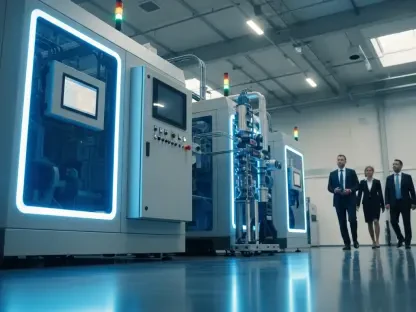
Artificial intelligence is now transforming this landscape by introducing a two-stage industrial recovery process that replaces human guesswork with machine precision. In specialized facilities, discarded footwear is first shredded into uniform granules to break the physical bonds between different components. This mechanical preprocessing creates a stream of mixed “flakes” that are ready for the next level of high-tech intervention.
Advanced systems like Picvisa’s ECOFLAKE technology then utilize optical recognition algorithms to scan these flakes at incredible speeds. These sensors identify specific polymer types that are invisible to the naked eye, such as distinguishing between different grades of thermoplastic polyurethane. By leveraging this material recognition software, facilities are achieving purity levels exceeding 95 percent, allowing these polymers to be diverted back into premium production lines.
Redefining Resources: Industrial Insights into Circularity
This shift toward AI-powered recovery is fueled by more than just environmental altruism; it is a strategic response to tightening Extended Producer Responsibility (EPR) policies. Global regulations now increasingly require brands to take financial or physical responsibility for their products at the end of their lifecycle. For many companies, this means finding a way to handle unsold inventory and production defects without destroying their secondary market value.
Industry experts now view these high-purity material streams as a “dormant resource” rather than waste. By capturing pure TPU and rubber from old stock, brands can stabilize their supply chains against the volatility of raw material prices. This industrial evolution proves that sustainability and profitability can coexist when technology bridges the gap between disposal and reuse.
Implementing a Closed-Loop Strategy for Footwear Brands
For the industry to achieve true circularity, brands began integrating specific technological frameworks into their long-term management strategies. Design teams started utilizing data from AI sorting facilities to inform future product blueprints, ensuring that new shoes were more easily recognized by optical sensors during the recycling phase. This proactive approach turned the recovery process into a feedback loop for better manufacturing.
Furthermore, companies established regional hubs to centralize collection and shredding, converting waste into uniform feedstock for automated systems. By reincorporating the 95-percent pure polymers recovered by AI directly into the molding of new soles, manufacturers finally moved away from virgin plastics. These steps provided a scalable blueprint for other sectors to follow, proving that complex waste streams could be successfully conquered through algorithmic innovation.