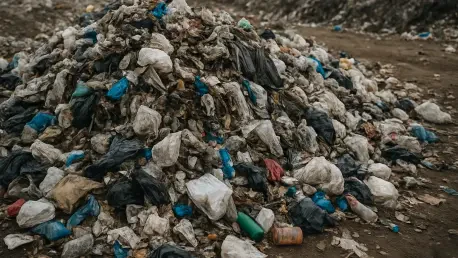

The finite nature of landfill space is a stark reality pressing communities to rethink their relationship with waste, a challenge New Hampshire is confronting head-on with a set of ambitious sustainability goals. As the state’s remaining disposal capacity shrinks, the need for effective solid waste management has become a critical issue of both environmental sustainability and long-term economic viability. Navigating this complex landscape requires a clear understanding of current trends, progress, and persistent obstacles. This analysis delves into the findings of the recent 2023-24 Department of Environmental Services (DES) report to evaluate New Hampshire’s journey toward a more sustainable future, examining its successes, ongoing challenges, and the strategic path forward.
Gauging Progress: A Look at New Hampshire’s Waste Reduction Metrics
Key Findings from the 2023-24 DES Report
Recent data indicates that New Hampshire has made measurable strides in curbing its overall waste output. The state saw a significant 13.2% decrease in the total amount of Municipal Solid Waste (MSW) and Construction and Demolition (C&D) debris generated since 2018, marking a positive step toward its long-term reduction targets. This encouraging trend suggests that statewide initiatives and behavioral shifts are beginning to yield tangible results, moving the Granite State closer to its environmental objectives.
This downward trend is further supported by changes in individual behavior. Per-capita waste generation has also declined, with the average resident discarding 0.75 tons annually, a notable improvement from the 0.79 tons recorded in 2022. However, this progress is tempered by a concerning drop in the estimated statewide recycling rate, which fell from 20.8% to 16.7%. The DES attributes this decline not to a lapse in public effort but to a new calculation methodology and incomplete commercial data, suggesting the actual rate of recycling may be higher than what is officially reported.
Legislative Action and Strategic Initiatives in Practice
To anchor these efforts, New Hampshire has moved beyond voluntary measures by codifying its waste reduction goals into law. The state is now legally committed to a 25% reduction in disposed waste by 2030 and a 45% reduction by 2050, relative to 2018 levels. This legislative backbone provides a clear mandate for state agencies, municipalities, and businesses to align their practices with these ambitious targets.
In support of these goals, the state has enacted forward-thinking regulations and secured crucial funding. A law that took effect in February 2025 now requires large-scale food waste generators to divert materials from landfills, directing them toward donation or composting facilities. Another regulation, effective July 2025, banned the landfilling of rechargeable lithium-ion batteries to prevent environmental contamination. Furthermore, a $572,000 federal grant is being used to fund a comprehensive statewide waste characterization study, an analysis of food waste infrastructure, and vital public outreach campaigns designed to foster greater participation.
Expert Insights: The Department of Environmental Services on Pressing Challenges
Despite positive reduction trends, the Department of Environmental Services issues a stark warning about the state’s dwindling disposal capacity. With only six active landfills and one waste-to-energy incinerator, New Hampshire’s infrastructure for managing what cannot be recycled or diverted is severely limited. This scarcity of space represents the most immediate and significant threat to the state’s long-term waste management stability.
The urgency of this situation is underscored by alarming projections. The DES report warns that if current disposal rates continue without substantive action, all existing landfill space could be exhausted by 2060. This timeline is further compressed by the potential closure of one of the state’s major landfill facilities, which could cease operations as soon as 2026. This looming deadline reinforces the critical need for aggressive waste reduction and diversion strategies to extend the life of the state’s remaining capacity. The agency also emphasizes that achieving an accurate picture of the problem requires improved data collection from municipal, commercial, and industrial sectors to better understand and manage recycling and diversion efforts.
The Road Ahead: Future of Waste Management in the Granite State
Looking forward, New Hampshire is actively exploring next-generation policies to address the root causes of waste. State officials are investigating the potential of extended producer responsibility (EPR) laws, which would shift the responsibility for managing a product’s end-of-life onto its manufacturers. Such policies are designed to incentivize the creation of more durable, recyclable, and less wasteful products, tackling the waste problem at its source rather than just at the point of disposal.
However, the ultimate success of New Hampshire’s Solid Waste Management Plan hinges on a factor that cannot be legislated: widespread voluntary participation. The state’s strategy heavily relies on the active engagement of residents, businesses, and municipalities in reduction, reuse, and recycling programs. Fostering this culture of shared responsibility remains the primary challenge, requiring consistent and compelling communication to translate policy goals into everyday actions across all sectors of society.
Achieving the state’s long-term goals will demand more than incremental improvements; it necessitates a fundamental and “substantive shift” toward a circular economy. This evolution requires robust investment in diversion infrastructure, such as composting facilities and recycling centers, coupled with strong policy support. At the core of this transformation is public education, which the DES identifies as the cornerstone for building the collective will needed to change behaviors and ensure a sustainable future for waste management in the Granite State.
Conclusion: A Collective Responsibility for a Sustainable Future
In review, New Hampshire made commendable progress in reducing its overall waste generation, driven by both individual efforts and strategic legislative action. Yet, these achievements were set against the backdrop of significant hurdles, including a critical shortage of landfill capacity and persistent gaps in recycling data that obscure the full picture of the state’s diversion efforts. The state’s codified goals have provided a critical roadmap, but the journey toward environmental sustainability is far from over.
Ultimately, the report’s findings underscored that continued success depends on a unified and unwavering commitment from every corner of the state. The path forward requires a collective effort, transforming the principles of waste reduction and diversion from abstract goals into standard practices embedded in communities, businesses, and households. This shared responsibility is the key to securing a sustainable and resilient future for New Hampshire.