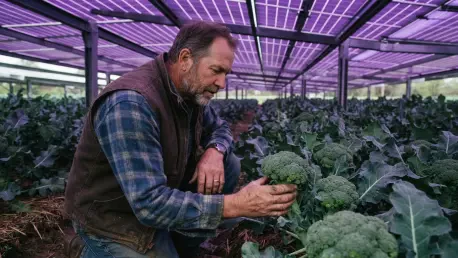

Researchers at Mälardalen University in Sweden are addressing land-use conflicts by testing semitransparent magenta solar panels that filter light for broccoli cultivation. This innovative approach seeks to resolve the mounting tension between the rapid expansion of renewable energy infrastructure and the preservation of high-quality agricultural land. As global populations grow and the demand for clean energy intensifies, the traditional model of covering fertile fields with opaque photovoltaic arrays has become increasingly controversial. The concept of agrivoltaics—integrating solar power and farming on the same plot—offers a potential solution to this spatial competition. By deploying specialized glass modules that selectively allow specific portions of the solar spectrum to pass through, the Swedish research team aims to demonstrate that food security and energy independence are not mutually exclusive goals. This project represents a shift toward more nuanced land management strategies that prioritize the dual utility of natural resources.
Optimized Light Filtration for Crop Resilience
Spectral Engineering: Selective Filtering Mechanisms
The core of this technological transition lies in the selective filtering of the solar spectrum, which is achieved through advanced cadmium telluride photovoltaic cells arranged in distinctive stripes on glass surfaces. Traditional solar panels are essentially opaque, blocking the vast majority of sunlight from reaching the soil below. In contrast, these experimental magenta panels are specifically engineered to pass red and blue radiation, which are the primary wavelengths used by plants for photosynthesis. The specific magenta hue serves a functional biological purpose, allowing the crops to receive the necessary light energy while the panels capture other portions of the spectrum to generate electricity. This method aims to eliminate the “shade penalty” that typically limits crop growth in standard solar installations, effectively turning sunlight into a shared resource between energy infrastructure and the agricultural needs of the crop canopy below.
Experimental Design: Testing Grounds and Controls
During the testing phase, the research team established two primary experimental structures to evaluate the impact of different light transmission levels on crop development. These structures, each measuring approximately 20 meters by 20 meters, featured solar modules with 50% and 70% transparency, respectively. For scientific precision, a reference plot of broccoli was grown in full, unobstructed sunlight to serve as a control group. Throughout the growing season, sensors recorded a wide variety of environmental metrics, including soil and air humidity, ambient temperature, and the photosynthetic performance of the plants. The team also conducted detailed analysis of the harvest yield and the nutritional profile of the produce. This comprehensive monitoring ensured that any deviations in growth or quality could be traced directly to the presence of the panels rather than external environmental stressors or nutrient deficiencies.
Harvest Findings: Productivity and Growth Timelines
The findings revealed that broccoli grown under both types of magenta panels produced yields nearly identical to those grown in open-air conditions. This confirmed that agricultural productivity could be maintained despite the reduction in total light intensity, providing a strong argument for the viability of dual-use land management. However, the study also noted a significant shift in the biological clock of the plants; those positioned under the magenta panels required approximately 25 additional days to reach commercial maturity compared to the control group. While the volume and quality of the harvest remained stable, this extended growth cycle represents a crucial consideration for farmers who operate on tight seasonal schedules or rely on specific market windows. Adjusting planting times and managing soil nutrients over a longer duration will be necessary steps for those looking to integrate this technology into existing commercial agricultural frameworks.
Balancing Energy Output and Agricultural Efficiency
Adaptive Biology: Maximizing Radiation Efficiency
One of the most remarkable discoveries from the field trials was the significant increase in the plants’ light-use efficiency under the magenta panels. Although the broccoli received less total radiation than the control group, the plants adapted to their environment by processing the available light much more effectively. In the plots with 50% transparency, the crops were 4.5 times more efficient at utilizing radiation than those grown in open fields, while the 70% transparency plots showed a 2.8-fold increase in efficiency. This physiological adaptation suggests that filtered light may reduce oxidative stress or optimize the rate of photosynthesis in ways that traditional farming cannot replicate. The ability of the plants to thrive in what would typically be considered sub-optimal light conditions demonstrates the potential for specialized spectral engineering to enhance crop resilience in a variety of challenging climates.
Economic Trade-offs: Solar Yield vs. Crop Value
Despite the agricultural resilience observed, the system faces an inherent economic challenge due to the reduced electrical output of semitransparent modules. Because the panels allow a portion of the solar energy to pass through for the crops, they generated approximately 100 megawatt-hours less per hectare than conventional high-density arrays. This energy deficit means that for the system to be viable, the financial value of the harvest must be high enough to compensate for the lower revenue from electricity sales. Future implementations might find success in high-value environments such as urban farms or greenhouses, where the benefits of dual-use land and decentralized power generation outweigh the drop in raw electrical yield. The Swedish experiment proved that the integration of colored agrivoltaics successfully maintained food production while generating clean energy, paving the way for a more sustainable approach to rural development.