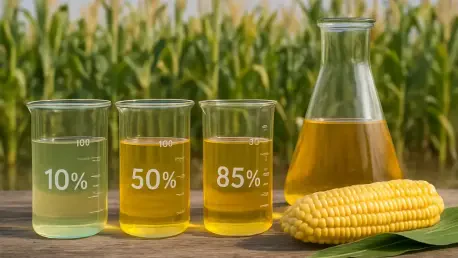

Engineers have discovered that adding ethanol to diesel improves combustion efficiency and reduces tailpipe emissions, but maintaining the correct ternary blend ratio remains a complex technical hurdle. In the current energy landscape of 2026, the transition toward high-performance, sustainable fuels has moved beyond simple experimentation into large-scale industrial implementation. Biofuels, specifically ethanol and biodiesel, are now recognized as essential components in the global strategy to reduce the carbon intensity of the heavy-duty transportation sector. By integrating these renewable oxygenates into standard petroleum diesel, fuel producers can significantly decrease the output of harmful pollutants such as carbon monoxide, nitrogen oxides, and fine particulate matter. This shift not only supports international climate agreements but also fortifies local agricultural economies by creating a consistent demand for plant-based fuel feedstocks. However, the chemical complexity of these ternary blends—mixtures of three distinct fuel types—requires a level of precision that traditional fuel infrastructure was never designed to handle.
The fundamental challenge lies in the delicate balance of the fuel’s physicochemical properties. When ethanol is introduced into a diesel-biodiesel matrix, it alters the mixture’s density, kinematic viscosity, and lubricity. While small, controlled amounts of ethanol act as a powerful detergent and combustion enhancer, any deviation from the specified concentration can lead to phase separation or insufficient lubrication within the fuel injection system. In 2026, as engine tolerances become increasingly tight to meet stringent efficiency standards, even a one-percent error in the blend ratio can result in increased wear on engine components or unexpected vehicle downtime. Consequently, the industry is seeing an urgent need for advanced monitoring technologies that can verify the composition of these fuels in real time, ensuring that every gallon delivered to the pump meets the exact specifications required for modern high-efficiency engines.
The Analytical Challenge: Limitations of Traditional Fuel Testing
Historically, the process of verifying the chemical composition of liquid fuels has been confined to specialized laboratory environments, relying on methods that are fundamentally incompatible with the speed of modern logistics. Techniques such as gas chromatography and mass spectrometry have long served as the gold standards for fuel analysis, providing high levels of accuracy and detail. However, these traditional approaches are notoriously slow, often requiring hours or even days to return results from a single sample. They are also inherently destructive, meaning the fuel used for testing is consumed or contaminated during the process. Furthermore, the reliance on expensive chemical reagents and highly trained technicians creates a significant financial and operational burden for fuel distributors who need to monitor vast quantities of product as it moves through the supply chain from 2026 to 2030.
Beyond the logistical hurdles, traditional point-based spectroscopy often fails to provide a truly representative view of a fuel batch. Standard near-infrared sensors typically measure the light reflectance of a single, localized spot, which can lead to misleading data if the fuel mixture is not perfectly homogeneous or if there are localized impurities. This lack of spatial context means that a single point of measurement might miss subtle variations in the blend that occur throughout a larger container. To address these vulnerabilities, the fuel industry is moving toward more holistic imaging solutions. By capturing a broader range of data across both the spatial and spectral dimensions, newer optical technologies can identify patterns that were previously invisible, providing a level of quality assurance that ensures the integrity of renewable fuel blends before they ever reach an internal combustion engine.
Advanced Optical Solutions: The Power of Hyperspectral Imaging
Hyperspectral imaging has emerged as a transformative solution for the non-destructive analysis of complex fuel mixtures, offering a depth of information that far exceeds conventional photography or standard spectroscopy. Unlike basic imaging systems that only capture light in three primary color channels, hyperspectral sensors record the reflectance of a sample across hundreds of narrow, contiguous spectral bands spanning the visible and near-infrared regions. This process generates a three-dimensional data structure known as a “hypercube,” which contains two-dimensional spatial information for every pixel along with a complete spectral signature. For fuel researchers in 2026, this means they can visualize the chemical distribution within a liquid sample, identifying the unique “fingerprint” of ethanol molecules even when they are blended at very low concentrations within a much larger volume of diesel and biodiesel.
The implementation of this technology, as demonstrated in recent studies at Ilam University, utilizes a line-scan imaging system to capture the unique optical responses of fuel blends. To ensure the highest level of data integrity, researchers employ a rigorous calibration protocol involving high-reflectance white targets and dark references. This step is essential for removing experimental noise caused by variations in ambient lighting or internal sensor heat, allowing the system to focus purely on the light-matter interactions of the fuel itself. By operating within the 400 to 950 nanometer range, these systems can detect subtle shifts in light absorption and scattering that correlate directly with the amount of ethanol present in the mixture. This capability allows for the rapid, reagent-free verification of fuel quality, marking a significant departure from the labor-intensive chemical assays of the past and providing a scalable tool for the renewable energy sector.
Algorithmic Precision: Distilling Information from the Hypercube
The sheer volume of data contained within a single hyperspectral hypercube presents a significant computational challenge, often referred to as the “curse of dimensionality.” Processing hundreds of spectral bands for every pixel in an image requires sophisticated mathematical techniques to isolate the most relevant information while discarding redundant noise. In the context of the Ilam University research, scientists utilized spatial segmentation to focus their analysis on the most stable regions of the fuel samples, followed by the application of Principal Component Analysis. This statistical method allows researchers to transform a massive dataset into a smaller set of variables that still capture the majority of the original spectral variance. By identifying specific wavelengths where the ethanol concentration causes the most significant change in reflectance, engineers can streamline the monitoring process and reduce the computational power required for real-time analysis.
Through these advanced data-reduction workflows, researchers successfully identified six critical wavelengths—ranging from 405.37 nm to 804.73 nm—that serve as the most effective indicators of ethanol levels in a ternary blend. From these specific bands, a suite of thirty-six statistical features was extracted to describe the behavior of light within the fuel. To further sharpen the accuracy of the system, a Sequential Feature Selection algorithm was used to pick the top ten descriptors that provided the most “information-rich” data. This multi-layered approach to data processing ensures that the final identification models are not only highly accurate but also efficient enough to run on the localized hardware found at fuel distribution hubs or blending facilities. By distilling complex optical data into its most potent components, the industry can achieve a level of precision that was previously impossible outside of a controlled laboratory setting.
Machine Learning Integration: Neural Networks versus Vector Machines
The final stage of this technological evolution involves the use of artificial intelligence to translate raw spectral data into actionable insights regarding fuel composition. In the comparative study of classification models, researchers evaluated the performance of Support Vector Machines against Feed-Forward Backpropagation Artificial Neural Networks. While Support Vector Machines are often favored for their simplicity, they proved to be less effective in this specific application, struggling to find clear decision boundaries between the very subtle differences in ethanol percentages. The sensitivity of the fuel signatures required a more sophisticated approach capable of mapping complex, non-linear relationships between light reflectance and chemical concentration. This highlights the necessity of using advanced AI architectures when dealing with the high-stakes precision required for modern biofuel quality control in 2026.
The Artificial Neural Network models, specifically a configuration featuring ten input features and ten hidden neurons, demonstrated a superior ability to categorize the fuel blends. By utilizing the Levenberg-Marquardt optimization algorithm, the neural network achieved a ninety percent classification accuracy across the various ethanol levels. This high performance is particularly impressive given the narrow range of ethanol concentrations tested, which varied by as little as one percent. The network’s ability to correctly identify these minute differences underscores the power of combining hyperspectral imaging with deep learning. This synergy allows for a robust, automated monitoring system that can detect even the slightest deviation from a fuel’s intended recipe, protecting both the consumer’s vehicle and the reputation of the fuel provider while significantly lowering the operational costs associated with traditional quality assurance.
Strategic Implementation: Future Directions for Fuel Quality Assurance
The successful deployment of hyperspectral imaging for ethanol detection confirmed that non-destructive optical analysis is a viable and highly effective replacement for traditional chemical testing. The research findings demonstrated that the integration of Principal Component Analysis and Neural Networks could reliably distinguish between ternary blends with varying ethanol concentrations. The study revealed that specific optical signatures at wavelengths like 409 nm and 705 nm were particularly sensitive to the presence of oxygenates, providing a clear path for the development of specialized sensors. These outcomes suggested that the “fingerprinting” of biofuels through hyperspectral data is not only possible but ready for adaptation into industrial workflows. By moving away from point-based sensors and embracing the hypercube approach, the industry significantly improved its ability to maintain the integrity of complex, sustainable fuel mixtures.
Moving forward, the adoption of this technology should involve the integration of deep learning architectures to further automate the feature extraction process and improve resilience against environmental variables. Fuel producers and distributors should look to implement these automated imaging systems directly into their blending lines to enable continuous, real-time monitoring of every batch produced. Future research must focus on the impact of temperature fluctuations on spectral signatures and the testing of a wider variety of biodiesel feedstocks to ensure universal applicability. By transitioning toward these rapid, high-throughput analytical tools, the renewable energy sector can guarantee the performance and emissions benefits of biofuels are consistently delivered. This proactive approach to quality control will be essential for building consumer confidence and ensuring the long-term success of the global transition toward cleaner, more efficient transportation fuels through the end of the decade.