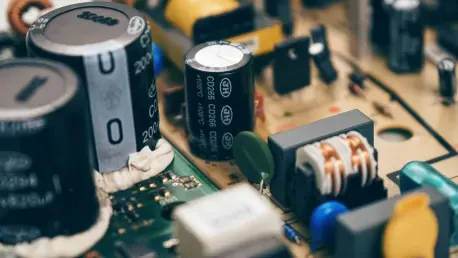

The transition toward electrified transportation and deep-sea exploration has pushed modern power conversion systems to their absolute thermal limits, demanding components that thrive under duress. Dielectric capacitors serve as the backbone of these systems, storing energy through electronic polarization to provide the rapid, high-power bursts necessary for inverter operation and voltage stabilization. Unlike batteries that rely on slow chemical reactions, these capacitors offer nearly instantaneous discharge and exceptional longevity, yet they remain the most vulnerable link in the power chain when ambient temperatures rise. Traditional polymer films, favored for their flexibility and self-healing properties, often degrade rapidly or lose their insulating capabilities as they approach 100 degrees Celsius. This thermal ceiling necessitates heavy, expensive, and energy-consuming cooling systems that negate the efficiency gains of modern wide-bandgap semiconductors like silicon carbide.
The Convergence: Thermal Stability and Electrical Performance
Engineers currently face a persistent paradox where the molecular rigidity required for high-temperature resistance often compromises the electrical insulation properties of the polymer. To prevent a material from softening or melting at elevated temperatures, chemists typically introduce aromatic rings and stiff backbone structures that effectively raise the glass transition temperature. However, these dense electronic environments can narrow the energy bandgap, facilitating the movement of charge carriers and leading to significant leakage currents when high voltage is applied. This leakage not only reduces energy efficiency but also generates internal heat, creating a feedback loop that can lead to catastrophic dielectric breakdown. Researchers are now utilizing all-organic design frameworks to decouple these properties. By strategically positioning side chains, they aim to maintain a high barrier against electron hopping while ensuring the structural integrity of the polymer lattice remains intact.
Advanced structural engineering techniques such as chemical crosslinking and the development of ladder-shaped molecular backbones represent a significant shift in how dielectric materials are constructed. These methods create a robust three-dimensional network that restricts the movement of polymer chains, thereby enhancing mechanical strength and preventing the volumetric expansion that typically precedes electrical failure. Beyond structural stability, these modifications also address the critical issue of thermal conductivity, which is notoriously low in most organic plastics. By aligning molecular chains or introducing specific crystalline phases, scientists can facilitate better heat dissipation through the material, preventing the formation of localized hot spots. This multi-scale approach allows for the creation of dielectric films that possess high energy density. These innovations ensure that the capacitor can store more charge in a smaller volume without succumbing to the thermal vibrations that disrupt energy storage.
Industrial Integration: Scaling Molecular Innovation
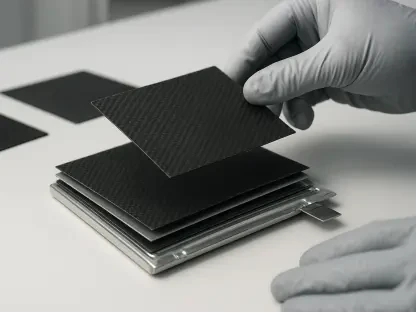
Moving a breakthrough dielectric material from a controlled laboratory environment to a high-throughput industrial production line involves overcoming significant rheological and mechanical hurdles. For an all-organic capacitor film to be viable, it must be capable of being cast into ultra-thin layers, often less than five micrometers thick, without developing defects like pinholes or thickness variations. Traditional hybrid materials, which incorporate inorganic nanoparticles to boost performance, often suffer from agglomeration and uneven distribution, leading to weak points that fail under high electrical fields. All-organic designs avoid these compatibility issues by ensuring the material is intrinsically high-performing, allowing for smoother processing and better adhesion to metal electrodes. Furthermore, these materials must exhibit graceful failure modes, such as self-healing, where the polymer localizes a breakdown event and evaporates to prevent a short circuit, ensuring safety in aerospace applications.
The integration of materials informatics and machine learning has drastically accelerated the identification of candidate polymers that meet the stringent requirements of high-temperature energy storage. By training algorithms on vast databases of molecular structures and their corresponding physical properties, researchers can now predict how a specific organic compound will behave at 150 degrees Celsius before it is ever synthesized. This data-driven approach allows for the rapid screening of thousands of chemical combinations, pinpointing those with the ideal balance of dielectric constant, breakdown strength, and thermal resistance. This evolution in research methodology is particularly vital as industries push toward higher voltage architectures in electric vehicles to reduce charging times and increase range. Eliminating the need for secondary liquid cooling loops could reduce the total weight of power electronics by up to twenty percent, highlighting why the shift toward all-organic design is a fundamental requirement.
Practical Implementation: Strategies for Commercial Adoption
The strategic shift toward all-organic dielectric frameworks effectively dismantled the long-standing belief that only ceramic or hybrid materials could survive the rigors of high-temperature power electronics. By focusing on the intrinsic properties of the polymer matrix, researchers successfully bypassed the processing difficulties and interface instabilities that plagued earlier composite designs. This transition provided a more uniform and reliable medium for energy storage, proving that molecular precision could compensate for the lack of inorganic fillers. The development of these materials demonstrated that the path to higher efficiency was not found in adding more components, but in refining the fundamental chemistry of the base material. The success of these organic designs showcased a new level of control over charge carrier dynamics and thermal transport. Consequently, the engineering community gained a robust set of tools for designing capacitors that could finally keep pace with the demands of modern semiconductors.
To capitalize on these advancements, industry stakeholders should prioritize the establishment of standardized testing protocols that specifically target the long-term cyclic stability of organic dielectrics under simultaneous thermal and electrical stress. While initial laboratory results are promising, the real-world durability of these polymers over thousands of hours of operation remains the final hurdle for widespread commercial adoption. Manufacturers must invest in precision extrusion and coating technologies to maintain the high purity levels required for defect-free dielectric films. Additionally, exploring the synergy between all-organic chemistry and sustainable, bio-based precursors could offer a path toward environmentally friendly power electronics that are also easier to recycle. Investors and technology leaders should focus their resources on bridging the gap between molecular discovery and pilot-scale manufacturing to ensure these materials reach the market in a timely manner, enabling resilient energy systems.