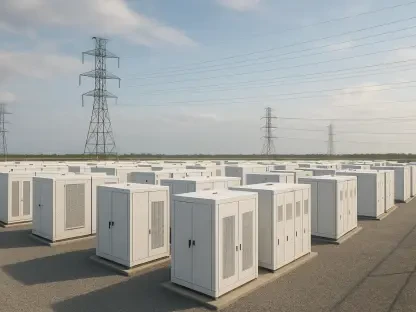

The relentless expansion of artificial intelligence has moved beyond the realm of pure software and is now forcing a massive, physical reconfiguration of the global electrical grid. While the public focus remains on the capabilities of neural networks, the industrial reality is centered on the colossal electrical requirements needed to sustain these computations. Hyperscalers are no longer searching for mere server space but are instead prioritizing high-capacity power generation as their primary requirement for expansion. This shift has transformed the energy sector from a supporting utility into the primary driver of industrial growth, creating a unique intersection where heavy machinery meets digital innovation.
1. The Explosive Growth of Power Generation and Data Infrastructure
1.1. Key Growth Metrics and Market Indicators
Financial indicators from the past few quarters suggest that this demand is a fundamental market realignment rather than a temporary trend. Leading industrial manufacturers have reported record-breaking revenue milestones reaching $20.5 billion, representing a significant 24% year-over-year increase. Such growth is largely attributed to energy and transportation divisions, where the thirst for reliable power has reached a fever pitch. Retail sales for specialized power generation equipment have climbed by a staggering 72% as firms scramble to secure the hardware necessary for massive data hubs.
Furthermore, the long-term outlook for this sector appears exceptionally stable due to an unprecedented accumulation of orders. Backlog figures for power equipment have reached approximately $72 billion, with production schedules now extending toward 2030. This level of visibility provides a significant cushion against broader economic fluctuations. It signifies a sustained capital investment cycle where the priority is no longer just building machines, but building the energetic foundation of the digital economy.
1.2. Real-World Applications and Industrial Scaling
On the ground, the response to this surge involves a return to high-output engineering that was once considered a specialized niche. Manufacturers are restarting production lines for specialized 10-MW gas engine platforms to provide the dedicated on-site power required by hyperscale facilities. These engines act as the heartbeat of modern data centers, ensuring that uptime is maintained even when the traditional grid faces strain. This move toward self-sufficiency represents a significant departure from the standard utility-dependent models of the past.
Moreover, the synergy between AI and physical infrastructure extends into the extraction of raw materials. The deployment of spatial data and AI-driven mining technologies, such as those developed by Skycatch, has become essential to improve the efficiency of resource recovery. By using advanced mapping, the industry is securing the materials needed to build the very generators that power AI systems. This circular relationship highlights how digital tools are now optimizing the physical supply chains they increasingly depend upon for survival.
2. Strategic Perspectives: The AI Power Surge
Industry leadership maintains that despite market volatility, customer activity within the energy sector remains at an all-time high. The pivot from traditional construction machinery toward high-energy digital support is viewed by analysts as a permanent shift in the industrial business model. Even as the sector faces rising operational costs and $2.2 billion in annual tariffs, the volume of demand provides unique revenue protection. The challenge remains in scaling manufacturing capacity quickly enough to prevent bottlenecks in global data center deployment.
3. Navigating the Long-Term Evolution of Energy Infrastructure
The industry must address the growing gap between traditional heavy machinery and the sophisticated needs of the digital age. This will likely involve a more aggressive transition toward decentralized power grids and on-site generation for massive computing hubs. Integrating more efficient cooling systems and advanced power delivery mechanisms will be vital as the heat density of AI chips continues to rise. While the growth trajectory is positive, the ability to manage rising supply chain costs remains a critical factor for success.
4. Final Assessment: The Power-Driven Industrial Shift
The surge in AI infrastructure successfully transformed power generation from a steady utility into a high-growth industrial frontier. Companies that adapted their manufacturing capacity to meet these massive energy requirements positioned themselves for a decade of stability and record revenue. As the industry moved toward 2030, the integration of heavy machinery and digital infrastructure proved to be the cornerstone of the global economy. This evolution necessitated a total rethink of how power was produced, distributed, and consumed on a global scale. Industrial leaders eventually realized that the only path forward involved hyper-localizing power assets to bypass aging national grids and ensure operational resilience.