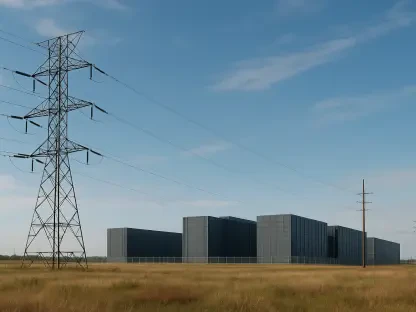

A colossal twenty-billion-dollar data center project planned for the industrial landscape of Joliet, Illinois, recently found itself at the heart of a federal regulatory storm over a financial commitment that barely covers the cost of a vending machine snack. This absurdity, involving a massive 1.8-gigawatt facility and a mere one-dollar letter of credit, forced the Federal Energy Regulatory Commission (FERC) to confront the fragile legal architecture supporting the nation’s power grid. When PowerHouse Hillwood attempted to secure its massive interconnection with that single dollar, it did more than just ignite a legal battle with Commonwealth Edison; it signaled that the current system for managing high-load energy demands was fundamentally broken.
The dispute served as a stark reminder that while the digital economy moves at the speed of light, the physical infrastructure of the grid remains bound by aging regulations and contractual loopholes. This case became the primary catalyst for a necessary overhaul, highlighting how massive industrial expansions could inadvertently place the financial burden of grid upgrades onto the shoulders of everyday utility customers if left unchecked.
The Billion-Dollar Question: A One-Dollar Credit
The stability of the Illinois power grid and a substantial private investment recently hinged on a financial gesture so small it seemed like a clerical error. PowerHouse Hillwood’s attempt to use a $1 letter of credit to satisfy a Transmission Security Agreement (TSA) for its Joliet site exposed a gaping hole in how utilities verify the seriousness of large-scale developers. Commonwealth Edison viewed this as a breach of trust and a threat to regional grid planning, leading to an immediate move to cancel the agreement.
This startling discrepancy between the massive scale of the project and the negligible financial accountability provided a clear example of the risks inherent in the status quo. It was not just about one project in Illinois; it was about the precedent it set for any developer looking to lock up grid capacity without assuming any real risk. The tension between the utility’s need for security and the developer’s quest for low-cost entry became the focal point of a federal inquiry that transcended the local dispute.
Navigating the Collision: Tech Expansion and Grid Infrastructure
As the digital economy scales at an unprecedented rate, the physical infrastructure supporting it struggles to keep pace with the sheer volume of power required. The dispute in Joliet represents more than a local disagreement; it is a microcosm of a national crisis where massive data centers threaten to outstrip local power capacity. Regulators now face the daunting task of balancing the rapid growth of the tech sector with the necessity of maintaining a reliable, affordable grid for the general public.
The central challenge involves ensuring that the heavy costs of expansion are borne by those driving the demand rather than the average ratepayer. Without a clear mechanism to tie project viability to financial commitment, the grid risks becoming cluttered with “paper projects” that claim capacity they cannot realistically utilize. This creates an environment of uncertainty that hampers real infrastructure development and threatens the long-term stability of the regional energy supply.
Analyzing the FERC Decision: The Joliet Data Center Dispute
The FERC ruling on the Commonwealth Edison and PowerHouse Hillwood case served as a pivotal moment for energy policy, highlighting the limitations of current transmission security agreements. Although the 1.8 GW Joliet data center promised significant economic activity, its potential impact on regional power availability raised alarms regarding the integrity of the interconnection queue. The contractual conflict arose when ComEd sought to cancel the TSA, arguing that the $1 credit failed to provide any meaningful protection against project failure.
FERC ultimately deferred the final contractual ruling to the U.S. District Court for the Northern District of Illinois, citing jurisdictional boundaries. However, the commission utilized the platform to address systemic regulatory failures that allowed such a situation to arise. The primary concern remained the prevention of ratepayer subsidies, as vague interconnection rules could easily force everyday consumers to shoulder the financial risks associated with private industrial developments that might never reach completion.
Expert Perspectives: Financial Responsibility and Project Viability
Commissioners at FERC voiced strong opinions on the necessity of “pro forma” agreements to standardize how large-scale loads integrate into the grid. Commissioner David LaCerte provided a pointed assessment, labeling the $1 credit an “embarrassing legal fiction” that trivializes the actual risks posed to infrastructure. His critique emphasized that the lack of substantial financial backing creates a moral hazard where developers can gamble with public resources.
Furthering this argument, Commissioner David Rosner insisted that substantial security deposits must serve as a litmus test for a developer’s project viability. He argued that transparency in grid planning is impossible if the system cannot distinguish between serious projects and speculative ones. Meanwhile, Chairman Laura Swett and Commissioner Lindsay See pushed for clear cost-recovery frameworks to provide certainty for both utilities and developers, ensuring a fair playing field for all grid participants.
A Roadmap: Future Interconnection and Cost-Allocation Reforms
The Joliet case accelerated the timeline for national policy shifts, moving the industry toward a more disciplined approach to grid integration. By establishing minimum financial benchmarks that reflect the true risk of 1 GW+ projects, regulators aimed to eliminate the ambiguity that led to the Illinois standoff. The shift focused on adopting uniform contractual templates to prevent protracted legal disputes and ensure that grid capacity was allocated to the most prepared entities.
In the months leading to mid-November 2026, regional transmission organizations prepared to meet a strict “show cause” mandate. This required them to propose updated cost-allocation models that effectively protected the broader energy ecosystem from the volatility of high-load industrial demand. These strategies ensured that the rapid influx of data centers did not compromise reliability. By late 2026, the commission established a framework that prioritized the collective stability of the grid over individual corporate interests.