
The sheer roar of thirty-three engines screaming at over two hundred miles per hour creates a sensory overload that traditional television has often struggled to replicate for the casual viewer at home. For decades, motorsports broadcasting focused on the mechanical and the tactical, providing wide-angle views that captured the geometry of the track but frequently missed the visceral human drama unfolding in the cockpit. As we move through 2026, Fox Sports has initiated a paradigm shift by treating the Indianapolis 500 not just as a sporting event, but as a high-stakes cinematic narrative. This evolution marks a departure from static coverage toward an immersive experience that prioritizes the raw emotion of the driver alongside the technical precision of the machine.
Evolution of Motorsports Broadcasting and the Pursuit of Cinematic Storytelling
The Intersection of Live Sports Production and Narrative Filmmaking
Modern audiences are no longer satisfied with being passive observers of a race; they demand the same visual intensity found in big-budget racing films. To meet this expectation, Fox Sports has blurred the lines between live production and narrative filmmaking by adopting a cinematic aesthetic. This strategy is driven by the realization that the drama of the Indy 500 lies in the physical and mental strain of the athletes. By moving away from flat, standard-definition perspectives, the production team now utilizes digital cinema optics to create a shallow depth of field, effectively isolating drivers and pit crews from the chaotic background of the speedway.
This cinematic approach requires a fundamental change in how cameras are positioned and how stories are told in real time. Instead of merely following the lead car, the broadcast now focuses on the micro-expressions of drivers and the frantic energy of the pit lane. The goal is to make the viewer feel the heat of the pavement and the tension of a three-wide pass into turn one. By integrating narrative-style framing into a live environment, the broadcast captures the high-stakes reality of the sport in a way that feels intentional and artistic rather than accidental.
Key Stakeholders and the Technical Infrastructure of the Modern Speedway
Executing a production of this magnitude requires a massive orchestration of talent and technology across the 1,000-acre Indianapolis Motor Speedway. This endeavor involves a deep collaboration between Fox Sports, IMS Productions, and technical partners like Game Creek and NEP Broadcast Sports International. The scale is staggering, with over seventy camera positions generating more than one hundred individual video feeds. Managing this data flux requires a robust on-site infrastructure that serves as the central nervous system for the entire operation, ensuring that every second of the race is captured with redundant precision.
The physical footprint of the production is equally impressive, utilizing twelve mobile units and consuming two megawatts of power. This logistical feat is supported by advanced power management systems that provide both primary and backup energy sources to prevent any loss of coverage during critical moments. Because the Indianapolis Motor Speedway is a historic venue, the integration of modern fiber-optic cables—spanning over twenty miles—must be handled with care to maintain the integrity of the site while providing the high-bandwidth connectivity necessary for 4K UHD distribution.
Cutting-Edge Innovations and Market Trends Shaping the Fan Experience
Immersive Camera Tech and the Shift Toward High-Fidelity Visuals
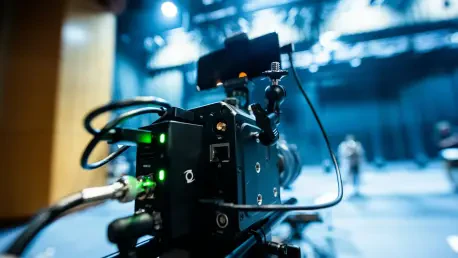
The most significant visual advancement in the current broadcast era is the deployment of specialized camera systems that provide unprecedented access to the driver’s perspective. The Top Gun camera, a miniature RF unit positioned to look directly at the driver’s face, serves as a window into the physical toll of high-G cornering. This camera, inspired by modern film techniques, captures the sweat, the focus, and the minute adjustments required to keep a car on the track at blistering speeds. When combined with the Buckeye cameras mounted on the rear quarter panels, viewers receive a multi-angle view of the race that was previously impossible.
Furthermore, the integration of Driver’s Eye technology has revolutionized the concept of the first-person view. By embedding micro-cameras directly into the driver’s helmet at the exact eyeline, the broadcast delivers a jarringly realistic experience of what it is like to navigate the brickyard. This perspective was recently highlighted during a high-speed qualifying incident, where the footage allowed fans to witness the split-second reactions of the driver during an impact. This level of immersion transforms the broadcast into an educational tool, showing exactly how difficult it is to control a car under extreme duress.
Quantifying the Growth of Data-Driven and High-Frame-Rate Broadcasts
To complement these cinematic visuals, the production utilizes a massive array of High Frame Rate (HFR) cameras to dissect every movement on the track. Currently, ten cameras operating at 240 frames per second provide cinema-grade slow motion, allowing the production team to highlight mechanical failures or subtle overtaking maneuvers that would be invisible to the naked eye at full speed. These visuals are supported by thirty ISO replay channels, which ensure that no matter where an incident occurs, a high-quality angle is available for immediate review.
The shift toward data-driven broadcasting is further evidenced by the implementation of a real-time heads-up display (HUD) for viewers. By syncing telemetry data directly with the video feed, the broadcast provides live information on braking, throttle position, gear selection, and speed. This layer of information turns the screen into a cockpit-like interface, bridging the gap between professional racing and high-end gaming simulations. This trend toward data transparency satisfies the hardcore racing enthusiast while providing necessary context for the casual fan.
Navigating the Complexities of High-Speed Technical Production
Overcoming the Physical and Environmental Limits of 200-MPH Coverage
Producing a broadcast at the Indy 500 is a constant battle against the laws of physics and the unpredictability of the environment. High-speed vibrations and extreme heat can wreak havoc on sensitive camera sensors and wireless transmitters. To counter these challenges, Fox Sports utilizes ruggedized equipment specifically designed to withstand the rigors of the track. Every mount and housing must be aerodynamically neutral to avoid affecting the car’s performance, requiring a meticulous engineering process for every in-car camera installation.
Environmental factors like signal interference also pose a significant threat to a seamless broadcast. With hundreds of thousands of fans in attendance, the local airwaves are congested, making it difficult to maintain stable RF connections for mobile cameras and drones. Technical teams must employ sophisticated filtering and frequency coordination to ensure that the wireless feeds from the cars remain clear and uninterrupted. This constant struggle for signal clarity is what makes the technical success of the Indy 500 a benchmark for the entire sports media industry.
Managing Massive Data Flux and On-Site Power Logistics
The volume of data generated during the race is nearly as overwhelming as the speed of the cars themselves. Handling over one hundred video feeds simultaneously requires a massive networking architecture that can process and route signals with millisecond latency. The production compound acts as a localized data center, where engineers monitor every stream to ensure color consistency and signal integrity. This process is essential for maintaining the high-fidelity HDR look that defines the modern cinematic broadcast style.
Logistical planning for power is another critical hurdle, as a single failure could black out the broadcast to millions of homes. The use of redundant power systems from providers like CE+T ensures that even if the local grid fluctuates, the production remains operational. This focus on reliability is a testament to the high stakes of live sports, where there are no second takes and every moment is historical. The transition to more efficient energy solutions is also a growing priority as the industry seeks to reduce the carbon footprint of massive on-site compounds.
Standards and Regulatory Frameworks for Aerial and Wireless Broadcasts
Safety Compliance for Drone Deployment Over Massive Crowds
Drone technology has transitioned from a novelty to a core component of the racing broadcast, but its use is governed by strict safety and regulatory standards. Partnering with aerial specialists like Beverly Hills Aerials, Fox Sports utilizes First-Person View (FPV) drones to provide dynamic, low-altitude shots that follow the cars through the turns. To comply with safety regulations regarding flights over large crowds, these drones are equipped with emergency parachutes and advanced flight-termination systems. This level of safety engineering is required to gain the necessary permits for operation in such a high-density environment.
The evolution of drone usage has moved away from static scenic shots toward active race participation. Pilots must be highly skilled to keep pace with cars traveling at 220 miles per hour while maintaining a safe distance. These aerial perspectives offer a sense of speed and scale that ground-based cameras cannot replicate, providing a bird’s-eye view of the drafting and slingshot maneuvers that define the Indy 500. As regulatory frameworks become more refined, the integration of these aerial assets will only become more seamless and frequent.
Spectrum Management and the Role of Private 5G in Broadcast Security
Managing the wireless spectrum during the Indy 500 is perhaps the most invisible but vital task in the entire production. With a vast array of wireless cameras, microphones, and team radios all vying for bandwidth, the risk of signal collisions is high. Fox Sports has begun leveraging private 5G networks to create dedicated lanes for broadcast data, reducing the reliance on traditional RF frequencies that are prone to interference. This shift toward 5G allows for higher data throughput, enabling the transmission of high-bitrate video from moving vehicles without the lag associated with older wireless technologies.
The use of 5G also enhances the security and reliability of the broadcast signals. By operating on a private network, the production team can prioritize critical feeds and manage bandwidth in real time based on the needs of the show. This environment serves as a rigorous testing ground; if a wireless technology can survive the interference and physical demands of the Indianapolis Motor Speedway, it is deemed robust enough for any other application in the world. This focus on spectrum efficiency is a primary driver for the future of all large-scale live events.
The Road Ahead: Distributed Production and the Connected Racing Ecosystem
Transitioning From On-Site Compounds to Fiber-Based Distributed Workflows
While the current Indy 500 production relies heavily on a massive on-site presence, the industry is rapidly moving toward a distributed production model. This approach involves sending raw video feeds via high-speed fiber-optic lines to a centralized hub, where the majority of the editing and directing takes place. Fox Sports has been at the forefront of this transition, partnering with companies like Lumen Technologies to install permanent fiber infrastructure at tracks across the country. This model reduces the need to transport dozens of mobile units and hundreds of personnel to every venue.
The move toward distributed production is often described as a crawl, walk, run phase. Currently, the Indianapolis Motor Speedway serves as a hybrid model, utilizing its extensive internal fiber network while still maintaining a significant on-site footprint. As fiber capacity increases and latency continues to drop, future broadcasts will likely see a reduction in the size of the on-site compound, with more of the creative work being done from remote studios. This shift not only increases operational efficiency but also allows for a more consistent production quality across different events.
Harnessing 5G and Advanced Telemetry for the Next Generation of Racing
The concept of the connected car is the next frontier in motorsports media. Currently, most race cars are limited in the amount of data they can transmit back to the broadcast team, often restricted to a few audio channels and basic telemetry. However, the goal for the coming years is to unlock the full potential of the vehicle as a data source. With the expansion of 5G connectivity, it will be possible to stream multiple high-definition camera angles and biometrics from every car simultaneously, giving fans a level of customization and detail that was previously science fiction.
Advanced telemetry will also play a larger role in storytelling by providing predictive analytics. Imagine a broadcast that can calculate the exact probability of an engine failure based on real-time heat sensors or predict the optimal pit window based on tire degradation data visible on the screen. This integration of deep data into the visual narrative will create a more intellectual and engaging viewing experience. The race car is no longer just a machine; it is a mobile broadcast studio and a data hub that feeds a global ecosystem of information.
Redefining the Greatest Spectacle: A New Era for Sports Media
The successful implementation of cinematic technology at the Indianapolis Motor Speedway established a new benchmark for how high-speed sports are consumed. By prioritizing emotional storytelling through the Top Gun and Driver’s Eye cameras, the production team managed to humanize the cockpit, making the Herculean efforts of the drivers relatable to a global audience. The integration of 1080p HDR and 4K UHD distribution further solidified the race as a premier visual event, proving that the technical infrastructure could handle the massive data requirements of a modern digital broadcast. This shift ensured that the spectacle of the race was matched by the quality of its presentation.
The transition toward distributed production and the testing of private 5G networks paved the way for more flexible and efficient broadcasting models in future seasons. Moving forward, stakeholders should prioritize the expansion of fiber-optic networks to all major racing venues to support remote workflows and reduce logistical costs. Furthermore, the industry must continue to refine the integration of real-time telemetry, turning raw data into compelling on-screen graphics that enhance the viewer’s understanding of the race. As connectivity between the car and the fan continues to deepen, the broadcast will evolve into a fully immersive, multi-platform experience that remains as unpredictable and thrilling as the race itself.