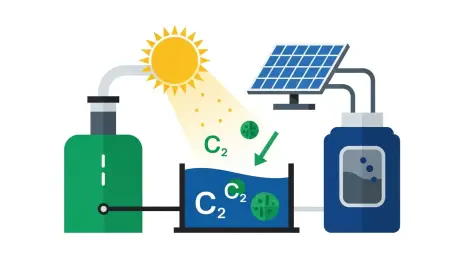

The global pursuit of sustainable chemical production has reached a critical milestone as researchers successfully demonstrate a biohybrid system capable of converting atmospheric carbon into tangible resources. Groundbreaking research led by Dr. Lin Su at Queen Mary University of London has introduced a modular biohybrid solar reactor that represents a fundamental paradigm shift in the field of green chemistry. This innovative system successfully fuses inorganic photoelectrochemistry with advanced synthetic biology, creating a stable platform where non-photosynthetic bacteria can thrive using only sunlight, water, and carbon dioxide. By engineering a synthetic version of photosynthesis, the research team has developed a process that is potentially more efficient and significantly easier to control than its natural biological counterparts found in the plant kingdom. This technological leap addresses the historical inefficiency of natural light harvesting while providing a scalable method for localized production of essential materials.
At the heart of this scientific innovation is the sophisticated transformation of Escherichia coli from a common microbe into a highly specialized autotrophic organism. Traditionally, E. coli is a heterotrophic species that relies on organic carbon sources like glucose or other sugars to survive, but this new biohybrid system allows it to grow directly from atmospheric or dissolved carbon dioxide. This breakthrough effectively paves the way for carbon-negative manufacturing, enabling the production of essential biomass and high-value chemicals without the need for traditional agricultural feedstocks or fossil fuels. By decoupling chemical production from the land-intensive requirements of industrial farming, the technology offers a vision of a future where industrial outputs are derived from the very greenhouse gases currently warming the planet. The integration of living cells into an inorganic framework allows for a level of metabolic precision that was previously unattainable in strictly chemical or biological systems, marking a new era of industrial biotechnology.
The Mechanics: Solar Energy Conversion and Enzymatic Bridging
The internal architecture of the reactor utilizes a specialized bismuth vanadate photoanode to facilitate the process of water splitting when the device is exposed to natural or concentrated sunlight. This initial chemical step is crucial because it generates the protons and releases the oxygen necessary for the aerobic respiration of the bacteria housed within the reaction vessel. On the opposite side of the device, a photocathode integrated with state-of-the-art organic photovoltaics and protected by a robust graphite epoxy layer works to reduce carbon dioxide with high precision. This dual-electrode configuration ensures that the energy captured from the sun is immediately converted into chemical potential, creating an environment that mimics the energy-harvesting capabilities of a leaf but with the durability of industrial hardware. The protection layer is especially important, as it prevents the degradation of sensitive electronic components in the aqueous environment required for microbial growth.
To convert captured carbon dioxide into a form that the bacteria can readily ingest, the system employs a series of isolated enzymes that act as highly specific biological catalysts. Specifically, carbonic anhydrase is used to accelerate the uptake and concentration of CO2 within the fluid medium, while formate dehydrogenase transforms the gas into formate, a stable one-carbon molecule. This formate serves as a strategic liquid energy vector, effectively bridging the gap between the solar-powered inorganic components and the living microbial cells that consume it to build their physical biomass. By utilizing formate as a middleman, the reactor avoids the high energy costs and complex engineering required to feed gaseous carbon directly to microbes. This elegant chemical bridge allows the bacteria to focus their internal energy on growth and synthesis rather than the difficult task of capturing dispersed carbon molecules, leading to a much more efficient overall conversion rate.
Achieving Synergy: Overcoming Biocompatibility and Toxicity Hurdles
One of the most persistent and difficult challenges in developing biohybrid systems has been the inherent toxicity of inorganic materials to living biological organisms. Many traditional metal catalysts and high-performance semiconductors leach heavy metal ions that can quickly poison bacteria, making it nearly impossible to maintain a stable, productive environment over long periods. The research team overcame this significant hurdle by utilizing carefully selected biocompatible materials and isolated enzymes instead of harsh synthetic catalysts, creating a “one-pot” reactor where chemical reactions and biological growth occur simultaneously without any mutual interference. This design philosophy ensures that the sensitive metabolic pathways of the E. coli are protected from the volatile intermediates of the water-splitting process, allowing the biological component of the system to flourish while the inorganic component provides a steady stream of nutrients and oxygen.
In this sophisticated integrated setup, the chemical and biological elements function in a symbiotic loop that is powered entirely by solar radiation. The water-splitting reaction provides the constant supply of oxygen necessary for the E. coli to perform aerobic respiration, while the photoelectrochemical reduction process provides the formate they need for caloric sustenance and carbon building blocks. This closed-loop system allows the bacteria to replicate and produce materials without requiring any external electrical bias or nutrients derived from traditional fossil fuel sources. The self-sustaining nature of the reactor suggests that such systems could be deployed in remote areas where traditional infrastructure is lacking, as they require only light and air to function. This level of autonomy represents a major advancement over previous bio-electrochemical systems that required constant maintenance and the frequent addition of expensive chemical mediators to keep the microbial populations healthy.
Scalability and Future Implications: From Laboratories to Solar Refineries
The modular design of this solar reactor offers a clear and viable roadmap for the creation of industrial-scale solar refineries that function like traditional chemical plants but with a net-zero environmental footprint. Because every individual component—from the efficiency of the organic solar cells to the specific metabolic pathways of the microbial chassis—can be independently optimized, the entire system is highly tunable for various industrial needs. Future versions of these bioreactors could be programmed through genetic engineering to produce specific high-value outputs such as bioplastics like polyhydroxybutyrate, complex pharmaceutical precursors, or specialized liquid biofuels. This flexibility turns the reactor into a programmable manufacturing platform that can be adjusted based on market demand or local resource availability, effectively decentralizing the production of essential chemicals and reducing the reliance on global supply chains.
Beyond its obvious industrial applications, this technology has profound and far-reaching implications for global food security and environmental restoration efforts. By growing nutrient-dense microbial protein directly from carbon dioxide, researchers believe they can significantly reduce the massive land and water footprints currently associated with traditional animal and crop farming. This “food from thin air” approach offers a resilient and sustainable alternative that could help feed a growing global population while simultaneously addressing the urgent need to decarbonize the global economy. As this technology moves from laboratory prototypes to pilot plants, the focus must shift toward enhancing the longevity of the enzymes and improving the efficiency of the light-harvesting components. Future development should prioritize the creation of robust enzyme-immobilization techniques and the selection of even more resilient microbial strains to ensure these systems can operate continuously for years.
Implementation: Strategic Steps Toward Bio-Economic Integration
The transition from fossil-dependent chemical production to a solar-powered bio-economy now requires a strategic focus on the durability of the biological and chemical interfaces. Commercial success for this technology will likely depend on the development of more stable enzyme scaffolds that can withstand the rigors of industrial operation without losing catalytic activity over time. Investors and policy makers should look toward integrated pilot projects that combine carbon capture from industrial flue gas with these biohybrid reactors to prove the system’s efficacy in real-world environments. Furthermore, establishing standardized protocols for the genetic modification of autotrophic E. coli will allow for a more rapid deployment of specialized “microbial factories” tailored to specific regional needs. This approach not only sequestered carbon but turns it into a valuable asset, creating a circular economic model that incentivizes the removal of greenhouse gases from the atmosphere.
As the industry moves forward, the integration of artificial intelligence for the real-time monitoring and optimization of these biohybrid systems will be essential for maximizing production yields. Smart control systems could adjust light intensity, nutrient flow, and temperature to maintain the delicate balance between the inorganic catalysts and the living bacteria, ensuring peak performance regardless of changing environmental conditions. Educational initiatives will also be necessary to train a new generation of bio-engineers capable of managing these complex hybrid facilities. By fostering collaboration between materials scientists and microbiologists, the path toward a carbon-neutral industrial sector becomes increasingly clear. The successful demonstration of the solar-powered E. coli reactor has provided the foundational proof needed to begin scaling these technologies, offering a tangible solution for a world seeking to harmonize its industrial ambitions with the ecological limits of the planet.