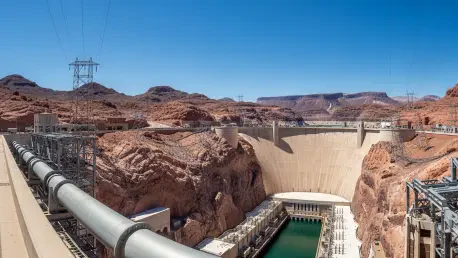

Christopher Hailstone brings a wealth of experience in energy management and grid security to a conversation that is increasingly defined by the harsh realities of water scarcity in the American West. As Lake Powell hovers at a precarious 23% capacity, the Colorado River Basin is facing a reckoning that stretches from the massive concrete walls of Glen Canyon Dam to the kitchen tables of rural Utah. This discussion delves into the complex balancing act between preserving the endangered humpback chub and maintaining affordable electricity for the 40 million people who rely on this dwindling resource. We explore the “cool mix flow” strategy, the rising tide of invasive predators, and the economic strain on families who are seeing their utility bills climb as the river reaches historic lows.
With Lake Powell currently at only 23% capacity, how do you evaluate the structural and mechanical trade-offs required to execute a “cool mix flow” at Glen Canyon Dam?
The situation at Glen Canyon Dam is a perfect storm of aging infrastructure meeting an unprecedented climate crisis. When the reservoir is this low, the physics of the dam work against us; the intake for the hydropower turbines sits in the warmer, upper layer of the water column. To achieve a “cool mix flow” that protects downstream species, officials have to rely on jet tubes to pull much colder water from the deeper, darker sections of the reservoir, but these tubes lack the turbines necessary to generate electricity. It is a heartbreaking mechanical compromise where we are essentially choosing to let nearly 900,000 acre-feet of water bypass our power-generating infrastructure. From a grid reliability perspective, this is incredibly risky because we are intentionally reducing our output during the sweltering months between June and October when demand is peaking. We are seeing a direct conflict between the dam’s role as a “battery” for the West and its role as an ecological gatekeeper for the Grand Canyon.
Could you explain the biological urgency behind releasing this cold water and why the survival of the humpback chub has become such a pivotal point of contention?
The biological stakes are incredibly high because we are fighting an invasive takeover that thrives in the warmth. As the reservoir drops, the water being pulled through the turbines is getting warmer and warmer, expected to consistently exceed 60 degrees Fahrenheit by mid-June, which is essentially a green light for smallmouth bass to start breeding. These predatory bass were introduced decades ago for sport fishing, but now they are leaking through the dam and feasting on the humpback chub, a threatened native fish that has lived in these waters for millennia. A recent study even suggested that about half of these bass actually survive the trip through the hydropower generators, emerging on the other side ready to spawn and decimate the local ecosystem. If we don’t use those jet tubes to drop the river temperature, we are effectively surrendering the Grand Canyon to non-native predators. It feels like a desperate, last-ditch effort to keep the river from becoming a breeding ground for an ecological disaster that could cost millions more to remediate in the long run.
Utilities have expressed deep concern about the “replacement energy costs” associated with these releases. What does that financial burden look like for the average energy provider?
The financial math is brutal for the 155 customers and utility groups represented by the Colorado River Energy Distributors Association. When you bypass the generators to save the fish, that “lost” electricity has to be bought from other sources on the open market, and it is rarely cheap. Last year alone, these replacement energy costs hit $19 million, and this year, projections suggest the price tag will jump to roughly $25 million—which is essentially equal to the total cost of the previous two years combined. This isn’t just a line item on a balance sheet; it impacts the critical funds used to operate and maintain the very transmission facilities that keep the lights on across seven states. Utilities are being forced to scramble for alternative power in a market that is already tight due to the regional drought, creating a cycle of financial instability that threatens the long-term viability of federal hydropower as a low-cost resource.
Beyond the high-level policy debates, how are these rising costs and “environmental experiments” trickling down to the actual residents who pay the monthly bills?
We are seeing a very human side to this crisis in places like Heber City, where the steady rise in electricity rates is stretching household budgets to the breaking point. For example, a resident might have seen their April bill climb from $86 just two years ago to over $125 today, a trend that is directly linked to the reduced generation at the dam. It is a sensory shift for these communities—the anxiety of opening a utility bill and the “hollow thud” of realizing that rates have hiked for five consecutive years. We are already seeing the fallout, with late payments jumping from 10% to 12% as families struggle to keep up with the cost of these environmental mandates. For a growing population, the combination of a shrinking river and these costly bypass experiments feels like a double-edged sword that cuts deepest into the pockets of those who can least afford it.
The downstream fisheries in Marble Canyon have already faced significant trauma. What happens to the local economy and the “world-famous” trout if these cool water releases are not approved?
The memory of the 2022 trout die-off still haunts the guides and local businesses in Marble Canyon, where record-breaking warmth once killed nearly half the rainbow trout population. For people who have worked these waters since they were teenagers, the river is more than just a resource; it’s a legacy that is visibly evaporating. If we hit those record temperatures again without the intervention of a cool mix, the trout fishery won’t just struggle—it will likely be destroyed, leaving guides to cancel entire seasons of bookings. There is no ambiguity in their warnings; without that cold water, the stress on the fish becomes terminal, and the vibrant, remote stretch of river between the dam and the Grand Canyon becomes a ghost town. It is a precarious wait-and-see game for the small businesses that rely on the ecological health of the river to survive.
What is your forecast for the Colorado River and the future of Glen Canyon Dam as we move toward the expiration of current management guidelines?
My forecast is that we are entering an era of “permanent crisis management” where the old rules simply no longer apply. With the long-term sharing agreements for the river’s dwindling resources set to expire this year and no replacement in sight, we are likely to see more of these emergency bypasses and even higher price volatility for electricity. I suspect that the Bureau of Reclamation will be forced to prioritize ecological survival over hydropower production more frequently, which will eventually necessitate a complete redesign of how we fund western power grids. We are moving away from the dream of “cheap, limitless water” and into a reality where every acre-foot of water and every megawatt of power will be a point of intense political and economic conflict. The next few years will be a test of our resilience, requiring us to find a way to pay for conservation without bankrupting the very people who live in the shadows of these Great Dams.