
The global energy landscape is currently undergoing a radical transformation as researchers move beyond the constraints of traditional silicon photovoltaic panels that have defined the industry for decades. While conventional solar arrays are highly efficient, their substantial weight and rigid glass construction make them difficult to integrate into non-traditional surfaces or transport to remote, high-stress environments. Australia’s national science agency, CSIRO, is addressing this limitation by pioneering the development of flexible, lightweight solar cells that are manufactured using advanced printing techniques similar to those employed for polymer banknotes. This transition from heavy, glass-based modules to thin, rollable films represents a fundamental shift toward a concept of “solar everywhere,” where energy generation is no longer confined to static rooftops but can be seamlessly integrated into clothing and portable tents. By utilizing perovskites—materials that can be formulated into functional solar inks—this technology promises to decentralize power production and lower barriers to entry.
Technical Innovations and Manufacturing Efficiency
Streamlining Production: The Role of Carbon Inks
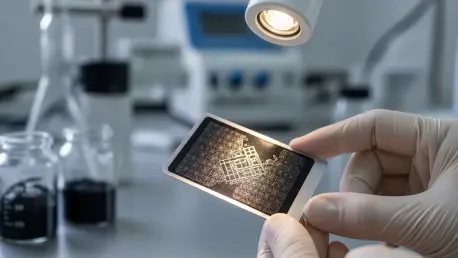
The integration of perovskite materials into the manufacturing process has allowed scientists to move away from the high-temperature, resource-heavy methods required for traditional silicon. One of the most significant technical achievements in this project involves the complete removal of expensive precious metals from the production sequence. While most experimental high-performance solar cells rely on gold or silver to maintain electrical conductivity and stability, the research team successfully substituted these with affordable carbon-based inks. This substitution drastically reduces the overall cost of raw materials and simplifies the international supply chain without causing a substantial drop in energy conversion efficiency. By utilizing these carbon alternatives, the production of flexible solar films becomes economically viable for mass-market applications that were previously considered too expensive. This shift ensures that the technology is not only technically feasible but also commercially competitive.
Beyond the immediate cost savings, the use of carbon-based inks enhances the mechanical flexibility of the printed modules, as carbon layers are less prone to cracking during repeated rolling and unrolling compared to thin metal foils. This durability is critical for consumer products that must withstand the rigors of daily use and environmental exposure. The team also focused on optimizing the chemical stability of the perovskite ink to ensure that it remains functional under varied atmospheric conditions. By developing a specialized encapsulant that protects the active layers from moisture and oxygen, researchers have extended the operational lifespan of these flexible cells significantly. This progress represents a vital step toward achieving the longevity standards required for industrial energy infrastructure. Consequently, the transition to carbon-based components has not only lowered the financial barrier to entry but has also provided a more robust material foundation for these portable power solutions.
Precision Engineering: Automated Testing and Records
The speed of development for these printed solar cells has been vastly accelerated by a state-of-the-art automated system designed to produce and test over 10,000 individual cells per day. This data-driven approach allows researchers to rapidly refine chemical recipes and printing precision, moving the technology from a limited laboratory experiment toward a robust industrial product. The automation provides a continuous feedback loop, where every batch of printed film is instantly analyzed for performance and physical durability. By identifying the most efficient material combinations in real-time, the system reduces the time required for traditional trial-and-error experimentation. This high-throughput methodology is essential for maintaining a competitive edge in the fast-moving renewable energy sector. The ability to iterate on designs daily ensures that any minor defects in the printing process are identified and corrected before large-scale production begins.
Recent milestones in energy conversion efficiency have further validated the potential of this printing method, with small-scale cells reaching 15.5 percent efficiency and larger modules achieving 11 percent. While these figures were once thought impossible for printed perovskites, the combination of advanced ink formulations and automated precision has brought them within range of commercial silicon standards. The “roll-to-roll” method used to achieve these results is highly energy-efficient, as it operates primarily at room temperature, unlike the energy-intensive furnaces required for traditional silicon refining. This lower energy footprint during manufacturing contributes to a shorter energy payback time, making the technology even more attractive from a sustainability perspective. Furthermore, the ability to print solar cells on long, continuous rolls of plastic film allows for the creation of massive arrays with minimal seams, mirrors the economics of the high-speed printing industry.
Versatile Applications and Field Testing
Real-World Deployment: Emergency and Industrial Use
The strategic value of flexible solar film is most evident in its ability to provide reliable power in environments where traditional, heavy panels are impossible to install. Because the film is extremely portable and can be rolled up like a rug, it represents an ideal solution for emergency disaster relief efforts. In the wake of natural disasters, emergency responders require immediate electricity for medical facilities, water purification systems, and vital communication hubs. This flexible material can be unrolled over tents or uneven ground to begin generating power instantly without the need for complex mounting hardware or heavy supports. The ability to deploy a 50-square-meter solar array from a single transportable container significantly enhances the operational capacity of humanitarian missions in remote areas. Moreover, the lightweight nature of the film reduces the logistical burden on transport aircraft, allowing more space for critical supplies.
In addition to humanitarian applications, the defense and mining sectors stand to benefit from this technology, as it allows for the deployment of solar arrays in remote locations that are difficult to access with heavy machinery. By transforming energy generation into a mobile asset, the flexible film reduces the reliance on diesel generators and fuel convoys, which are often the most expensive components of remote industrial operations. For instance, temporary mining camps can utilize these films to power sensors and worker accommodations with minimal environmental impact. The films can also be integrated into the portable structures used by defense forces, providing silent, emission-free power in the field. This tactical advantage is paired with the ease of removal; when a camp is relocated, the solar film is simply rolled up and transported to the next site. The versatility of the material ensures that energy production is no longer a static requirement.
Future Implementation: Next Steps for Integrated Solar
The final phase of this developmental journey focused on evaluating the durability of printed solar cells in the extreme environment of low Earth orbit. A specialized strip of the flexible film was launched on a satellite in early 2024 to assess its resilience against intense solar radiation and extreme temperature fluctuations. This testing proved that the material could maintain its structural integrity and electrical performance even in the vacuum of space, where traditional materials often degrade. Space agencies identified the lightweight profile of this film as a critical factor in lowering the costs of future satellite missions, as it replaced heavy, glass-shielded silicon arrays. The success of these orbital tests validated the robustness of the printing process and provided a strong argument for the adoption of flexible solar across a variety of aerospace applications. These findings established a new benchmark for space-grade energy solutions.
Building on these successes, the transition toward widespread commercial adoption was supported by strategic steps to integrate the technology into urban infrastructure. Researchers focused on incorporating the solar film directly into the fabrication of building materials, such as windows and roofing membranes, to create passive energy-generating structures. This approach effectively turned everyday surfaces into power plants, reducing the carbon footprint of the built environment without altering its aesthetic appeal. Furthermore, the integration of these cells into the internet of things ecosystem redefined how low-power devices were maintained, as the films provided a continuous power source for sensors. By embedding energy generation directly into the design of products, the necessity for frequent battery replacements was successfully mitigated. These initiatives ensured that the technology moved beyond a scientific innovation and became a practical solution for the global economy.