
Christopher Hailstone is a veteran in the energy management space, currently navigating the intersection of grid security and renewable transitions. As the utilities landscape evolves, his focus has shifted toward how industrial waste can solve the twin challenges of decarbonization and fuel reliability. Today, we delve into the mechanics of high-temperature pyrolysis and the growing profitability of the renewable natural gas market as companies scale their operations to meet new carbon standards.
Our conversation explores the innovative ways organic waste is being reimagined as a high-value asset for heavy industry. We discuss the specific chemistry of biomass breakdown, the strategic move to replace traditional coal in steel production, and the promising results of neutralizing harmful “forever chemicals” through advanced processing. We also take a hard look at the economic indicators driving the sector, from rising RIN prices to the massive infrastructure projects taking shape across North America, highlighting how established energy players are successfully pivoting toward circular economy models.
High-temperature pyrolysis can split woody biomass into roughly 20% biocarbon and nearly 80% volatile matter; how does this dual output change the economic math for waste-to-energy projects?
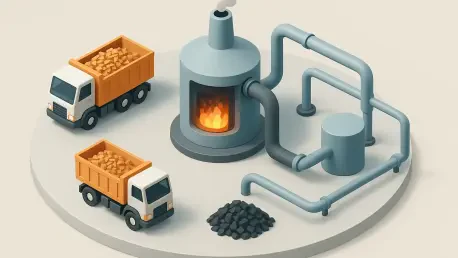
When you look at a feedstock, you have to find value in every ounce of it to make the numbers work in today’s market. By utilizing high-temperature pyrolysis, we see woody biomass split into about 20% biocarbon and roughly 78% volatile matter and gas, which is a complete game-changer for project revenue. If a developer ignored that 78% portion, they simply wouldn’t be able to pay enough for the raw materials to keep a facility running sustainably. We are seeing this strategy come to life at the first commercial-scale plant in Thorold, Ontario, where the combination of solid fuel and RNG creates a diversified income stream that traditional waste processing just can’t match. It’s about transforming what used to be a disposal cost into a multi-product profit center where every molecule of gas is harvested for value.
Why is the steel industry specifically becoming such a significant driver for biocarbon demand compared to other potential offtake markets like agriculture?
Heavy industry, particularly steelmakers like ArcelorMittal, provides a level of scale and stability that the agricultural biochar market currently lacks. While biochar offtakers are often small and scattered, a single steel mill can consume massive quantities of biocarbon at once to replace metallurgical coal in their furnaces. This creates a much more straightforward path to market because you aren’t relying on a complex, diffuse web of carbon credits to keep the lights on. It’s a visceral, industrial shift where you can practically feel the heat of the transition as these massive facilities swap out fossil fuels for carbon-neutral alternatives that fit right into their existing infrastructure. The market for biochar is still evolving and feels more fragmented, whereas the steel industry’s appetite for biocarbon is immediate and high-volume.
The partnership in Baltimore focuses on processing biosolids; what are the implications of using pyrolysis to eliminate “forever chemicals” like PFAS?
Dealing with biosolids has always been a major headache for municipalities, but the collaboration between Synagro, the City of Baltimore, and Char Tech is turning that problem on its head. By applying this high-temperature process, pilot results show that PFAS—those persistent “forever chemicals”—are substantially eliminated, leaving behind a clean, usable biochar. This isn’t just about waste management; it’s a critical environmental safeguard that protects our water and soil from long-term contamination that has plagued urban centers for decades. Seeing those chemical bonds break under intense heat provides a tangible sense of relief for local officials who are under immense pressure to find safe disposal solutions. It proves that we can handle the most difficult waste streams while simultaneously producing a valuable renewable resource.
With several facilities coming online across Canada, how does the strategy of licensing technology versus building new plants influence the speed of deployment in the United States?
Speed is the absolute priority right now, which is why we’re seeing a shift toward licensing models for the U.S. market. While the team is busy commissioning commercial-scale plants in Saint-Félicien, Québec, and Hurket, Ontario, they recognize that building every single facility themselves would take far too long to meet the climate demand. By licensing the technology to American partners, they can get these biosolids-processing solutions into the ground much faster than through direct construction alone. It allows the technology to scale horizontally, ensuring that the infrastructure for RNG and biocarbon production isn’t bottlenecked by one company’s capital constraints. This approach is essential for rapidly deploying the technology across the border where the need for PFAS remediation and renewable energy is skyrocketing.
Looking at the current credit pricing for D3 and D5 RINs, what do these financial shifts tell us about the health of the renewable natural gas sector?
The financial health of the sector is looking incredibly robust right now, with D3 RIN prices climbing to $2.380, up from $2.330 just last year. We are also seeing D5 RINs move up to $2.160, signaling a sustained and growing appetite for these environmental attributes in the fuel market. When you pair those numbers with carbon prices like $130 per metric ton in Oregon and $84.25 in California, the economic incentive to produce RNG becomes undeniable for investors. These aren’t just abstract figures on a spreadsheet; they represent the hard currency that is funding the next generation of energy infrastructure across the continent. This upward trend in pricing reflects a market that finally recognizes the scarcity and value of truly low-carbon fuel sources.
Several biogas companies reported significant revenue increases this quarter; what internal operational changes are contributing to this transition from net losses to profitability?
We’re seeing a dramatic shift toward operational maturity, evidenced by companies like Anaergia nearly doubling its revenue to $63.9 million this quarter compared to $32.3 million previously. Companies like Montauk Renewables are hitting their stride too, with RNG production reaching 1.5 million mmBtus and a successful swing back into positive net income from a previous loss of $5.5 million. Clean Energy Fuels also demonstrated this momentum by selling 63.2 million gallons of RNG, supported by new fueling and maintenance agreements with major partners like GFL Environmental. It’s a transition from the capital-intensive “build phase” to the “delivery phase,” where the initial investments are finally manifesting as consistent, high-volume energy output. You can see the shift in the numbers as these firms move from proving the concept to dominating the market.
The new Neogenyx project in Nebraska is a massive manure-to-RNG undertaking; how does the scale of 1.2 million mmBtus per year impact the local agricultural landscape?
The Broken Bow project is a monumental step for the agricultural sector, particularly with its capacity to generate 1.2 million mmBtus of RNG annually from feedlot manure. By deploying eight massive anaerobic digesters that process 4,400 standard cubic feet of biogas per minute, the facility creates a circular economy right on the farm. The sensory impact of this is huge—not only are we managing the intense odors and environmental risks of manure, but we’re returning valuable byproducts like livestock bedding and fertilizer back to the land. It turns a significant waste liability into a localized resource, strengthening the resilience of the entire farming operation and proving that large-scale agriculture can be part of the climate solution. This is Neogenyx’s first foray into the agricultural space, and it sets a very high bar for future projects.
Waga Energy recently commissioned a plant at the Decatur Hills Landfill; how do 20-year agreements like this one provide the stability needed for long-term grid security?
Long-term stability is the bedrock of energy security, and a 20-year agreement like the one Waga Energy signed for the Indiana facility is a perfect example of that. This plant is expected to churn out 203,000 mmBtus of RNG every year, providing a predictable, decentralized fuel source for the local region for the next two decades. Because private equity firms are backing these long-term commitments, it gives the utility sector the confidence to integrate these green fuels into the broader energy mix without fear of sudden supply drops. It’s a quiet but powerful shift that ensures our energy supply is anchored by long-lived, sustainable assets rather than volatile fossil fuel imports. Watching these units go from construction to commissioning under a 20-year guarantee provides exactly the kind of certainty the market craves.
What is your forecast for the biocarbon and RNG industry over the next few years?
I anticipate a massive surge in industrial adoption as the gap between carbon-heavy fuels and biocarbon continues to narrow. With the successful deployment of plants in places like Thorold and the rising value of D3 RINs, we are going to see more steelmakers and heavy manufacturers move away from metallurgical coal entirely because the alternatives are finally available at scale. The infrastructure is finally catching up to the technology, and as more of these 1.2 million mmBtu facilities come online, RNG will transition from a niche alternative to a primary component of our industrial energy strategy. We are standing at the threshold of a period where waste is no longer a problem to be buried, but a vital fuel to be harvested for a more secure and cleaner energy grid.