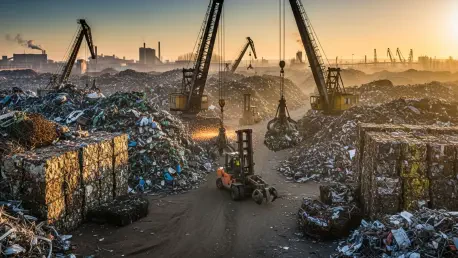

The global industrial landscape is undergoing a radical transformation where the scrap metal yard, once seen as the graveyard of machinery, has emerged as the essential lifeblood of modern steel production. As the global industrial landscape pivots toward a circular economy, the humble scrap heap has transformed from industrial waste into a high-value strategic asset that dictates the profitability of the world’s largest steelmakers. This transition from traditional blast furnaces to Electric Arc Furnace (EAF) technology is fundamentally altering market leverage, making recycled steel the primary driver of modern manufacturing efficiency. This analysis explores the financial dominance of North American steel giants, the impact of advanced market intelligence, the logistical bottlenecks reshaping global trade, and the projected power shift between raw material suppliers and manufacturers through 2026.
Financial Growth and Operational Success in EAF Steelmaking
Statistical Evidence: Industry Profitability and Expanding Margins
The current fiscal year has revealed robust earnings for industry leaders, specifically those utilizing the agile EAF production model. Nucor Corp. recently reported a staggering $1.1 billion in net income for the second quarter, while Steel Dynamics Inc. (SDI) followed with a healthy $530 million. These figures are not merely reflections of high demand but are primarily driven by the “steel mill margin,” which is the critical spread between the cost of raw materials and the price of finished goods. This benchmark reached $723 per ton in recent months, signaling a significant increase in pricing power for mills that have mastered the intake of secondary materials.
Data provided by the American Iron and Steel Institute (AISI) reinforces this narrative of sector-wide health. Crude steel production in the United States has maintained a steady output of approximately 1.86 million tons per week, which corresponds to a capacity utilization rate of 80.5 percent. This percentage is vital because it represents a state of operational efficiency where fixed costs are minimized relative to output. This performance marks a nearly five percent improvement over the levels recorded during the same period in 2025, suggesting that the industry is successfully scaling its green manufacturing capabilities.
Real-World Applications: The EAF Production Model
Nucor and SDI have demonstrated the strategic advantage of the EAF model by utilizing a sophisticated blend of ferrous scrap and direct-reduced iron (DRI). This specific mix allows these companies to maintain extreme flexibility in volatile markets, adjusting their recipes based on the availability and price of recycled inputs. Unlike traditional integrated mills that rely on the slow and expensive process of starting or stopping blast furnaces, EAF mills can ramp production up or down in response to immediate seasonal demand shifts. This agility has proven to be the decisive factor in sustaining profitability during periods of unpredictable global commodity pricing.
The stock market performance of SDI serves as a potent case study for the resilience of this sector. After trading in the $184 range earlier in the year, the stock experienced a meteoric rise to peaks near $289 by mid-June, eventually finding a stable floor around $241. This trajectory reflects a growing investor confidence in the EAF model’s ability to weather economic headwinds. Furthermore, the operational efficiency inherent in these mills has allowed them to outperform traditional steelmaking counterparts, particularly as manufacturing sectors demand faster lead times and higher sustainability standards for their material inputs.
Analytical Innovation and Expert Industry Perspectives
High-Resolution Data and the End of Market Opacity
The era of making industrial decisions based on guesswork or lagging indicators has ended due to the integration of modern market intelligence. Experts like Atilla Widnell of Navigate Commodities have highlighted how the use of satellite imaging and real-time tracking of mill operating rates has eliminated traditional market opacity. By monitoring the heat signatures and logistical activity of EAF facilities from orbit, analysts can now determine production volumes with incredible accuracy before corporate earnings are even released. This level of transparency has fundamentally reduced the “surprises” that once plagued the financial reports of major steel producers.
Moreover, this shift toward high-resolution data has forced a change in how Wall Street evaluates the sector. Financial institutions are moving away from traditional models that rely on monthly surveys and are instead adopting data-driven forecasting as the standard for navigating commodity volatility. This innovation ensures that the divergence between the profitability of finished steel and the costs of raw materials is tracked in real-time. Consequently, market participants are better equipped to understand the nuances of supply chain disruptions, allowing for more strategic capital allocation across the recycled materials landscape.
The Role of Strategic Sourcing in Corporate Health
Strategic sourcing has become a pillar of corporate stability, particularly through the acquisition and expansion of internal recycling subsidiaries. The role of the David J. Joseph company within the Nucor ecosystem exemplifies how securing a captive supply chain can protect a manufacturer from the whims of the open scrap market. By controlling the collection and processing of the materials they consume, these steel giants have insulated themselves from external price shocks. Expert opinions suggest that this vertical integration is the primary reason why large mills continue to see expanding margins while independent raw material processors face tighter operational spreads.
The Evolving Landscape of Global Logistics and Trade
Environmental Bottlenecks and Their Impact on Supply Chains
Environmental constraints have recently emerged as the most significant disruptors of global scrap metal transport, particularly in Europe. Low water levels on the Rhine River have created a geographic bottleneck that prevents barges from moving large quantities of scrap to major steelworks in Germany and neighboring regions. This logistical hurdle has forced a massive realignment of global trade flows. Since European supply is constrained, Turkish steelmakers—the world’s largest importers of scrap—have been compelled to pivot their sourcing efforts away from Europe and toward exporters in the United States.
This shift in trade dynamics has granted U.S. shippers a newfound level of price leverage in the international market. Even in what many considered a stagnant export environment, American suppliers have successfully commanded premiums of roughly $5 per ton due to the lack of competition from European river-based logistics. In contrast, mills within the heart of Europe, including those in France, Italy, and Poland, are seeing their prices compressed. The inability to move material efficiently, combined with the seasonal pause in manufacturing during the August holiday period, has created a temporary surplus of scrap that cannot reach its intended destination.
Future Projections and Potential Market Disruptions
The outlook for the remainder of the year is characterized by a sense of cautious optimism among raw material suppliers. As European manufacturing is expected to return to full capacity in the late summer and early autumn, the demand for recycled steel is projected to rise sharply. This return of international competition for scrap could shift the leverage back to suppliers, especially if domestic mill utilization in the U.S. stays above the 80 percent benchmark. If both domestic and international appetites for material surge simultaneously, the price of scrap could see significant upward pressure toward the end of the year.
However, risks remain regarding broader commodity market volatility and the potential for extended factory pauses if energy costs fluctuate. The delicate balance between logistical agility and steady demand will define the profitability of the sector as it enters the final quarters. Market observers are closely watching for any signs of a slowdown in the automotive or construction sectors, which could dampen the need for the high-quality recycled materials currently being produced. Despite these uncertainties, the established efficiency of the EAF sector provides a solid foundation for continued growth.
Final Assessment of the Recycled Steel Industry
Summary of Critical Market Trends and Financial Takeaways
The recycled steel industry proved that it was no longer a secondary player but the central architect of the modern industrial economy. The high-performance state of the EAF sector demonstrated an incredible capacity to navigate global logistical hurdles while maintaining massive net incomes. Financial success was directly linked to the widening spreads between raw material costs and finished steel prices, a metric that remained the most reliable indicator of future growth. It became clear that the industry’s reliance on recycled materials was not just an environmental choice but a calculated financial strategy that maximized operational flexibility.
Strategic Outlook and Call to Action
The industry concluded that integrating advanced tracking technology and sustainable sourcing was the only viable path to remaining competitive in an increasingly transparent market. Companies that invested in real-time data and vertical supply chains successfully mitigated the risks posed by geographic bottlenecks like the Rhine River. The future of steel production was found in the balance between logistical agility and the steady, secure demand for recycled materials. Stakeholders recognized that the path forward required a commitment to technological innovation and a deep understanding of the global flow of secondary commodities to ensure long-term resilience.