
The current state of Scotland’s waste management infrastructure suggests a looming systemic failure that threatens to leave urban centers struggling with uncollected refuse and severe public health risks. This potential emergency results from a convergence of mechanical breakdowns, vanishing landfill capacity, and policy shifts that have outpaced technical readiness. While the sector is essential for maintaining urban aesthetics and sanitation, it currently operates on the edge of a precipice. Market players, including private contractors like Patersons and regulatory bodies like Zero Waste Scotland, are navigating a landscape where traditional disposal methods are legally phased out before modern alternatives are fully operational.
The fundamental shift from traditional landfilling to energy-from-waste incineration represents the most significant change in Scottish environmental law in decades. This transition aims to modernize refuse handling but has inadvertently created a period of extreme vulnerability. As the industry attempts to move toward a more sustainable model, the reliance on a few large-scale facilities has become a liability. Any disruption in this centralized system now ripples through the entire logistics chain, impacting municipal collections and the physical cleanliness of city streets.
Assessing the Fragility of Scotland’s Current Waste Disposal Infrastructure
The fragility of the current network is exposed by a combination of dwindling landfill outlets and the rigid enforcement of environmental targets. Historically, landfills served as the ultimate safety valve for the system, absorbing excess volumes during peak periods or facility outages. However, the rapid closure of these sites has left the nation without a buffer. Consequently, even a minor mechanical fault at a processing plant can lead to an immediate backlog that local authorities find impossible to clear.
Public health remains at the forefront of this industrial challenge, as the failure to manage domestic waste creates immediate environmental hazards. Beyond the visual blight of overflowing bins, the accumulation of organic waste encourages pest activity and odor issues in densely populated areas. Regulatory bodies like Zero Waste Scotland emphasize the necessity of the circular economy, yet the practical reality for waste contractors is a desperate search for any available disposal point that can accept daily tonnage.
Identifying Key Drivers and Statistical Trends in Refuse Processing
Evolving Methods and the Shift Toward a Circular Economy
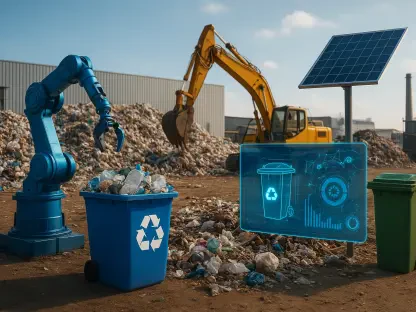
The industry is currently undergoing a radical transformation as it moves away from simple black bag disposal toward sophisticated resource recovery. This evolution has forced a change in consumer behavior, requiring more rigorous sorting of materials at the source to ensure that plastics, metals, and fibers are captured. While these efforts are commendable for their environmental benefits, they have also increased the complexity of the logistics chain. The system now depends on highly specialized machinery that, while efficient, introduces new points of failure that did not exist in the era of simple burial.
Technological reliance on massive, centralized incineration facilities has created a structural vulnerability. While these plants are designed to turn trash into electricity, their high-tech nature means that specialized parts and expert labor are required for even basic repairs. This centralization means that if one major plant goes offline, there are no smaller, localized alternatives to pick up the slack. The push for a circular economy is hindered by this lack of diversified, localized recycling initiatives that could provide a safety net for regional waste streams.
Analyzing Market Data and Capacity Projections
Market data reveals a stark contraction in the number of active landfill sites across the country. In the recent past, ten major outlets served the national need, but that number has plummeted to just three primary sites. This reduction was intentional, designed to force the industry into adopting greener alternatives, yet the speed of the decline has outpaced the construction of replacement facilities. The resulting scarcity of space has driven up disposal costs and created a logistical nightmare for those responsible for municipal cleanliness.
Projections for incineration capacity suggest a growing gap between what is needed and what is currently operational. Although several new energy-from-waste plants are in the pipeline, the reality of the 2026 to 2028 window indicates a period where demand will significantly exceed supply. Indicators suggest that the system will be under extreme duress as it approaches the 2028 ban on biodegradable waste. Without a sudden surge in processing capability, the infrastructure may not possess the resilience required to manage the transition without significant service disruptions.
Navigating the Immediate Obstacles to Systemic Resilience
A primary obstacle to current resilience is the prolonged failure at the Glasgow Recycling and Renewable Energy Centre. This facility was intended to be the cornerstone of the region’s waste strategy, but its absence has forced a massive diversion of refuse to remaining landfill sites. This diversion has accelerated the exhaustion of the Mount Vernon site, creating a void space emergency. With the site approaching its physical limit, the regional waste network is losing its final localized outlet, necessitating expensive and carbon-intensive transport to distant facilities.
Logistical complexities are further compounded by regional crackdowns on illegal disposal and stricter cross-border regulations. Previously, waste could be moved to northern English sites with relative ease, but environmental agencies have tightened oversight to prevent unauthorized dumping. This has left Scottish contractors with fewer escape valves when local plants fail. Mitigation strategies now involve a frantic search for temporary landfill extensions, though such measures often clash with long-term government environmental goals, creating a stalemate between immediate necessity and future policy.
The Regulatory Framework and the Impact of Environmental Moratoriums
The 2022 moratorium on new incinerator applications was intended to prevent an oversupply of disposal capacity that might discourage recycling. However, this policy may have had the unintended consequence of chilling investment in necessary infrastructure. By limiting the number of new facilities, the government created a ceiling on processing capability that does not account for the periodic failure of existing aging plants. This regulatory cap has left the industry without the strategic landfill capacity required to bridge the gap during emergencies.
Compliance with ambitious environmental standards remains a high-wire act for municipal authorities. While the goal of a zero-waste future is clear, the practical requirement for secure service delivery often necessitates the use of less-than-ideal disposal methods. The conflict between state-mandated landfill bans and the physical reality of full incinerators has created a regulatory environment where service reliability is constantly under threat. Local authorities are finding it increasingly difficult to balance these mandates while ensuring that residential collections continue without interruption.
Forecasting the Future of Scotland’s Waste Management Landscape
Future shifts in the landscape may see the emergence of market disruptors that favor decentralized recycling technology over massive, centralized incinerators. Small-scale processing units that can be deployed at a community level could reduce the reliance on vulnerable national infrastructure. Such a move toward localized solutions would align with circular economy goals while providing the resilience that the current system lacks. However, the adoption of these technologies depends on favorable economic conditions and a shift in government funding priorities.
Stagnant household recycling rates present a significant hurdle that must be cleared to ensure long-term stability. If the volume of waste produced does not decrease, no amount of incineration or landfill capacity will ever be truly sufficient. Global economic conditions also play a role, as the market for exported recyclables fluctuates, impacting the financial viability of domestic sorting programs. The evolution of government policy will likely need to pivot from managing disposal to aggressively enforcing waste reduction at the point of production and consumption.
Synthesizing Solutions for a Sustainable and Stable Waste Industry
The assessment concluded that the capacity gap in Scotland’s waste sector posed a genuine threat to localized public health and urban cleanliness. It was found that the reliance on a shrinking number of disposal outlets left the entire system vulnerable to predictable mechanical failures. The industry required a more diversified infrastructure that included both large-scale energy recovery and decentralized recycling hubs. Stabilization of the sector depended on the government’s willingness to allow temporary landfill extensions as a strategic buffer while new processing technologies reached operational maturity.
Experts determined that improving public transparency regarding the state of waste infrastructure was essential for building support for new initiatives. The report suggested that the path to a zero-waste future necessitated a better alignment between environmental law and the physical capabilities of the waste management industry. Moving forward, the focus shifted toward aggressive waste reduction and the implementation of localized processing solutions. Only through such diversification did the system achieve the stability required to maintain clean streets without compromising long-term ecological goals.