
The global energy transition has reached a critical juncture as industries worldwide prioritize the development of green hydrogen to achieve ambitious carbon neutrality targets. While the potential for hydrogen to decarbonize sectors such as heavy manufacturing and long-haul transport is widely recognized, the energy losses inherent in traditional production methods have long remained a significant barrier to widespread adoption. Most current systems rely on separate solar arrays and electrolyzers connected by complex power electronics, creating multiple points where energy is dissipated as heat or lost through conversion inefficiencies. However, a recent technological breakthrough from the Fraunhofer Institute for Solar Energy Systems has demonstrated a solar-to-hydrogen efficiency of 31.3 percent in a real-world setting. This achievement suggests that the industry is moving toward a direct-coupling model that bypasses traditional electrical bottlenecks. By integrating energy harvesting and chemical conversion into a single, streamlined process, this approach offers a more direct and efficient path for turning sunlight into fuel.
Technological Innovations in Direct Energy Conversion
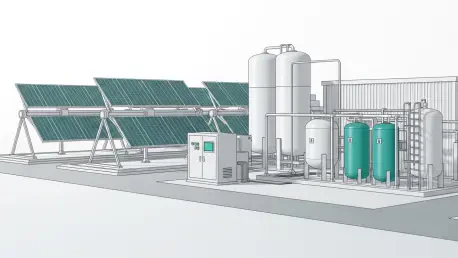
The core of this advancement lies in direct solar-to-hydrogen coupling, a method that integrates solar harvesting and electrolysis into one streamlined system without intermediate electrical components. Standard production methods typically involve several steps, including power converters and long-distance wiring, which act as energy sinks that consume a notable percentage of the total power generated. By connecting specialized solar cells directly to an electrolyzer, the research team ensured that electricity flows immediately into the chemical reaction required to split water. This “perfect match” design maximizes energy yield by removing the hardware components that traditionally drain power before it can be converted into chemical energy. This integration not only boosts overall efficiency but also reduces the complexity and physical footprint of the production equipment. As industrial sectors look for ways to scale up hydrogen production from 2026 to 2030, this streamlined architecture provides a blueprint for reducing both the capital costs and the operational energy losses associated with green fuel generation.
Concentrated Photovoltaics: Maximizing Solar Harvesting Efficiency
The primary catalyst for this record-breaking performance is the strategic deployment of Concentrator Photovoltaics, a technology that differs significantly from the flat silicon panels seen on residential rooftops. This system employs a grid of Fresnel lenses that function essentially as high-precision magnifying glasses to concentrate incoming sunlight onto tiny, extremely powerful solar cells. By focusing the light from a large area onto a small semiconductor surface, the system achieves a much higher energy density than traditional methods allow. This approach is particularly effective because it enables the use of high-performance materials that would otherwise be too expensive to deploy over large surface areas. The concentration of light allows the system to generate the high voltage and current required for electrolysis without needing massive arrays of expensive semiconductors. Consequently, the hardware footprint is reduced while the energy output is maximized, creating a highly efficient bridge between solar radiation and the chemical energy required to split water molecules into hydrogen.
Multi-Junction Semiconductors: Capturing the Full Optical Spectrum
At the heart of this technology are specialized four-junction solar cells, which are engineered with multiple layers of semiconductor material to capture a broader range of the solar spectrum. Unlike standard cells that only convert a fraction of available light into electricity, these multi-layer structures are designed to absorb specific wavelengths, ensuring that almost no part of the incoming energy is wasted. These cells were originally developed for high-stakes environments like space satellites, but the use of concentrator lenses makes them economically viable for terrestrial energy production. Because these lenses rely on precisely focused beams of light, the entire assembly must be mounted on a dual-axis tracking system that follows the sun across the sky with extreme accuracy. This mechanical precision ensures that the focal point remains perfectly aligned with the solar cells throughout the day, maintaining peak efficiency even as the angle of the sun changes. This synergy between advanced material science and mechanical engineering represents a shift toward more complex but far more productive energy harvesting strategies.
Dual-Axis Tracking: Maintaining Precise Alignment With the Sun
To maintain the high efficiency levels achieved by concentrated photovoltaics, the system utilizes a robust dual-axis tracking mechanism that adjusts the orientation of the lenses in real-time. This mechanical setup is essential because Fresnel lenses require a direct, perpendicular line of sight to the sun to function effectively. By constantly recalculating the solar position, the trackers ensure that the concentrated beams of light hit the multi-junction cells with surgical precision from sunrise to sunset. This constant adjustment allows the system to harvest the maximum amount of direct normal irradiance, which is the most energy-dense part of the solar spectrum. While the addition of moving parts introduces more complexity compared to static solar panels, the gain in energy density more than compensates for the mechanical overhead. This high-precision tracking is a hallmark of industrial-scale solar-to-hydrogen plants being planned for the second half of this decade. Such systems are designed to operate in regions with high solar intensity, where the ability to follow the sun’s path is the difference between a marginal energy gain and a record-breaking fuel yield.
Performance Analysis and Measurement Standards
The validity of this breakthrough is supported by thirteen days of rigorous testing in the outdoor conditions of Freiburg, Germany, where the system faced real-world atmospheric variables. Unlike laboratory trials that occur in a controlled environment, this experiment accounted for factors like wind speed, atmospheric haze, and shifting cloud cover over 13,000 individual measurements. Notably, the system’s performance improved as the water temperature rose from 68 degrees to 135 degrees Fahrenheit, reaching a peak efficiency of 31.3 percent and maintaining consistent stability throughout the duration of the trial. This thermal resilience is a critical finding, as many renewable technologies suffer from reduced efficiency when operating in high-heat environments. The ability of the electrolyzer to function more effectively as it warms suggests that these systems are well-suited for hot, arid climates where solar irradiance is at its highest. This field data provides essential proof that the technology can transition from a laboratory curiosity to a functional component of the global energy infrastructure in the coming years.
Outdoor Field Trials: Proving Stability in Variable Environments
Conducting long-term outdoor testing was a vital step in proving that direct-coupled solar-to-hydrogen systems could handle the unpredictability of nature. During the observation period, the equipment was subjected to fluctuating light levels and varying humidity, yet it consistently maintained high conversion rates. The researchers monitored the internal pressure of the hydrogen gas and the current density of the electrolysis cells to ensure that no degradation occurred during high-intensity periods. This data set clarifies that the multi-junction cells and the electrolyzer can work in tandem without requiring complex buffering systems or batteries. Furthermore, the stability of the system under high thermal loads confirmed that the heat generated by the concentrated sunlight could be managed effectively within the water-splitting process. This performance in a non-laboratory setting is what sets this achievement apart from previous attempts, as it demonstrates that the theoretical limits of solar-to-hydrogen conversion are finally being reached in practice. The successful operation over thousands of measurements provides investors with the confidence needed to scale these prototypes.
Standardized Efficiency Metrics: Benchmarking the Higher Heating Value
The 31.3 percent efficiency figure is calculated based on the Higher Heating Value, a comprehensive standard that measures the total chemical energy available when hydrogen is burned. Using this comprehensive metric allows for a clear comparison with previous outdoor records, which typically hovered around 19.8 percent efficiency. This significant jump represents a major technical leap for the industry, providing a new benchmark for what direct-coupling systems can achieve in a functional environment. By adopting the Higher Heating Value as the reporting standard, the research team ensured that their results were transparent and directly comparable to other energy conversion technologies. This level of standardization is necessary for the hydrogen market to mature, as it allows for a precise calculation of the levelized cost of energy. As global energy organizations set new targets for 2027 and beyond, having a reliable, high-efficiency benchmark helps in the planning of large-scale infrastructure projects. The transition from the 20 percent threshold to over 30 percent marks a turning point where solar hydrogen becomes a much more competitive alternative to fossil-fuel-derived energy.
Strategic Pathways to Commercial Viability
As global energy organizations prioritize green hydrogen for sectors like steelmaking and shipping, this high-efficiency method becomes increasingly relevant for large-scale use. Producing fuel near industrial hubs could reduce the need for expensive transport infrastructure and lower the overall cost of the transition to renewables. Researchers estimate that in sun-drenched regions, this technology could eventually produce hydrogen at a competitive price of roughly $1.36 per pound, provided the hardware can be mass-produced. Despite the technical success, several hurdles remain, including the high cost of multi-junction materials and the mechanical complexity of dual-axis trackers. Scaling the prototype from a small collection area to a full-sized industrial plant will require proving that these specialized materials can remain durable over a standard twenty-year lifespan. Investors are currently looking for pilot projects that can demonstrate long-term reliability in harsh environments, such as coastal or desert locations. These strategic efforts are essential for moving the technology from the pilot phase into a mainstream solution for the global energy crisis.
Localized Industrial Production: Reducing Transport and Grid Costs
One of the most actionable next steps involved the strategic placement of these high-efficiency systems directly at industrial sites to eliminate the logistical burdens of hydrogen transport. By generating fuel on-site for steel mills or chemical plants, companies successfully avoided the high costs of specialized pipelines and high-pressure trucking. This localized approach also reduced the strain on the national electrical grid, as the energy was converted to fuel immediately without requiring long-distance transmission. Engineers recognized that the modular nature of concentrated solar-to-hydrogen units allowed for incremental scaling, meaning a facility could grow its production capacity alongside its energy needs. This flexibility was particularly valuable for medium-sized enterprises that wanted to reduce their carbon footprint without committing to massive infrastructure overhauls. As the manufacturing of Fresnel lenses became more standardized, the cost of setting up these localized hubs dropped significantly. This shift toward decentralized production represented a major departure from the centralized energy models of the past, favoring a more resilient and efficient industrial landscape.
Engineering Resilience: Overcoming Mechanical and Economic Barriers
The transition toward widespread adoption also required a concerted effort to enhance the mechanical durability of the tracking hardware and the chemical stability of the electrolyzers. Engineers developed advanced self-lubricating joints and weather-resistant coatings to ensure that the dual-axis trackers could operate for decades with minimal human intervention. Furthermore, the industry moved toward the use of recycled materials for the structural components of the solar arrays, which helped to offset the high initial cost of the multi-junction semiconductor layers. These refinements allowed for a consistent decrease in the levelized cost of hydrogen throughout the latter half of this decade. Research also focused on creating hybrid systems that could utilize stored thermal energy to continue hydrogen production during brief periods of cloud cover. By addressing these practical challenges, the technology moved beyond its status as a laboratory record and became a cornerstone of modern industrial planning. The validation of this high-efficiency conversion process ultimately catalyzed a surge in investment for zero-emission fuel projects across the globe, setting a new standard for sustainable energy harvesting.