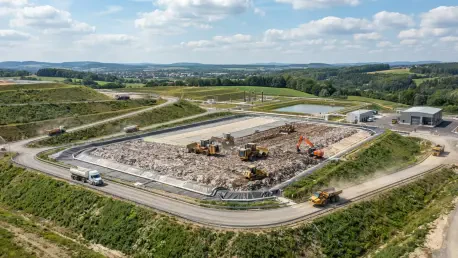

The landscape of municipal solid waste management has undergone a radical transformation as industrial giants and private equity firms aggressively consolidate local assets into expansive national networks. This momentum is evidenced by the finalization of over one hundred significant deals during the current year, signaling a shift toward a more centralized and technologically advanced infrastructure. Instead of viewing waste as a mere liability to be buried, the market now treats it as a critical raw material for the circular economy. This evolution is driven by the need for greater operational efficiency and the increasing value of resource recovery in a world focused on sustainability. Large-scale acquisitions are no longer just about territory; they represent a strategic play to control the entire lifecycle of waste, from the initial collection at the curb to the sophisticated processing at specialized facilities. As a result, the industry has transitioned from a fragmented collection of local haulers into a highly integrated sector defined by complex environmental logistics and capital investments.
Market Leaders and Strategic Expansion Strategies
Publicly traded corporations like Republic Services and GFL Environmental have remained at the forefront of this consolidation wave by systematically absorbing smaller, family-owned regional operations. Republic recently strengthened its presence in Missouri through the strategic acquisition of Queen City Disposal, while GFL Environmental targeted the Midwest and Texas markets by bringing Big Hook Trucking & Disposal and Four Seasons Disposal under its corporate umbrella. These moves are not merely about increasing truck counts but are aimed at integrating regional routes into larger, more cost-effective networks. Meanwhile, Clean Harbors executed one of the most financially significant maneuvers by finalizing the acquisitions of EnviroServe and ES&H for a combined total of seven hundred and seventy-five million dollars. This massive investment was specifically designed to enhance their field services and emergency response capabilities, positioning the firm as a dominant force in specialized environmental management and hazardous waste remediation across North America.
While corporate expansion offers benefits like increased capital for technology, it often creates ripples of concern within the local waste management ecosystems. In Wisconsin, for instance, the recent acquisitions by GFL Environmental sparked debates among local officials and residents regarding significant shifts in landfill volumes and the potential for reduced competition. Such localized disruptions illustrate the double-edged nature of rapid industry consolidation, where the pursuit of regional dominance can clash with established community disposal patterns. Casella Waste Systems followed a similar expansionist path in the Northeast by acquiring Dave’s Disposal in Maine, further tightening the corporate grip on the New England waste stream. These strategic moves allow larger entities to optimize their internal assets, such as transfer stations and landfills, effectively cutting out third-party costs. However, the centralization of control also means that local municipalities now navigate a landscape where providers are no longer local neighbors but multi-billion dollar entities.
Private Equity and Renewable Natural Gas Infrastructure
Parallel to the growth of public giants, private equity firms are carving out significant niches by building entirely new service platforms from the ground up. The formation of Blue Castle Waste Solutions, backed by Blue Sage Capital, serves as a prime example of this trend, as the firm simultaneously acquired multiple haulers across Minnesota and Iowa to create a unified regional powerhouse. This strategy focuses on asset integration, where disparate small businesses are merged into a single entity to leverage shared administrative costs and improved purchasing power. Other players, such as Meridian Waste and GreenWaste—backed by Warren Equity Partners and Macquarie Asset Management—have continued to execute tuck-in acquisitions. By bolting smaller, specialized assets onto their existing operations in states like Virginia and California, these firms are able to densify their routes and improve profit margins. This model highlights a shift in investment philosophy, where waste is viewed as a stable, recession-proof asset.
The biogas and renewable natural gas sector experienced an intense period of restructuring as companies prioritized infrastructure for cleaner energy. Firms like Divert and Vanguard Renewables, a BlackRock portfolio company, moved to acquire multiple anaerobic digestion facilities to increase processing capacity. This segment’s growth underscored a fundamental change: profitability became tied to energy production. Even distressed assets, like the Rialto Bioenergy Facility, found new life through acquisitions by Berq RNG. Consequently, the industry matured into a vertically integrated market where resource recovery replaced simple disposal. These consolidations proved that controlling the waste lifecycle was the most effective way to secure stability. Looking ahead, stakeholders recognized that success resided in advanced technologies. Moving forward, the industry prioritized regional hubs that combined collection and energy conversion. This shift suggested that remaining independent required finding specialized niches to survive.