
The fragmented nature of American waste management systems has long served as a barrier to the ambitious sustainability goals set by major beverage manufacturers and environmental advocates alike. For decades, the lack of a cohesive national strategy meant that recyclability was often a theoretical concept rather than a practical reality. Currently, the industry struggles with a patchwork of municipal rules that vary significantly from one zip code to another, leading to public confusion and high contamination rates.
Within this landscape, the role of specific plastic stakeholders has become increasingly prominent. Organizations like the International Bottled Water Association (IBWA) are now leading the charge for a more uniform approach, specifically focusing on the recovery of high-value materials such as polyethylene terephthalate (PET), high-density polyethylene (HDPE), and polycarbonate (PC). These materials are the backbone of the consumer packaging industry, yet infrastructure limitations continue to prevent them from reaching their full reuse potential.
The Current State of the US Recycling Industry and the Role of Plastic Stakeholders
While the Environmental Protection Agency reports a total recycling rate for all plastics at under nine percent, the data for specific resins tells a more nuanced story. PET bottles used in the beverage industry achieve a recovery rate closer to 29 percent, highlighting a massive discrepancy between general waste and specialized packaging. This gap suggests that the problem is not necessarily the material itself, but the outdated systems used to collect and sort it.
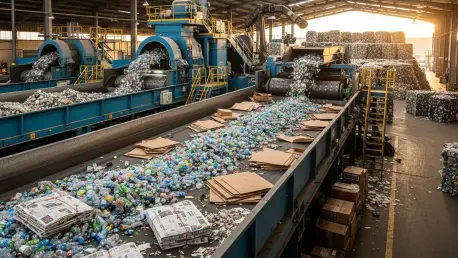
Stakeholders argue that current recovery standards are hampered by a lack of investment in sorting facilities that can handle modern packaging innovations. As manufacturers move toward lightweighting and complex resin blends, the machinery at municipal recovery centers often fails to keep pace. This technical lag results in tons of high-quality plastic being diverted to landfills simply because local facilities cannot efficiently separate them from the waste stream.
Analyzing Market Dynamics and the Shift Toward Circularity
Emerging Trends in Material Recovery and Sustainable Consumer Packaging
The narrative of American manufacturing is shifting from a linear “take-make-waste” model toward a circular economy where materials are treated as valuable assets rather than refuse. This transition is being driven by both corporate responsibility and a fundamental change in consumer behavior. Modern shoppers increasingly prioritize products that use high percentages of recycled PET (rPET), forcing brands to secure a consistent supply of post-consumer resin to maintain market share.
Advanced sorting technologies, including AI-driven robotic arms and high-speed optical sensors, are now the frontline of this circular transition. These tools allow facilities to achieve higher purity levels, which is essential for “bottle-to-bottle” recycling. When the purity of collected plastic increases, the cost of reprocessing drops, making the entire circular model more economically viable for large-scale production.
Market Growth Projections and the Rising Demand for Recycled Content
Market analysis indicates that the demand for rPET will continue to outpace domestic supply unless collection rates improve significantly. As more states consider mandates for recycled content in consumer goods, the competition for high-quality post-consumer resin is expected to intensify. This rising demand creates a price premium for recycled materials, which, while challenging for manufacturers, provides the necessary financial incentive for recyclers to expand their operations.
Projections for the next few years suggest that if collection rates for PET can be pushed toward 50 percent, the domestic supply chain would stabilize. This stabilization would reduce the industry’s reliance on imported recycled materials and protect it from the volatility of global plastic markets. Furthermore, increased recycled content mandates are likely to drive the market value of post-consumer resins to new highs, making recycling a more attractive investment for private equity.
Addressing the Structural Obstacles and Technical Bottlenecks
One of the most persistent hurdles in the modernization process is the “data deficit” currently plaguing the industry. Policymakers often operate in the dark, lacking precise information on exactly how much material is recovered versus how much is lost to contamination. Without accurate, standardized metrics across all fifty states, it is nearly impossible to identify which specific links in the recycling chain require the most urgent intervention.
Geographic disparities further complicate the issue, as rural and underserved communities often lack access to basic curbside services. In many parts of the country, the cost of transporting recyclables to a processing center exceeds the market value of the materials themselves. Additionally, the low cost of virgin plastic—often tied to the fluctuations of the petrochemical industry—makes it difficult for recycled alternatives to compete on price without legislative support.
Federal Policy as a Catalyst for Modernization: The STEWARD and CIRCLE Acts
The legislative landscape is finally shifting with the introduction of the Strategies to Eliminate Waste and Accelerate Recycling Development (STEWARD) Act. This comprehensive framework aims to bridge the accessibility gap by providing federal grants specifically for communities that have historically been left behind by recycling infrastructure. Moreover, the act mandates a rigorous national data collection effort, ensuring that future policy decisions are backed by hard evidence rather than estimates.
Parallel to this, the Cultivating Investment in Recycling and Circular Local Economies (CIRCLE) Act offers a market-based solution through federal tax credits. By incentivizing private-sector infrastructure upgrades, the CIRCLE Act seeks to modernize the nation’s sorting and processing capabilities without placing the entire financial burden on taxpayers. These bipartisan efforts represent a move toward a standardized, nationwide approach that treats recycling as a critical piece of national infrastructure.
The Future Roadmap for a Standardized National Recycling Framework
As federal oversight moves from voluntary guidelines to standardized metrics, the industry is poised for a period of rapid evolution. The expansion of extended producer responsibility (EPR) models, where manufacturers take a greater share of the financial burden for end-of-life packaging, is expected to reshape the economic landscape. This shift will likely encourage companies to design packaging that is not only recyclable but also easier and cheaper to process.
Disruptive technologies, particularly in the realm of chemical recycling, may soon provide a solution for plastics that were previously considered “unrecyclable.” By breaking down polymers into their original molecular building blocks, these processes can create virgin-quality resin from contaminated or mixed-plastic waste. However, the success of these innovations will depend heavily on trade policies and global economic conditions that influence the price of raw materials.
Strategic Recommendations for Achieving a Fully Circular Economy
The successful modernization of the recycling sector was clearly dependent on a synchronized approach that combined legislative action with private investment. The findings suggested that infrastructure alone was insufficient; without the data transparency provided by new federal mandates, investments were often misdirected toward inefficient programs. The strategic pivot toward specialized grants for underserved regions effectively expanded the collection footprint, while tax incentives allowed for the rapid deployment of optical sorting technology across the country.
Ultimately, the transition to a fully circular economy required a fundamental reevaluation of waste as a resource. The path forward involved moving beyond simple collection to focus on the high-purity processing needed for true material circularity. Future considerations must now focus on the global harmonization of these standards to ensure that domestic progress is not undermined by international market fluctuations. The lessons learned during this period of legislative reform provided a blueprint for how a modernized, high-tech recycling value chain could thrive in a resource-constrained world.