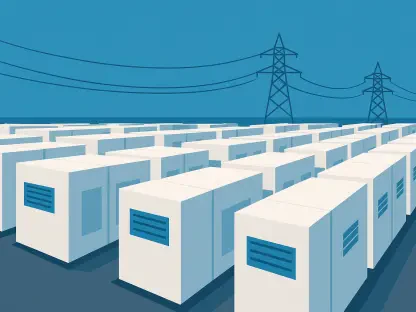

Developers may soon face stricter milestones and financial deposits to prove their projects are viable before they can secure a permanent connection to the power grid. This shift in policy arrives as the United Kingdom struggles to harmonize its ambitious digital transformation goals with the physical realities of an overstretched electrical infrastructure. Data centers, once considered quiet industrial neighbors, have evolved into voracious energy consumers that require gigawatt-scale commitments to support the rapid expansion of artificial intelligence and cloud-based services. The current backlog of connection requests has reached a critical bottleneck, where the time to secure a high-voltage link can stretch across several years, potentially stifling technological innovation. Regulators are now forced to choose between maintaining traditional grid management protocols and adopting radical new strategies to ensure that the lights stay on while the nation’s digital economy continues to grow at an unprecedented pace.
Balancing Massive Demand: Infrastructure Limits and Scaling
The exponential growth of generative artificial intelligence and high-performance computing has fundamentally altered the power profile of modern data centers. Unlike traditional enterprise facilities, these specialized hubs require significantly higher power densities to cool dense racks of advanced processing units. This surge is not a localized phenomenon but a nationwide trend centered around West London and the M4 corridor, where the proximity to fiber optic cables and financial markets creates a geographical concentration of demand. Utilities are seeing individual site requests that rival the energy consumption of entire towns, forcing a reevaluation of how bulk power is distributed across the regional network. Consequently, the disconnect between the speed of digital deployment and the decades-long timelines required for building new physical transmission lines has created a systemic friction that threatens to undermine the country’s standing as a global technology leader.
While the digital sector moves at the speed of software, the physical infrastructure of the National Grid remains rooted in a legacy framework designed for centralized power stations. The transition toward a decentralized energy model, incorporating offshore wind and solar farms, adds another layer of complexity to the grid’s capacity to handle steady, high-load consumers like data centers. Integrating these intermittent renewable sources requires sophisticated balancing mechanisms and significant upgrades to transformers and circuit breakers that are nearing the end of their operational lifespans. Engineers are working to deploy advanced grid-enhancing technologies, such as dynamic line rating and modular power flow controllers, to squeeze more capacity out of the existing wires. However, these incremental improvements may not be enough to satisfy a sector that is projected to double its energy footprint between 2026 and 2030, necessitating a more fundamental overhaul of the high-voltage backbone.
Navigating Reform: The New Queue Management Policy
The introduction of the “first ready, first served” policy represents a departure from the traditional queuing system that historically allowed speculative projects to occupy capacity for years without making physical progress. Under this revised framework, the National Grid Electricity System Operator now has the authority to terminate connection agreements for projects that fail to meet strict developmental milestones. This regulatory tightening aims to flush out “zombie” projects that have stalled due to lack of funding or planning permission, thereby freeing up capacity for shovel-ready data center developments. Developers are now required to provide transparent evidence of land rights and procurement contracts for long-lead equipment before they can claim a spot in the transmission queue. By prioritizing projects with high viability, the government hopes to reduce the average waiting time for new connections, which currently acts as one of the primary barriers to entry for international hyperscale operators.
Moving forward, the successful management of the data center surge depended on a multi-faceted approach that blended regulatory rigor with technical innovation. Stakeholders prioritized the deployment of high-density power corridors and fast-tracked the adoption of standardized modular grid components to accelerate construction. It became clear that the grid could not function as a passive utility but instead required active participation from the largest energy users. Operators invested heavily in long-term power purchase agreements with renewable energy developers, providing the financial certainty needed to build new offshore wind capacity. Furthermore, the industry transitioned toward a model of spatial intelligence, where facility locations were determined by proximity to energy sources rather than just data latency. By embracing these systemic changes, the nation established a blueprint for a resilient digital economy that balanced the thirst for compute power with the essential requirement for a stable and sustainable energy supply.