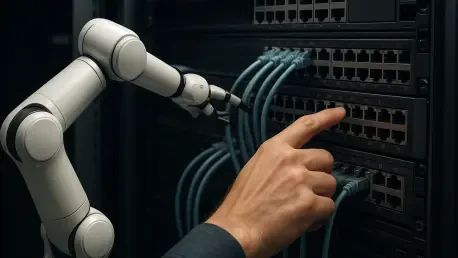

Zayo’s human-in-the-loop model serves as an essential approval gate to ensure that AI-suggested solutions do not create new security vulnerabilities. As global data traffic continues its relentless surge from 2026 through the end of the decade, the reliance on traditional manual configurations has become nearly impossible for large-scale network-as-a-service providers. The industry is currently witnessing a profound shift toward agentic networking, where intelligent agents operate with a deep understanding of the underlying architecture. This evolution is not merely about replacing human labor with algorithms but rather about creating a symbiotic relationship where machines handle the heavy lifting of data correlation while humans manage high-stakes decisions. The complexity of modern software-defined perimeters and multi-cloud environments necessitates a level of speed that only AI can provide, yet the inherent risks of autonomous errors demand a disciplined framework. This strategy ensures that while the network becomes smarter, it remains inherently predictable and safe for mission-critical enterprise operations.
Categorizing the Stages of Intelligent Infrastructure
Tier 1: Knowledge Retrieval and Digital Documentation
The initial stage of integrating artificial intelligence into network management involves the deployment of sophisticated knowledge tools and conversational interfaces. These systems act as advanced digital librarians, specifically designed to help engineering teams navigate the labyrinthine technical manuals and configuration protocols that define modern fiber-optic infrastructure. Instead of spending hours cross-referencing legacy documentation, operators can query an AI agent to retrieve specific command-line parameters or hardware specifications in seconds. This level of adoption focuses entirely on information accessibility and does not grant the AI any permissions to modify the network fabric itself. By isolating the AI’s role to knowledge retrieval and report generation, enterprises can familiarize their workforce with generative tools without exposing the physical layer to the risks of automated logic errors. This foundational step is crucial for building trust between human operators and the digital assistants that will eventually take on more active roles.
Tier 2: Investigative Analysis and Operational Correlation
Moving beyond simple information retrieval, the second tier of adoption introduces AI-supported network operations, where the technology begins to assist in the investigative process. At this stage, agents are tasked with analyzing massive streams of telemetry data to identify subtle performance anomalies that might escape human detection until a full failure occurs. These tools excel at correlating disparate events, such as a localized latency spike in a specific data center branch and a corresponding drop in packet throughput across a regional backbone. By synthesizing these signals into a coherent narrative, the AI provides operational teams with a list of probable root causes and suggested remediation steps. However, the decision-making authority remains strictly human; the AI functions as a highly specialized consultant rather than an administrator. This collaborative approach significantly reduces the time to resolution for complex outages while ensuring that every change is vetted by a seasoned professional who understands the unique traffic patterns.
Tier 3: Agentic Integration and the Future Frontier
The frontier of this technological shift is represented by the third tier, known as agentic networking, which leverages the Model Context Protocol to facilitate direct interaction between AI and hardware. This stage moves away from static automation scripts toward dynamic agents that possess enough context to understand the intent behind a network design rather than just the individual commands. These advanced systems are capable of real-time monitoring and can autonomously prepare configuration changes based on shifting traffic demands or detected security threats. Despite the impressive capabilities of these systems in early 2026, they are currently treated with a high degree of caution by industry leaders. The primary challenge lies in ensuring that these agents do not develop logic loops or unintended behaviors when faced with “black swan” events or hardware failures that produce contradictory telemetry. Consequently, even at this advanced level, the focus remains on maturing the technology within sandbox environments before deploying it across core backbones.
Maintaining Stability Through Human Oversight
Governance: Managing the Nuanced Judgment Gap
While the analytical speed of artificial intelligence is undeniably superior to human cognition, it frequently lacks the nuanced judgment required to manage the gray areas of network engineering. Real-world networking often involves dealing with incomplete data, aging legacy hardware, and conflicting alerts that require a holistic understanding of the business impact of any given action. For instance, an AI might prioritize a configuration change that optimizes throughput but inadvertently violates a specific regional compliance regulation or a strict service level agreement with a high-priority client. Human oversight provides the necessary context to navigate these trade-offs, ensuring that technical efficiency does not come at the cost of corporate governance or legal liability. The presence of a human in the decision-making loop prevents the cascading failure scenario where an automated agent attempts to fix a minor issue by executing a series of rapid-fire changes that eventually destabilize the entire regional infrastructure beyond easy recovery.
Security: Implementing the Approval Gate Protocol
The implementation of an approval gate model is the primary mechanism through which organizations maintain control over their automated assets. In this framework, the AI agent performs the exhaustive work of log analysis, threat detection, and solution prototyping, but the actual execution of a change request requires an explicit cryptographic sign-off from a human administrator. This ensures that every modification to the production environment is documented, justified, and validated by a responsible party, effectively maintaining a clear audit trail for security and regulatory purposes. Furthermore, this model allows senior engineers to mentor junior staff by reviewing AI-suggested solutions together, turning every network incident into a learning opportunity. By keeping the final authority in human hands, enterprises can protect themselves against prompt injection attacks or other emerging security threats that target the logic of the AI agents themselves. This balanced approach provides the benefits of machine-speed analysis while preserving the integrity and reliability of the critical paths.
Strategic Implementation and Future Outlook
Infrastructure: Solving Alert Fatigue Through AI
One of the most immediate benefits of integrating intelligence into network management is the dramatic reduction in alert fatigue for operational staff. In the hyper-connected landscape of 2026, a single physical fault can trigger thousands of redundant alarms across various application layers, virtualized environments, and hardware monitoring systems. AI-driven correlation engines are uniquely equipped to filter out this noise, identifying the primary catalyst of an incident with a high degree of confidence. While these digital agents are incapable of physically splicing a severed undersea cable or replacing a failed router in a remote facility, their ability to pinpoint the exact geographical and logical location of a failure is invaluable. By providing field technicians with precise coordinates and diagnostic data before they even leave the dispatch center, organizations can reduce mean time to repair by significant margins. This synergy between digital insight and physical action represents the most practical application of AI in current infrastructure management.
Risk Management: Navigating the Complexity Paradox
Despite the promise of simplified operations, the introduction of agentic networking creates a notable paradox where the tools intended to reduce complexity actually introduce new layers of infrastructure to manage. Each AI agent must be treated as a privileged non-human entity within the network’s identity and access management framework, requiring its own set of security credentials and behavioral monitoring. This effectively expands the attack surface of the organization, as a compromised or poorly configured agent could theoretically be manipulated to grant unauthorized access or disrupt critical services. Consequently, the focus for many enterprises has shifted toward the governance of these agents, establishing strict boundaries on what they can see and do within the environment. Success in this new era requires a disciplined approach to lifecycle management, where agents are regularly audited for bias, logic drifts, and adherence to security policies. The goal is to ensure that the automation layer remains a robust asset rather than a liability.
Future Considerations: Actionable Steps for Resilient Networks
The transition toward agentic networking throughout the current period was characterized by a cautious embrace of automation coupled with a steadfast commitment to human expertise. Organizations that successfully navigated this shift did so by treating artificial intelligence as a force multiplier for their existing teams rather than a complete replacement for human intuition. Looking ahead, enterprises should prioritize the development of robust model context frameworks that allow agents to understand the specific intent of their network designs. It is recommended that decision-makers invest in training their operational staff to work alongside these intelligent systems, focusing on the higher-level strategy of network orchestration rather than the minutiae of manual configuration. By establishing clear approval gates and maintaining rigorous identity management for all automated agents, businesses ensured that their infrastructure remained resilient against both technical failures and sophisticated security threats. The focus must now remain on refining these collaborative models.