
Christopher Hailstone is a seasoned authority in the complex intersections of energy management, grid reliability, and industrial infrastructure. With a career spanning decades in the utilities sector, he has become a go-to expert for understanding how national security depends on a stable, high-output industrial base. His insights are particularly vital as we witness a global shift toward decarbonized manufacturing and the revitalization of domestic supply chains. Today, we sit down with him to discuss the seismic shifts in the steel industry, where the lines between private enterprise and public interest are increasingly blurred by the demands of the modern era.
In this conversation, we examine the strategic motivations behind the United Kingdom’s decision to bring British Steel into public ownership. We look at the economic pressures that made traditional steelmaking unsustainable under previous private management, specifically focusing on the massive daily financial losses that preceded this nationalization. Furthermore, we explore the technological transition from legacy blast furnaces to recycled-content electric arc furnaces and what this means for the long-term viability of the Scunthorpe complex and the communities it supports.
The transition of a major steel producer into public ownership aims to safeguard critical infrastructure and national security; how does this move redefine the role of heavy industry within a country’s broader industrial strategy?
When a government takes a step as significant as passing the Steel Industry (Nationalization) Act, it signals that certain sectors are simply too vital to be left to the whims of the global market. Steel isn’t just a building material; it is the fundamental skeleton of a nation’s transport networks, defense capabilities, and energy infrastructure. By bringing these assets into public ownership, the U.K. is prioritizing the delivery of its Modern Industrial Strategy over short-term corporate profits. You can feel the weight of this decision in the way it stabilizes the supply chain for major construction projects that define the physical landscape of the country. It moves heavy industry from being a private commercial venture to a foundational pillar of national resilience that the public now has a direct stake in protecting.
When we look at the financial side, reports suggest the company was losing nearly $940,000 every single day under its previous ownership. How do such staggering losses impact the feasibility of maintaining traditional blast furnace operations versus making the leap to newer technologies?
Losing $940,000 a day is a catastrophic drain that creates an atmosphere of constant crisis, making it nearly impossible for a private entity like the Jingye Group to justify the massive capital investment needed for modernization. Those old blast furnaces in Scunthorpe are relics of an era that didn’t account for the high costs of carbon or the volatility of modern energy prices. The sheer scale of that daily deficit explains why negotiations to secure the company’s future while delivering value for taxpayers originally stalled. Transitioning to new technology is the only way to stop the bleeding, but it requires a level of financial backing that only a sovereign state can provide during such a volatile period. The government recognized that without this intervention, the blast furnaces would likely have been idled, leaving the nation’s industrial heart to go cold.
The shift toward electric arc furnace (EAF) technology represents a massive technological pivot for the Scunthorpe site. What are the logistical and environmental implications of moving away from traditional iron ore smelting to recycling-based production?
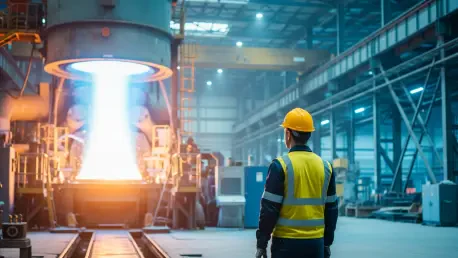
Moving to electric arc furnaces is a total transformation of the sensory and operational environment of the mill, shifting from the intense, coal-heavy heat of a blast furnace to a cleaner, more precise recycling process. This technology allows the U.K. to utilize its own scrap steel, effectively turning the country’s waste into a high-value resource for the future. Beyond the obvious decarbonization benefits, this transition is essential for building a competitive and sustainable sector that can survive in a world with tightening environmental regulations. We are seeing a shift from the heavy, carbon-intensive “old world” of steel to a leaner, more agile “new world” that relies on the strength of the national power grid rather than imported coking coal. It is a strategic move that aligns the physical production of steel with the broader goals of reaching net-zero emissions while keeping the East Midlands at the center of the industrial map.
Securing the future of the Scunthorpe complex isn’t just about output; it’s about the social fabric of the East Midlands. How does public ownership influence the long-term stability for the local workforce and the communities that have supported these mills for generations?
Public ownership provides a psychological and economic safety net for the thousands of families in Scunthorpe who have lived in the shadow of those chimneys for decades. When the government states its focus is on backing the communities that rely on this industry, it changes the conversation from one of managed decline to one of reinvestment and hope. For the workers on the ground, the move to public ownership means their specialized skills are being recognized as a national asset rather than a line-item expense to be cut. There is a profound sense of relief when a community realizes its primary employer isn’t going to vanish overnight because of a board meeting in a distant country. This stability allows for better long-term planning, not just for the mill, but for the schools, small businesses, and local infrastructure that thrive when the steel industry is healthy.
What is your forecast for the global steel industry, particularly regarding the balance between nationalized production and private enterprise in the race toward decarbonization?
I expect we will see a “hybrid era” where governments increasingly intervene to de-risk the massive costs associated with the green transition. While private enterprise is excellent at driving efficiency, the sheer scale of moving from blast furnaces to EAF technology—especially given the need for updated grid infrastructure—requires a level of coordination that often necessitates state involvement. We will likely see more nations treating steel production as a strategic utility, similar to how they treat water or electricity, ensuring that the foundational materials for the 21st century are produced domestically. The race toward decarbonization will favor those who can integrate their steel production directly into their renewable energy strategies, making the “green steel” of the future a hallmark of national pride and economic sovereignty. Ultimately, the successful steel sectors of the 2030s will be those where the public and private interests are perfectly aligned to support both the planet and the national interest.